
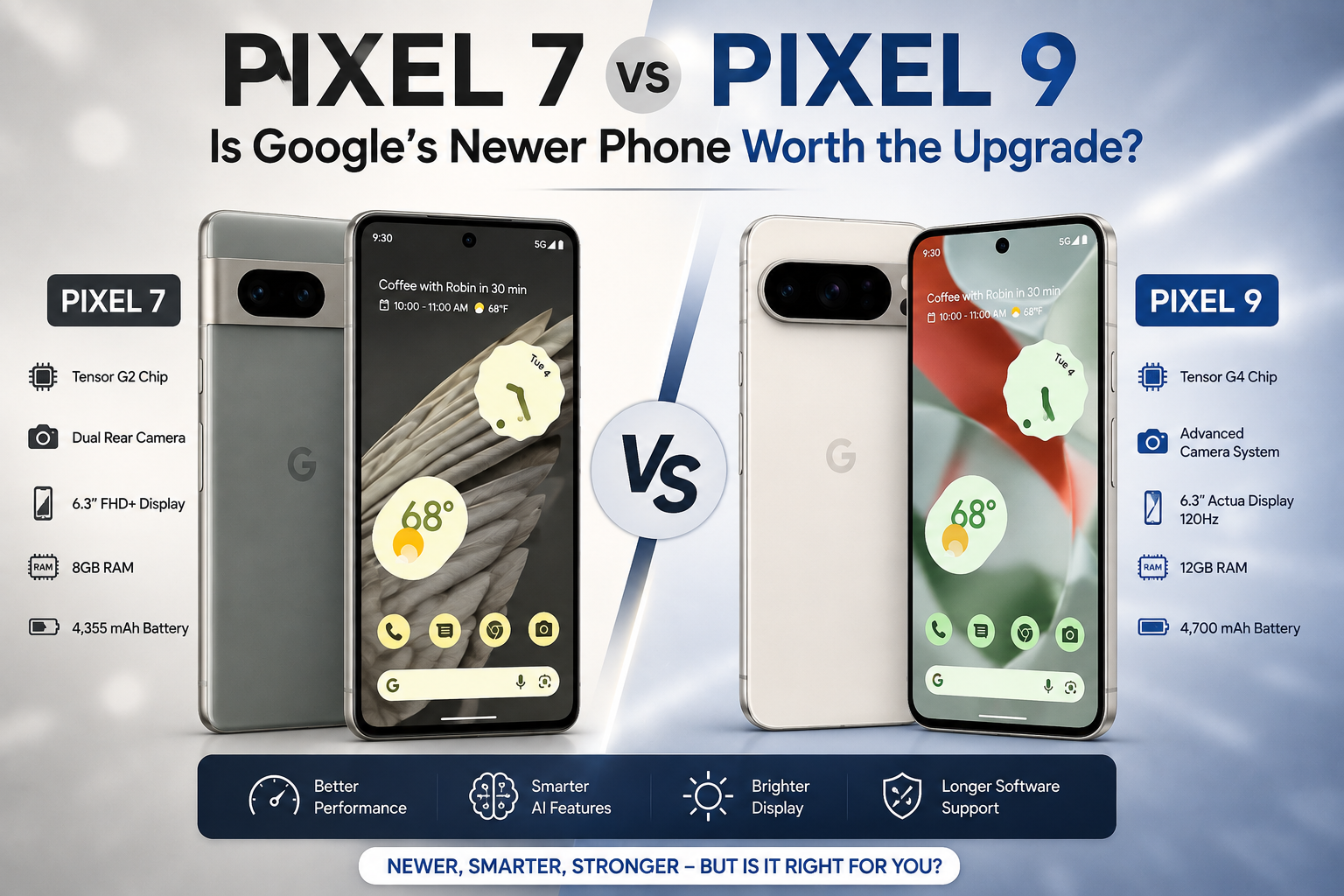
The Google Pixel 7 was an impressive smartphone when it arrived, offering a clean Android experience, strong cameras, useful software features, and Google’s distinctive design. The Pixel 9 represents a newer generation with updated hardware, a redesigned appearance, improved performance, and a stronger focus on artificial intelligence.
But does that automatically mean the newer model is the better choice for everyone?
Not necessarily.
For someone currently using a Pixel 7, the real question is whether the improvements are meaningful enough to justify an upgrade. For a new buyer, the decision may depend on price, availability, performance needs, camera preferences, and how important newer AI features are.
Comparing these two phones is a little like comparing a reliable car you have owned for a few years with its newest version. The newer model may have a more refined interior, improved technology, and additional features, but the older one may still get you where you need to go perfectly well.
In this detailed comparison, we will explore the differences in design, display, performance, cameras, battery life, software, artificial intelligence, and long-term value to help you decide which Google phone makes more sense for you.
1. Pixel 7 vs Pixel 9: The Main Differences
The biggest difference between these devices is not limited to one specification.
The Pixel 9 is a newer generation built around updated hardware and Google’s expanding focus on AI-powered features. It introduces a refreshed design, a newer processor, improvements to memory and display technology, and additional capabilities designed for modern smartphone use.
The Pixel 7, meanwhile, remains a capable device for everyday tasks. It can still handle communication, web browsing, photography, social media, video streaming, navigation, and many other common activities without difficulty.
What the newer model changes
The Pixel 9 focuses on refinement rather than completely reinventing the smartphone.
Its improvements are spread across several areas:
- A newer design and updated construction
- Improved processing hardware
- More advanced AI features
- Updated camera capabilities
- Better display technology
- Increased memory
- Longer-term software support for a newer device
This means the upgrade becomes more attractive when you value several improvements together.
If you are expecting the Pixel 9 to make your Pixel 7 feel completely outdated overnight, however, that may not be the case.
The older phone can still provide a satisfying experience for many users.
2. Design and Build: A More Modern Look
One of the first differences you are likely to notice is the design.
The Pixel 7 has the recognizable horizontal camera bar that became a major part of Google’s smartphone identity. Its curved edges give it a softer appearance, and the design still looks distinctive compared with many competing devices.
The Pixel 9 takes a different approach.
The newer model has a more modern and refined appearance, with flatter sides and a redesigned camera housing. The overall shape feels closer to current premium smartphone trends while maintaining Google’s visual identity.
Pixel 7 design
The older device has a smooth and rounded feel. Its design remains visually distinctive, and many people may still prefer its softer appearance.
It does not suddenly become unattractive simply because a newer model exists.
Pixel 9 design
The newer model feels more refined and contemporary. The flatter frame can create a different feeling in the hand, while the redesigned camera section gives the phone a fresh identity.
Whether one design is better depends partly on personal preference.
Some people prefer rounded edges because they feel comfortable. Others like the sharper, flatter style of newer smartphones.
The important point is that the Pixel 9 feels like a noticeable visual update rather than a minor copy of its predecessor.
3. Display Quality and Everyday Experience
The display is one of the most important parts of any smartphone because you interact with it constantly.
You see it when checking messages in the morning, browsing the internet during the day, watching videos at night, and doing almost everything in between.
The Pixel 7 already offers a high-quality OLED display with strong contrast and vivid colors. For many users, it remains perfectly enjoyable for everyday activities.
The Pixel 9 improves the overall display experience, particularly in areas such as brightness and smoothness.
Brightness matters more than you might think
A brighter display can make a noticeable difference when you are outside.
Reading messages, following maps, viewing photographs, or watching content becomes easier when the screen remains visible under strong lighting conditions.
This may not sound like the most exciting upgrade, but practical improvements often matter more than flashy features.
Smoother scrolling
A higher refresh rate can make scrolling, animations, and on-screen movement feel smoother and more responsive.
The Pixel 9 offers a more modern display experience that can make everyday navigation feel more polished.
When moving from one phone to another, this may be one of those improvements you do not fully appreciate until you use it regularly.
The Pixel 7 display is still good, but the newer screen provides a more refined experience for users who spend a lot of time on their phones.
4. Performance: Tensor G2 vs a Newer Generation
Performance is one of the clearest generational differences.
The Pixel 7 uses Google’s Tensor G2 processor, while the Pixel 9 uses a newer Tensor generation designed to support improved performance and more advanced AI features.
For normal daily use, both phones can perform well.
Opening applications, sending messages, browsing websites, checking social media, and watching videos do not require extreme processing power.
The difference becomes more noticeable during heavier tasks and over longer periods of ownership.
Everyday performance
The Pixel 7 is still capable of handling the needs of an average smartphone user.
If your daily routine mainly includes:
- Messaging
- Social media
- Browsing
- Streaming
- Photography
- Navigation
- Online shopping
you may not experience an urgent need to upgrade.
More demanding tasks
The newer processor in the Pixel 9 is better suited to demanding workloads and newer software features.
Gaming, image processing, multitasking, and AI-powered tasks can benefit from improved hardware.
The additional memory available on the newer device can also help when managing multiple applications and complex tasks.
Think of the two phones as different generations of a workspace. The Pixel 7 provides a comfortable desk for everyday work, while the Pixel 9 gives you a larger and more organized space for handling additional tasks at once.
For light users, the difference may be subtle. For heavy users, the newer hardware can become more meaningful.
5. Camera Comparison: Is the Pixel 9 Better?
Google’s Pixel smartphones are widely associated with computational photography.
The company uses a combination of camera hardware and software processing to create polished images.
The Pixel 7 already has a strong camera system capable of capturing detailed photographs in a variety of conditions.
This is important because upgrading does not mean the older camera suddenly stops taking excellent pictures.
However, the Pixel 9 brings improvements to camera hardware and image processing.
Main camera performance
Both devices are capable of producing high-quality images.
Google’s image processing helps with exposure, color, contrast, and detail, making it easier for users to capture good photographs without manually adjusting complicated settings.
The newer model benefits from updated hardware and processing improvements that can provide a more refined experience.
Ultrawide photography
The ultrawide camera allows you to capture a larger field of view.
This can be useful for landscapes, architecture, travel, group photos, and situations where stepping farther back is not possible.
The Pixel 9 improves this part of the camera system, giving users more flexibility in different shooting situations.
Night photography
Low-light photography is an area where computational processing becomes especially important.
A smartphone needs to balance exposure, detail, color, and noise without making the image look unnatural.
Both phones can handle night photography effectively, but newer hardware and software improvements can give the Pixel 9 an advantage in certain conditions.
For casual users, the difference may not always be dramatic.
For people who take photographs frequently, however, the refinements can become more noticeable over time.
6. Artificial Intelligence: Where the Pixel 9 Pulls Ahead
Artificial intelligence is one of the biggest differences between older and newer Google smartphones.
The Pixel 7 introduced useful intelligent features, but the Pixel 9 was developed during a period when AI became a much larger part of the smartphone experience.
Google has increasingly integrated intelligent tools into photography, communication, search, writing, and other everyday activities.
Smart assistance
AI can help users interact with information more efficiently.
Depending on the available feature and software version, intelligent tools may assist with tasks involving text, images, search, and communication.
The goal is to reduce the amount of manual work required.
Imagine searching through a crowded desk for one important document. A useful AI feature should act like an assistant who helps you locate it quickly, rather than adding another pile of paperwork.
That is the difference between helpful technology and unnecessary technology.
Image editing
Newer Pixel devices offer more advanced image-related tools designed to simplify certain editing tasks.
Instead of requiring professional software, users can make selected changes directly through the phone.
Why AI matters for upgrades
If you rarely use smart editing, writing assistance, summaries, or advanced search tools, the AI improvements alone may not justify replacing a Pixel 7.
However, if you regularly use these features, the Pixel 9 can offer a more advanced experience.
This is one of the areas where your personal habits matter more than a specification sheet.
7. Battery Life and Charging
Battery life is an everyday feature that can dramatically affect your experience.
A phone may have an excellent camera and powerful processor, but those advantages become less useful if you constantly need to search for a charger.
The Pixel 7 provides respectable battery performance, but battery health can naturally decline after years of use.
This is especially important for people comparing a brand-new Pixel 9 with a Pixel 7 that has been used daily since its release.
The comparison is not always between two batteries in the same condition.
Newer hardware efficiency
The Pixel 9 benefits from newer internal hardware and updated power management.
Improvements in efficiency can help the phone manage energy more effectively during everyday use.
Real-world battery life
Your experience will depend on several factors:
- Screen brightness
- Network signal
- Gaming
- Camera use
- Video streaming
- Background applications
- Battery health
- Software settings
A person who uses navigation and mobile data all day will have different results from someone who mostly uses Wi-Fi and messaging.
For Pixel 7 owners, declining battery health may actually be one of the strongest reasons to consider an upgrade.
Of course, replacing the battery can also be a more affordable alternative if the rest of the phone still meets your needs.
8. Software and Long-Term Support
Software support is increasingly important when buying a smartphone.
Most people no longer want to replace their device every year or two.
They expect security updates, operating system improvements, and continued compatibility with modern applications.
The Pixel 7 still receives software support, but it is an older device. The Pixel 9 starts with the advantage of being newer, which means it has a longer future support window.
Why this matters
Long-term support can affect:
- Security
- Application compatibility
- New features
- Device longevity
- Resale value
A newer device naturally has more years ahead of it.
This does not mean the Pixel 7 is immediately obsolete. It simply means that buyers planning to keep their next phone for many years may find the Pixel 9 more appealing.
Clean Android experience
Both devices provide Google’s version of Android and closely integrate with services such as:
- Google Photos
- Google Maps
- Gmail
- Google Drive
- Chrome
- Google Assistant and related intelligent tools
For people already using these services, switching between the two devices is relatively straightforward.
The biggest software difference comes from the newer features and capabilities available to the newer hardware.
9. Connectivity, Security, and Everyday Features
Modern smartphones are more than communication devices.
They hold personal photographs, passwords, banking applications, work information, messages, and other sensitive data.
Security is therefore an important part of the overall comparison.
Both the Pixel 7 and Pixel 9 include security features designed to protect user information.
Biometric authentication can make it easier to unlock the device and access sensitive applications.
Software updates also play an important role because they can address vulnerabilities and improve protection over time.
Connectivity improvements
Newer smartphones can also benefit from updated connectivity technology.
Faster wireless standards, improved modem performance, and other refinements can contribute to a better everyday experience.
However, these improvements may depend on your network, location, carrier, and how you use your phone.
A new connectivity feature is only useful if it improves something you actually do.
For example, someone who spends most of the day on reliable home Wi-Fi may not notice the same benefits as a person who constantly relies on mobile data.
10. Price and Overall Value
Price can completely change the comparison.
If both phones cost nearly the same amount, the newer Pixel 9 is likely to be the more attractive purchase because of its updated hardware and longer expected lifespan.
But if the Pixel 7 is available at a significantly lower price, it can still offer excellent value.
Buying a Pixel 7 today
The older model may make sense if:
- You want a more affordable Google phone.
- You mainly use basic everyday applications.
- You do not need the latest AI tools.
- You are satisfied with its camera capabilities.
- You find a good deal in excellent condition.
Buying a Pixel 9
The newer model may be a better investment if:
- You want a longer-lasting device.
- You value newer AI features.
- You want improved performance.
- Display quality is important to you.
- You multitask frequently.
- You plan to keep the phone for several years.
The best value is not always the phone with the lowest price.
It is the device that provides what you need for the amount you are willing to spend.
A heavily discounted Pixel 7 may be a smarter purchase for a light user than an expensive newer model with features that will never be used.
11. Should Pixel 7 Owners Upgrade?
This is perhaps the most important question.
If you already own a Pixel 7 and it still performs well, upgrading is not necessarily essential.
Your current phone can still handle everyday tasks and capture excellent photographs.
However, the Pixel 9 becomes more attractive if you are experiencing problems with battery life, performance, storage, or aging hardware.
You may want to upgrade if:
- Your battery no longer lasts comfortably through the day.
- You want a brighter and smoother display.
- You frequently use demanding applications.
- You want more advanced AI features.
- You need more memory or storage.
- You plan to keep your next phone for many years.
- Your Pixel 7 has physical damage or other hardware issues.
You may want to keep your Pixel 7 if:
- It still runs smoothly.
- The battery remains acceptable.
- You are happy with the camera.
- You do not need newer AI features.
- You mainly use basic applications.
- Upgrading would stretch your budget.
There is no need to upgrade simply because a newer model exists.
Technology companies release new devices every year, but your personal experience should determine when it is time to move on.
12. Pixel 7 vs Pixel 9: Which One Is Right for You?
Both smartphones can be good choices, but they serve different situations.
The Pixel 7 is still a capable option for users who want Google’s clean Android experience, strong photography, and reliable everyday performance at a potentially lower cost.
The Pixel 9 is the more future-focused choice.
It offers newer hardware, improved performance, a refined design, enhanced display technology, additional AI capabilities, and a longer remaining period of software support.
The choice can be simplified.
Choose the Pixel 7 if you want:
- A potentially lower purchase price
- Strong everyday performance
- Excellent computational photography
- A clean Android experience
- A phone that handles common tasks well
Choose the Pixel 9 if you want:
- Newer hardware
- Better long-term value
- More advanced AI tools
- Improved display technology
- Stronger multitasking capabilities
- A newer design
- More years of future software support
For a first-time buyer, the Pixel 9 is generally the more future-ready option if the budget allows.
For an existing Pixel 7 owner, the decision is more complicated. The upgrade makes sense when you can clearly identify improvements that will affect your daily experience.
If your current phone still does everything you need, waiting may be the smarter choice.
Conclusion
The Pixel 7 vs Pixel 9 comparison is not simply a battle between old and new.
The Pixel 7 remains a capable smartphone with a good display, strong cameras, useful Google software, and enough performance for many everyday users. It can still be an excellent choice when available at the right price.
The Pixel 9, however, represents a more refined and future-focused version of Google’s smartphone strategy. Its newer processor, improved display, updated design, additional memory, enhanced AI capabilities, and longer-term potential make it the stronger option for users who want the latest experience.
The best decision depends on your situation.
If you already own a Pixel 7 and remain happy with its performance, there may be no urgent reason to upgrade. But if you want a noticeable improvement in display quality, AI features, performance, and long-term usability, the Pixel 9 offers a meaningful step forward.
In the end, the right smartphone is not the newest one simply because it exists. It is the one that fits your needs today and continues to serve you well tomorrow.
Frequently Asked Questions
1. Is the Pixel 9 much better than the Pixel 7?
The Pixel 9 offers newer hardware, a redesigned body, improved performance, updated display technology, and more advanced AI features. However, the Pixel 7 remains capable for everyday use, so the difference may depend on how you use your phone.
2. Is it worth upgrading from Pixel 7 to Pixel 9?
It can be worth upgrading if you want better performance, a brighter and smoother display, newer AI tools, improved battery efficiency, and longer-term software support. If your Pixel 7 still works well and meets your needs, waiting may also be reasonable.
3. Which phone has the better camera?
Both phones offer strong camera performance and Google’s computational photography. The Pixel 9 benefits from newer hardware and software improvements, but the Pixel 7 can still capture excellent images for everyday photography.
4. Does the Pixel 9 have better battery life than the Pixel 7?
The newer device benefits from updated hardware and power management, but actual battery life depends on your usage, settings, network conditions, and battery health. An older Pixel 7 with a worn battery may show a larger difference compared with a new device.
5. Should I buy a Pixel 7 in 2026?
The Pixel 7 can still be worth considering if it is available at a significantly lower price and meets your performance needs. However, buyers who want the longest possible software support and newer features may find a newer Pixel model to be a better long-term investment.
