
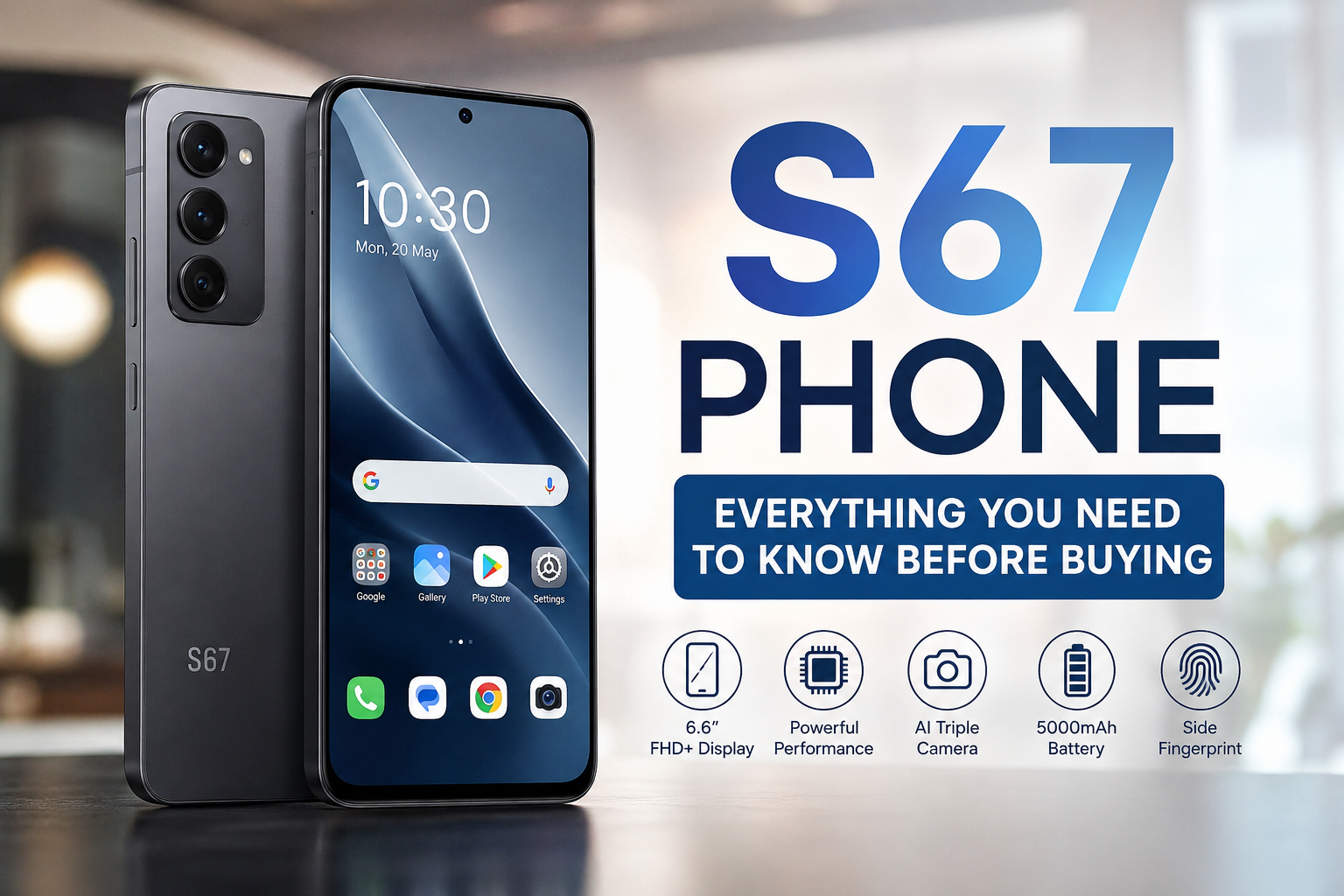
The smartphone market is full of devices with familiar names, similar designs, and confusing specifications. That is why a model name like the S67 phone can leave buyers wondering: What exactly is it? Which brand makes it? Is it a good device, and more importantly, is it worth your money?
The answer depends on the exact model and manufacturer being discussed. In some markets, similar model names are used for budget smartphones, imported devices, refurbished handsets, or region-specific products. This makes it especially important to look beyond the name printed on the box. A phone can sound impressive because of its model number, but the real experience comes from its display, processor, cameras, battery, software, build quality, and long-term support.
Think of a smartphone’s name like the title of a book. The title may catch your attention, but it does not tell you whether the story inside is good. Before choosing any device sold under the S67 name, you should understand what you are actually getting.
This guide explores the key things to know about an S67 phone, from design and performance to cameras, battery life, connectivity, software, and buying considerations.
Understanding the S67 Phone Name
One of the first things buyers should understand is that S67 may not always identify one universally recognized smartphone model. Smartphone naming can vary between manufacturers, retailers, and regions. Some sellers may also use shortened names, product codes, or unofficial descriptions.
Always check the manufacturer
Before making a purchase, look for the complete product name. Check the brand, model number, storage configuration, and official specifications. For example, two devices may both be advertised with a similar S67 name while having completely different processors, cameras, displays, and operating systems.
This is particularly important when shopping through online marketplaces.
A listing with attractive photos and a low price can look convincing, but you should examine the technical details carefully. Does the listing clearly identify the manufacturer? Does it explain the processor and memory? Is the operating system mentioned? Are there real customer reviews?
These questions can save you from disappointment later.
Why model verification matters
The model name alone tells you very little about daily performance. A large display does not automatically mean a high-quality screen, and a high megapixel number does not guarantee excellent photographs.
Instead of focusing only on the name, look at the complete package.
Design and Build Quality
The physical design of a smartphone plays a major role in how enjoyable it feels to use every day.
An S67 phone may come in a modern style with a large touchscreen, slim body, rear camera module, and fingerprint security. However, the materials and construction can vary significantly depending on the exact device.
Comfort matters more than appearance
A beautiful smartphone is great, but you also need to ask yourself whether it feels comfortable in your hand.
Large devices provide more screen space for videos, games, and browsing. On the other hand, they can be difficult to use with one hand. Smaller models are easier to carry but may feel less immersive when watching content.
The placement of buttons also matters. The power button and volume controls should be easy to reach. A fingerprint sensor should respond quickly and be positioned naturally.
Build materials
Budget devices commonly use plastic frames and backs. However, that isn’t necessarily a drawback. Plastic can reduce weight and may handle minor impacts better than glass.
More expensive devices may use aluminum, glass, or other premium materials. These can make a handset feel more luxurious, but they may also increase repair costs.
The best choice is not always the most expensive material. It is the one that provides a good balance between comfort, durability, and price.
Display Quality and Screen Experience
The display is one of the most important parts of any smartphone because it is the feature you interact with constantly.
Whether you are reading articles, watching videos, scrolling through social media, or playing games, the screen determines much of the overall experience.
Screen size
A larger panel can make entertainment more enjoyable. Videos feel more immersive, text is easier to read, and multitasking can be more comfortable.
However, screen size is just one factor to consider.
Resolution also matters. A sharper display can make text and images look clearer. Brightness is equally important, especially if you regularly use your phone outdoors.
Refresh rate
Some modern smartphones offer higher refresh rates. This can make scrolling and animations appear smoother.
Imagine turning the pages of a flipbook. If there are only a few pictures, the movement may look jumpy. Add more pictures between each movement, and the animation appears smoother. A higher refresh rate works in a similar way.
That does not mean every user needs the highest possible refresh rate. If you mainly use your phone for calls, messaging, and browsing, a standard display may be perfectly adequate.
Brightness and color
A good screen should remain visible in different lighting conditions. Outdoor visibility can be particularly important for people who frequently travel or work outside.
Color accuracy also affects photos, videos, and games. Some displays produce deeper contrast and more vibrant colors, while others offer a more natural appearance.
Performance for Everyday Use
Performance is where marketing can become misleading.
A smartphone may advertise a powerful-sounding processor, large memory, or advanced features, but the real question is simple: How well does it perform when you actually use it?
For everyday tasks, the processor handles activities such as opening applications, switching between programs, browsing websites, streaming videos, and processing photos.
Memory and multitasking
RAM helps a phone manage multiple applications. More memory can improve multitasking, particularly if you frequently switch between social media, messaging, navigation, browsers, and other programs.
However, bigger numbers are not the only factor. Software optimization can also have a major impact on overall performance.
A well-optimized device with moderate specifications can sometimes feel smoother than a poorly optimized phone with more impressive numbers on paper.
Storage space
Storage is another important consideration.
Your phone needs space for applications, photos, videos, downloads, and system files. A device that seems to have plenty of storage at first can fill up surprisingly quickly.
If you take many photos or record videos, consider choosing a larger storage option. Expandable storage can also be useful, depending on the model.
Before buying, check how much of the advertised storage is actually available to the user after the operating system is installed.
Camera Features and Photography
Cameras have become one of the biggest reasons people choose one smartphone over another.
An S67 phone may advertise multiple rear lenses, a high-resolution main camera, portrait features, night photography, or artificial intelligence enhancements. These features can sound exciting, but camera quality depends on much more than the megapixel count.
The main camera
A good camera needs to capture detail, manage light, and produce natural colors.
In daylight, many modern phones can take acceptable photos. The real differences often become more visible in challenging situations, such as indoor scenes or nighttime photography.
Look for real-world sample images when possible. Product photos from advertisements are often professionally created and may not accurately represent everyday camera performance.
Front camera
For many people, the selfie camera is just as important as the rear system.
A front camera is used for video calls, social media, online meetings, and personal photographs. Good image processing can make a major difference in skin tones, exposure, and detail.
Extra lenses
Some phones include wide-angle, macro, or depth sensors.
These can be useful, but you should consider whether you will actually use them. A smartphone with fewer high-quality cameras may provide a better experience than one with several low-quality sensors.
In other words, camera quantity and camera quality are not the same thing.
Battery Life and Charging
Battery performance can make or break the ownership experience.
You can have an excellent display and fast processor, but if the battery dies halfway through the day, the experience quickly becomes frustrating.
Daily endurance
Battery capacity provides a basic idea of potential endurance, but real battery life depends on several factors.
These include:
- Screen brightness
- Display refresh rate
- Processor efficiency
- Mobile network usage
- Gaming
- Video streaming
- Background applications
- Software optimization
Two people using the same device may get very different results.
Someone who mainly sends messages and browses the internet may easily get through a full day. A heavy gamer or frequent video streamer may need to recharge much earlier.
Charging speed
Fast charging can be extremely convenient.
Instead of waiting for hours, you may be able to add a useful amount of power during a short break. However, charging speed depends on the charger, cable, and device support.
It is worth checking whether a compatible charger is included in the box. Some smartphones support fast charging but do not include the highest-powered adapter.
Software and User Experience
Hardware is only half of the smartphone experience. Software is what connects everything together.
The operating system controls the interface, notifications, security features, permissions, applications, and many everyday functions.
Ease of use
A good interface should feel simple rather than overwhelming.
You should be able to find important settings without searching through endless menus. Notifications should be manageable, and useful features should not be hidden behind unnecessary complexity.
Some manufacturers add their own software interface on top of Android. This can provide extra customization but may also introduce unwanted applications or advertisements.
Updates and security
Software updates are often overlooked when buying a phone, especially when the price is attractive.
However, updates can improve security, fix problems, and sometimes introduce new features.
Before purchasing an unfamiliar device, investigate whether the manufacturer provides regular updates. A cheaper phone can become less appealing if it receives little or no long-term software support.
Your smartphone contains personal conversations, photos, accounts, and financial information. Security should not be treated as an optional feature.
Connectivity and Everyday Features
Modern smartphones are more than communication devices. They are cameras, navigation tools, entertainment centers, payment devices, and portable computers.
Because of this, connectivity matters.
Mobile networks
Check whether the exact S67 model supports the network bands used by your mobile carrier.
This is particularly important when buying imported or international devices. A phone may work perfectly in one country but offer limited compatibility in another.
Depending on the model, you may need to check support for 4G or 5G connectivity.
Wi-Fi and Bluetooth
Wi-Fi performance affects streaming, downloads, and general internet use. Bluetooth is important for wireless earphones, speakers, smartwatches, and other accessories.
Newer standards can provide improvements, but compatibility with your existing devices is equally important.
Other useful features
Depending on the specific model, you may find features such as:
- Dual SIM support
- NFC
- Fingerprint security
- Face unlocking
- USB-C connectivity
- GPS navigation
- Expandable storage
- Headphone support
- Stereo speakers
Do not assume that every version includes the same features. Always check the exact specification sheet.
Gaming and Entertainment Experience
Can an S67 phone handle games?
That depends on the processor, graphics hardware, memory, cooling, and software optimization.
Casual gaming
Most modern smartphones can handle simple games without major problems.
Puzzle games, card games, racing titles, and many popular mobile applications do not necessarily require flagship-level hardware.
Demanding games
Graphically intensive games are more challenging.
A budget processor may still run them, but you may need to lower the graphics settings. Frame rates can drop during busy scenes, and the phone may become warm during long gaming sessions.
If gaming is one of your main reasons for buying a phone, look beyond general specifications. Search for performance tests involving the specific games you play.
Media consumption
For movies, television shows, and online videos, a good display and decent speakers can make a significant difference.
A large screen can turn a long journey into a more enjoyable experience. Add headphones, and your smartphone becomes something like a small personal cinema in your pocket.
Security, Privacy, and Reliability
Smartphones store an enormous amount of personal information.
That makes security essential.
Screen protection
A PIN, password, fingerprint sensor, or facial recognition feature can help protect your data.
Biometric security is convenient because it allows quick access, but you should still use a strong backup password.
Application permissions
Be careful about the permissions requested by applications.
Does a flashlight application really need access to your contacts? Does a simple game need your precise location?
Taking a few seconds to review permissions can improve your privacy.
Manufacturer reliability
When purchasing a less familiar device, research the manufacturer and seller.
Look for information about warranty coverage, customer service, replacement parts, and software support.
Buying a smartphone is not only about the day it arrives. You should also think about what happens if the battery develops a problem, the screen breaks, or the software needs an update.
Who Should Consider an S67 Phone?
The right smartphone depends on the person using it.
There is no universal winner because different users have different priorities.
For casual users
If you mainly make calls, send messages, browse websites, use social media, and watch videos, you may not need expensive flagship hardware.
A well-priced device with reliable battery life, sufficient storage, and smooth everyday performance may be all you need.
For students
Students may value a large display, long battery life, affordable price, and enough storage for educational applications and documents.
A durable case can also be a smart investment.
For photography enthusiasts
If photography is a priority, look closely at real camera results rather than relying on megapixel numbers.
Low-light performance, image processing, stabilization, and color accuracy are often more important.
For gamers
Gamers should prioritize processor performance, graphics capability, memory, thermal management, and display responsiveness.
A visually impressive phone may not necessarily provide the best gaming experience.
What to Check Before Buying
Before purchasing an S67 phone, take a few minutes to compare the details.
Use this buying checklist
First, confirm the exact manufacturer and model number.
Second, check the processor. You do not need to memorize technical details, but understanding the chipset can help you estimate performance.
Third, look at the RAM and storage configuration.
Fourth, examine the display resolution, brightness, and size.
Fifth, investigate the camera using independent sample photos.
Sixth, check battery capacity and charging support.
Seventh, verify network compatibility with your carrier.
Eighth, research the manufacturer’s software update policy.
Finally, review the warranty and return policy.
A smartphone purchase should not feel like a guessing game. The more information you have before paying, the more likely you are to be satisfied afterward.
Common Mistakes to Avoid
Many buyers make the same mistakes when choosing a smartphone.
Focusing only on megapixels
More megapixels do not automatically mean better photographs.
Camera sensors, lenses, image processing, and lighting all play important roles.
Choosing the cheapest listing
An extremely low price can be tempting, but check what is included.
Is the device new, refurbished, or used? Does it include a warranty? Is the advertised storage genuine? Are the specifications accurate?
Ignoring software support
A phone without reliable updates may become less secure and less enjoyable over time.
Buying more power than you need
The opposite problem also exists.
Some people spend a large amount of money on premium features they rarely use. If you only browse, message, and stream videos, a powerful flagship processor may be unnecessary.
The smartest purchase is not always the most expensive phone. It is the phone that fits your needs.
Price, Value, and Long-Term Ownership
Price should always be considered alongside long-term value.
A cheap smartphone may save money initially, but frequent repairs, poor battery life, limited storage, or weak software support can reduce its overall value.
On the other hand, an expensive device is not automatically a good investment.
Look at the complete ownership experience
Ask yourself how long you plan to keep the phone.
If you expect to use it for several years, better build quality, stronger performance, and longer software support may justify spending more.
If you simply need an affordable device for basic communication, a budget option may make much more sense.
Value is personal.
For one person, the best value might be a large battery and affordable price. For another, it might be a better camera or faster performance.
The Future of Smartphones Like the S67
The smartphone industry continues to evolve rapidly.
Artificial intelligence features, improved cameras, faster networks, more efficient processors, and better battery technology are becoming increasingly common.
Even budget devices are now receiving features that were once limited to premium models.
This is good news for consumers.
The gap between affordable and expensive smartphones has narrowed in several areas. You no longer need to spend the highest possible amount to get a capable camera, large display, or all-day battery life.
At the same time, buyers need to be more careful because product names and marketing claims can create confusion.
The future is likely to bring smarter software, improved energy efficiency, and more personalized experiences. But one principle will remain the same: the best smartphone is the one that meets your real needs.
Final Thoughts
An S67 phone may attract attention because of its name, design, price, or advertised features, but a smart buying decision requires looking deeper.
Before making a purchase, verify the exact manufacturer and model. Then examine the display, processor, memory, storage, camera performance, battery, charging, software, connectivity, security, and warranty.
Do not let a long specification list overwhelm you. Start with the features you actually use every day. If you love photography, prioritize the camera. If you travel frequently, focus on battery life and network compatibility. If you play demanding games, pay attention to performance and cooling.
A smartphone should work like a reliable everyday companion rather than a complicated machine you constantly have to manage. When you choose based on your real needs instead of marketing alone, you are far more likely to find a device that delivers a satisfying experience.
Frequently Asked Questions
1. What is the S67 phone?
The S67 name can refer to different smartphones or region-specific devices, depending on the manufacturer and market. Before buying, check the complete brand name and model number to confirm the exact device.
2. Is the S67 phone good for gaming?
Gaming performance depends on the exact processor, graphics hardware, RAM, cooling, and software optimization. Casual games may run smoothly, while demanding titles may require lower graphics settings on less powerful hardware.
3. Does the S67 phone have a good camera?
Camera quality depends on the specific model. Instead of judging the camera only by megapixel numbers, check real-world image samples, low-light performance, video quality, and image stabilization.
4. How long does the S67 phone battery last?
Battery life depends on battery capacity and how you use the device. Screen brightness, gaming, mobile data, video streaming, and background applications can all affect daily endurance.
5. What should I check before buying an S67 phone?
Verify the exact manufacturer and model number, then check the processor, RAM, storage, display, cameras, battery, charging speed, network compatibility, software updates, warranty, and seller reliability.