
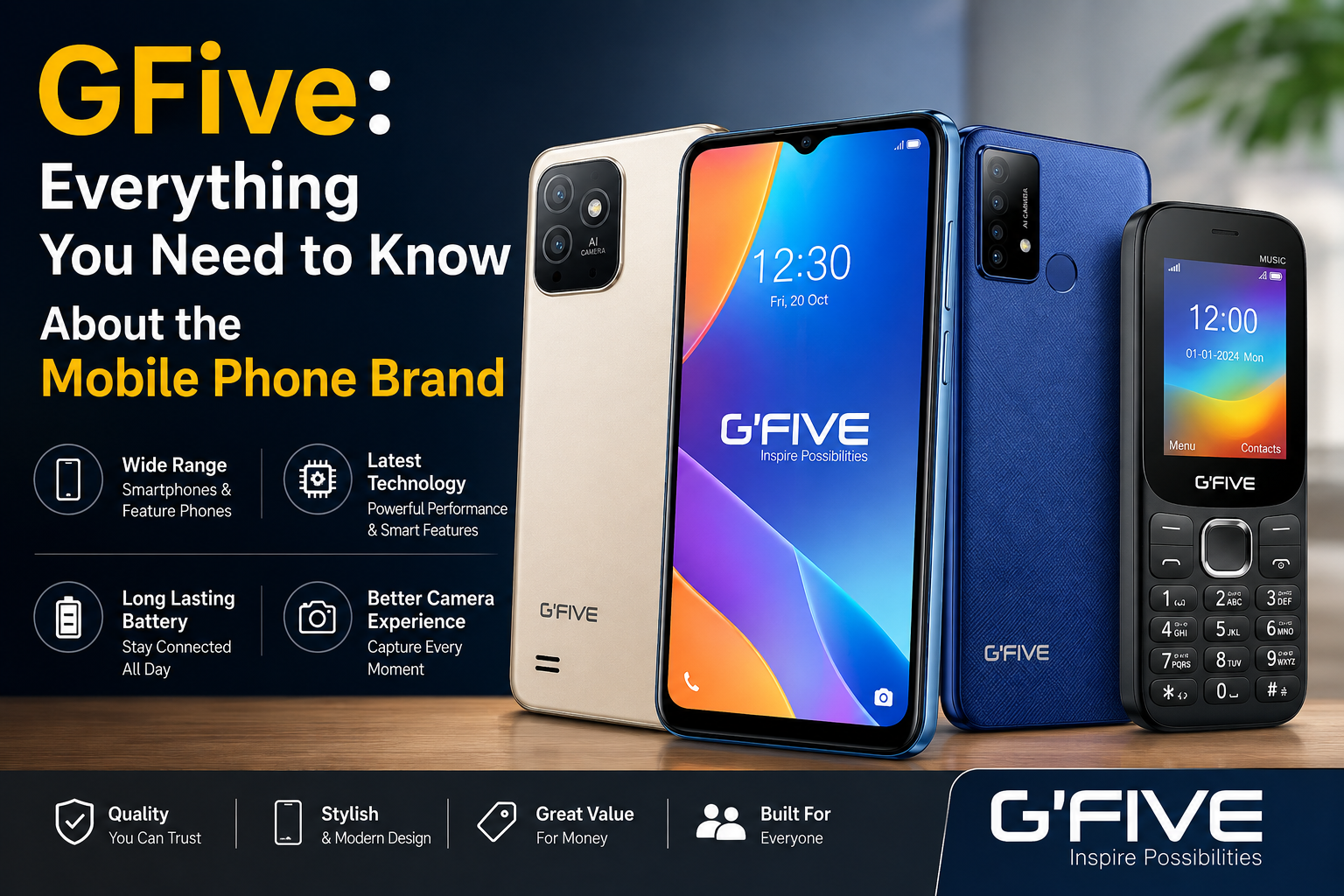
GFive is a name that many mobile phone users, particularly in Pakistan and other emerging markets, will recognize. The brand became known for offering affordable mobile phones with practical features at a time when smartphones were rapidly becoming part of everyday life.
Today, the mobile industry is dominated by brands competing over cameras, processors, displays, artificial intelligence, and 5G connectivity. Yet GFive has an interesting place in that story. The company built recognition by focusing on something much simpler: giving ordinary users access to useful mobile technology without making the price difficult to manage.
The brand has changed significantly over the years, adapting to new technologies and the evolving needs of mobile users. Its product range has included traditional feature phones, Android smartphones, dual-SIM devices, and newer models aimed at users who want larger displays, better cameras, and more modern hardware. G’Five’s current official website lists products such as the Vision Pro, Vision 1, Pro 16, Note 25, Note 25 Ultra, Magic, 4G Promax, and 4G Ultra Pro.
So, what exactly is GFive, how did it become known in the mobile market, and what should you know before considering one of its phones?
Let’s take a closer look.
1. What Is GFive?
A mobile brand focused on accessible technology
GFive, also written as G’Five, is a consumer electronics and mobile phone brand associated with smartphones and feature phones.
The company describes its mission as providing mobile devices that combine practicality, innovation, and accessibility. Its stated brand personality emphasizes being positive, practical, passionate, and consumer-oriented.
That positioning helps explain why the brand historically focused heavily on affordable handsets.
Instead of treating a mobile phone as a luxury product, GFive’s approach has generally been to make useful communication technology available to a broader audience.
Its product history includes everything from simple dual-SIM feature phones to Android smartphones with larger displays and more capable processors.
The company has also promoted its manufacturing and research capabilities. Its official corporate information says G’Five has worked with technologies associated with GSM, GPRS, EDGE, CDMA, WCDMA, and other mobile communication standards.
In simple terms, GFive has been part of the transition from basic mobile phones to increasingly capable connected devices.
2. The Early History of GFive
A brand that grew during the feature-phone era
GFive became particularly visible during the period when feature phones were still extremely popular.
Before Android smartphones became affordable, consumers often looked for phones that offered practical extras such as:
- Dual-SIM support
- FM radio
- Bluetooth
- Music playback
- Video playback
- Cameras
- Expandable storage
- Long battery life
- Flashlights
- Large keypads
GFive products were designed around many of these needs.
A 2010 report from The Daily Star described G’Five handsets being launched in Bangladesh and noted features such as dual-SIM support, color displays, cameras, Bluetooth, GPRS, and multimedia functions. Some models even offered two battery slots.
This was important because consumers in developing mobile markets often wanted more features without paying flagship prices.
The company’s early success therefore came from understanding a straightforward principle: a phone did not need to be expensive to be useful.
That idea helped GFive gain recognition across several emerging markets.
3. GFive and the Pakistani Mobile Market
A particularly important market for the brand
Pakistan became one of the markets where GFive developed significant recognition.
The company later established local assembly operations, with reports in 2016 describing the production of GFive smartphones and feature phones carrying a “Made in Pakistan” label. ProPakistani reported that the company’s assembly line had a stated capacity of around 500,000 units per month at that time.
PhoneWorld similarly reported that GFive had established a manufacturing and assembly plant in Pakistan and described the company as a pioneer in local mobile-phone assembly.
This local presence was significant for several reasons.
First, it connected the brand more closely with Pakistani consumers.
Second, local assembly demonstrated that mobile-phone production was becoming more accessible within the country.
Third, it helped strengthen the broader ecosystem surrounding mobile devices.
The relationship between GFive and Pakistan therefore goes beyond simply selling phones.
The company became part of a period when the Pakistani market was rapidly expanding and consumers were moving from basic handsets toward smartphones.
4. From Feature Phones to Smartphones
The smartphone transition changed everything
The mobile-phone industry experienced a major transformation during the 2010s.
Traditional phones were gradually replaced by smartphones capable of running applications, browsing the internet, streaming videos, using social networks, and performing tasks that previously required computers.
GFive responded by expanding its smartphone portfolio.
Historical models included devices from the President, G, A, Blade, Bravo, and other series. Archived product listings show phones such as the President G10, President G6, President G9, A97, GPower models, 4G LTE models, and several other discontinued devices.
This evolution was similar to watching a small family car gradually become an SUV.
The basic purpose remained the same—getting you where you need to go—but the capabilities expanded.
The same thing happened with GFive phones.
A basic handset focused mainly on calls and messages.
A smartphone could handle communication, entertainment, photography, navigation, social media, and internet browsing from one device.
That shift gave GFive an opportunity to compete in a completely different category.
5. GFive Smartphones and Their Main Features
Designed around everyday needs
GFive’s smartphone range has varied significantly from one generation to another.
Older models were designed around basic Android functionality, while newer products on the company’s current website offer considerably more modern specifications.
For example, the current official product listing for the G’Five Pro 16 describes a 6.528-inch HD IPS display with a 720 × 1600 resolution, a MediaTek Helio G85 octa-core processor, dual-SIM support with 4G connectivity, a 13MP front camera, an 8MP rear camera with LED flash, and 8GB of listed RAM/storage configuration.
This demonstrates how far the brand’s smartphones have moved beyond the basic handsets of its early years.
Depending on the model, modern GFive phones may focus on areas such as:
Large displays
Larger screens make phones more comfortable for watching videos, browsing websites, reading, and using social media.
Dual-SIM connectivity
Dual-SIM support remains particularly useful for people who maintain separate personal and business numbers or use different networks.
4G connectivity
4G allows users to access faster mobile data for browsing, streaming, social media, and online communication.
Multiple cameras
Modern models use front and rear cameras to cover selfies, video calls, documents, and everyday photography.
Android software
Android provides access to a broad ecosystem of applications and services.
The exact specifications naturally depend on the individual model, so buyers should always check the official product page rather than assuming that every GFive phone has the same hardware.
6. Current GFive Phones
A broader lineup than many people may expect
GFive’s current official website lists several smartphone models and product families.
Its trending products currently include:
- Note 25
- Note 25 Ultra
- Pro 16
- Magic
- 4G Promax
- 4G Ultra Pro
The site also lists newer products such as Vision Pro and Vision 1.
This suggests that the company is continuing to develop products rather than relying entirely on its older feature-phone reputation.
The Vision Pro, for example, is presented by GFive as a premium-oriented smartphone emphasizing style, performance, and connected living. The Vision 1 is similarly positioned around a combination of design, performance, and everyday usability.
The product range therefore covers different types of users.
Some customers may want a basic 4G handset.
Others may prefer a larger Android phone with more storage and better cameras.
This is important because the word “GFive” no longer describes just one type of phone.
It represents a broader product family.
7. Display Experience
Why screen size matters
The display is one of the first things people notice when using a smartphone.
For many users, the screen is where almost everything happens.
You browse websites on it. You watch videos on it. You read messages. You view photographs. You play games. You use social media.
Modern GFive smartphones increasingly use larger displays for this reason.
The Pro 16, for example, is listed with a 6.528-inch HD IPS screen and a 720 × 1600 resolution.
That size provides considerably more viewing space than traditional feature phones.
However, buyers should look beyond screen size.
Resolution, panel technology, brightness, refresh rate, viewing angles, and touch response can all affect the experience.
A large screen is useful, but a larger screen does not automatically mean a better screen.
It is similar to buying a television. A huge display can be impressive, but picture quality still matters.
For GFive buyers, the ideal screen will depend on how the phone is used.
Someone who mainly sends messages may not care about advanced display technology.
A person who watches videos every day may care much more.
8. Performance and Everyday Use
What can you expect from a GFive smartphone?
Performance depends heavily on the model.
Older GFive smartphones were designed for simpler Android applications and basic multitasking.
Newer models have moved toward more capable processors and larger memory configurations.
The Pro 16, for example, uses the MediaTek Helio G85 octa-core platform according to the company’s current product information.
That gives the device a substantially more modern foundation than the entry-level hardware found in many of the brand’s older smartphones.
For everyday activities, performance generally needs to be judged around the tasks you actually perform.
If your routine involves:
- Web browsing
- YouTube
- Navigation
- Music
- Basic photography
then an affordable modern smartphone may provide everything you need.
But demanding gaming, intensive video editing, heavy multitasking, or other resource-intensive activities require stronger hardware.
This is why specifications should never be viewed in isolation.
A processor number is useful, but your actual experience depends on the entire combination of hardware and software.
9. Camera Capabilities
From simple snapshots to everyday photography
Cameras have become one of the most important smartphone features.
GFive’s modern products reflect this change by offering front and rear cameras on its smartphones.
The Pro 16, for example, is listed with a 13MP front camera and an 8MP rear camera with LED flash.
These specifications suggest a focus on everyday photography and communication rather than competing directly with premium camera phones.
A smartphone camera can be useful for much more than taking holiday photographs.
People use their phones to:
- Scan documents
- Photograph receipts
- Take product pictures
- Join video calls
- Capture family moments
- Post on social media
- Record short videos
For these activities, convenience often matters as much as megapixel count.
A higher number does not automatically produce better photographs.
Image processing, sensor quality, lighting, software, stabilization, and lens design all play important roles.
So, if photography is your priority, compare the exact GFive model rather than judging the entire brand by one specification.
10. Battery Life and Charging
An important consideration for budget users
Battery life can make or break the smartphone experience.
A phone with excellent specifications is not very useful if it constantly needs to be charged.
GFive’s history shows that battery capacity has long been an important part of its product strategy.
Older feature phones often focused heavily on battery endurance, while newer smartphones need to balance larger screens and more powerful hardware against energy consumption.
For modern users, battery performance depends on several factors:
- Battery capacity
- Screen brightness
- Processor efficiency
- Mobile network strength
- Application usage
- Background activity
- Gaming
- Video streaming
Someone who watches videos for several hours a day will naturally consume more power than someone who mainly sends messages.
This is why manufacturers’ battery claims should be treated as estimates rather than guarantees.
If battery life matters to you, look at the exact capacity of the model you are considering and think about your own usage habits.
11. Dual-SIM and Connectivity
A feature that remains highly practical
Dual-SIM functionality has traditionally been an important feature in affordable mobile phones.
GFive has offered many dual-SIM models throughout its product history.
That feature can be extremely useful.
You might use one SIM for work and another for personal communication.
Or you might keep one number for calls while using another network for mobile data.
Some current GFive models continue this approach. The Pro 16, for example, is listed with dual Nano-SIM support and both SIMs active on 4G.
Connectivity also extends beyond cellular networks.
Depending on the model, users may have access to Wi-Fi, Bluetooth, GPS, mobile data, and other wireless technologies.
Again, the exact features vary by phone.
The safest approach is to check the official specifications before making a purchase.
12. GFive Feature Phones
Why simple phones still have a place
Not everyone needs a smartphone.
That may sound surprising in an era when phones have become pocket-sized computers, but there is still a market for simple mobile devices.
Feature phones can be attractive because they are:
- Easy to operate
- Usually affordable
- Often lightweight
- Simple to maintain
- Less demanding on battery
- Suitable for calls and messages
GFive’s history is strongly connected with this category.
Its older product range included models designed around practical features such as dual SIM, multimedia playback, Bluetooth, cameras, and long battery operation.
For an older person, a backup phone, a worker who needs a simple handset, or someone who does not want constant app notifications, a feature phone can still make sense.
Sometimes simplicity is not a weakness.
It is the entire point.
13. GFive’s Approach to Affordable Technology
Technology without unnecessary complexity
One of the most interesting aspects of GFive’s history is its focus on affordability.
The company describes its mission around providing practical and innovative communication products and says its positioning is to “Inspire Possibilities.”
That philosophy fits the needs of price-conscious consumers.
A smartphone does not need to be the fastest or most expensive device to be useful.
For many people, the important questions are much simpler:
Can I make calls?
Can I use messaging apps?
Can I browse the internet?
Can I take photographs?
Can the battery last through my day?
Can I afford it?
These are practical questions.
GFive’s market position has historically been built around answering them without pushing consumers toward premium prices.
14. GFive’s Strengths
Where the brand can make sense
There are several reasons someone might consider a GFive phone.
Affordable positioning
The brand has historically focused on accessible mobile devices, particularly in emerging markets.
Variety
The range has included feature phones, smartphones, 4G devices, and different levels of hardware.
Dual-SIM options
This remains useful for many consumers.
Local market presence
GFive has an established history in Pakistan, including local assembly efforts.
Practical features
Rather than focusing only on premium specifications, many GFive products emphasize everyday functionality.
Newer smartphone options
The current official lineup shows that the brand continues to offer smartphones with larger displays, modern processors, cameras, and 4G connectivity.
These qualities make the brand worth considering, especially for consumers shopping within a limited budget.
15. Limitations to Consider
Why you should compare before buying
No brand is perfect.
GFive operates in a highly competitive market where consumers can choose from many manufacturers.
Before buying a particular phone, consider:
Software support
Check the Android version and whether security updates are provided.
Processor performance
A budget processor may be perfectly adequate for everyday use but less suitable for demanding games.
Camera quality
Do not judge a camera solely by megapixels.
Display
Look at resolution, panel type, brightness, and refresh rate.
Storage
Make sure the internal storage is sufficient for your applications and photographs.
After-sales support
Check warranty coverage and service availability in your area.
Network compatibility
Confirm that the model supports the network bands used by your carrier.
These considerations matter for every smartphone brand, not just GFive.
16. Are GFive Phones Good for Gaming?
It depends on the model
Gaming performance varies significantly across the GFive range.
Older entry-level models were not designed for demanding modern games.
Newer phones with stronger processors and larger memory configurations can handle lighter games more comfortably.
But if gaming is your primary reason for buying a smartphone, you should compare the exact chipset, RAM, graphics hardware, display refresh rate, cooling, and battery capacity.
A phone designed for basic communication is not automatically a gaming phone.
Think of it like choosing a car.
A compact city car may be excellent for commuting but not the right choice for racing.
The same principle applies to smartphones.
17. Who Should Consider a GFive Phone?
A practical choice for the right user
GFive phones may be worth considering for people who prioritize value and everyday functionality.
They can be particularly relevant to:
- Budget-conscious smartphone buyers
- First-time smartphone users
- People who want dual-SIM support
- Users who need a secondary phone
- Consumers who prefer straightforward devices
- Feature-phone users upgrading to Android
- People who primarily use messaging, browsing, and social media
However, users seeking flagship-level photography, high-end gaming, premium materials, or advanced display technology should compare other options as well.
The goal is not to decide that one brand is universally better.
The goal is to find the phone that fits your needs.
18. How to Choose the Right GFive Phone
Start with your actual usage
Before purchasing, ask yourself five questions.
What is my budget?
Set a realistic spending limit before comparing models.
Do I need a smartphone or a feature phone?
If you mainly make calls and send messages, you may not need an expensive Android device.
How much storage do I need?
People who take many photographs or install many applications should prioritize more storage.
Do I need 4G?
For modern internet use, 4G is generally much more useful than older mobile technologies.
How important is the camera?
If photography is central to your routine, pay close attention to real-world camera reviews rather than relying only on megapixel numbers.
Once you answer these questions, choosing between different models becomes much easier.
19. GFive’s Place in Mobile Technology
A brand shaped by changing consumer needs
GFive’s story reflects a much larger transformation in the mobile industry.
The company started in an era when feature phones dominated many markets.
Then came affordable Android smartphones.
Then 3G and 4G became increasingly common.
Displays became larger.
Cameras became more capable.
Processors became faster.
And phones became central to everyday digital life.
GFive adapted along the way.
Its current product catalog demonstrates that the company is still presenting smartphones and other mobile devices to consumers, including newer models such as the Vision Pro, Vision 1, Pro 16, Note series, and 4G products.
That evolution is perhaps the most interesting thing about the brand.
GFive is not simply a story about old feature phones.
It is a story about how affordable mobile technology has changed.
Conclusion
GFive has had an interesting journey through the mobile-phone industry. From feature phones with dual-SIM functionality and practical multimedia features to Android smartphones with larger displays, modern processors, cameras, and 4G connectivity, the brand has evolved alongside changing consumer expectations.
Its connection with Pakistan is also notable. The company established local assembly operations and became associated with the country’s growing mobile manufacturing ecosystem.
Today, the most important thing to remember is that GFive is a broad product category rather than a single type of phone. Some models are designed for basic communication, while others offer a more complete smartphone experience.
Is GFive right for you? That depends on what you need.
If affordability, practical features, dual-SIM functionality, and everyday usability are your priorities, some GFive models may deserve consideration. If you need flagship cameras, premium displays, advanced gaming performance, or long-term software support, you should compare the exact model carefully against competing smartphones.
Ultimately, the best phone is not necessarily the most expensive one. It is the one that gives you the features you actually need without paying for things you will never use.
Frequently Asked Questions
1. What is GFive?
GFive, also written as G’Five, is a mobile and consumer electronics brand known for feature phones and smartphones. Its products have historically targeted emerging markets with an emphasis on practical features and accessible pricing.
2. Is GFive a Pakistani mobile brand?
GFive has international roots, but it has had a significant presence in Pakistan and established local mobile-phone assembly operations there. Reports from 2016 described GFive smartphones and feature phones being produced in Pakistan with a “Made in Pakistan” label.
3. Does GFive make smartphones?
Yes. GFive currently lists multiple smartphones on its official website, including Vision Pro, Vision 1, Pro 16, Note 25, Note 25 Ultra, and other models.
4. Are GFive phones good for everyday use?
The answer depends on the model. Newer GFive smartphones can provide features such as Android software, 4G connectivity, larger displays, dual-SIM support, and multiple cameras. However, buyers should compare the specifications of the exact model before purchasing.
5. Does GFive still sell mobile phones?
Yes. GFive’s current official website lists an active product catalog containing smartphones and other mobile devices, including several newer models and 4G products.