
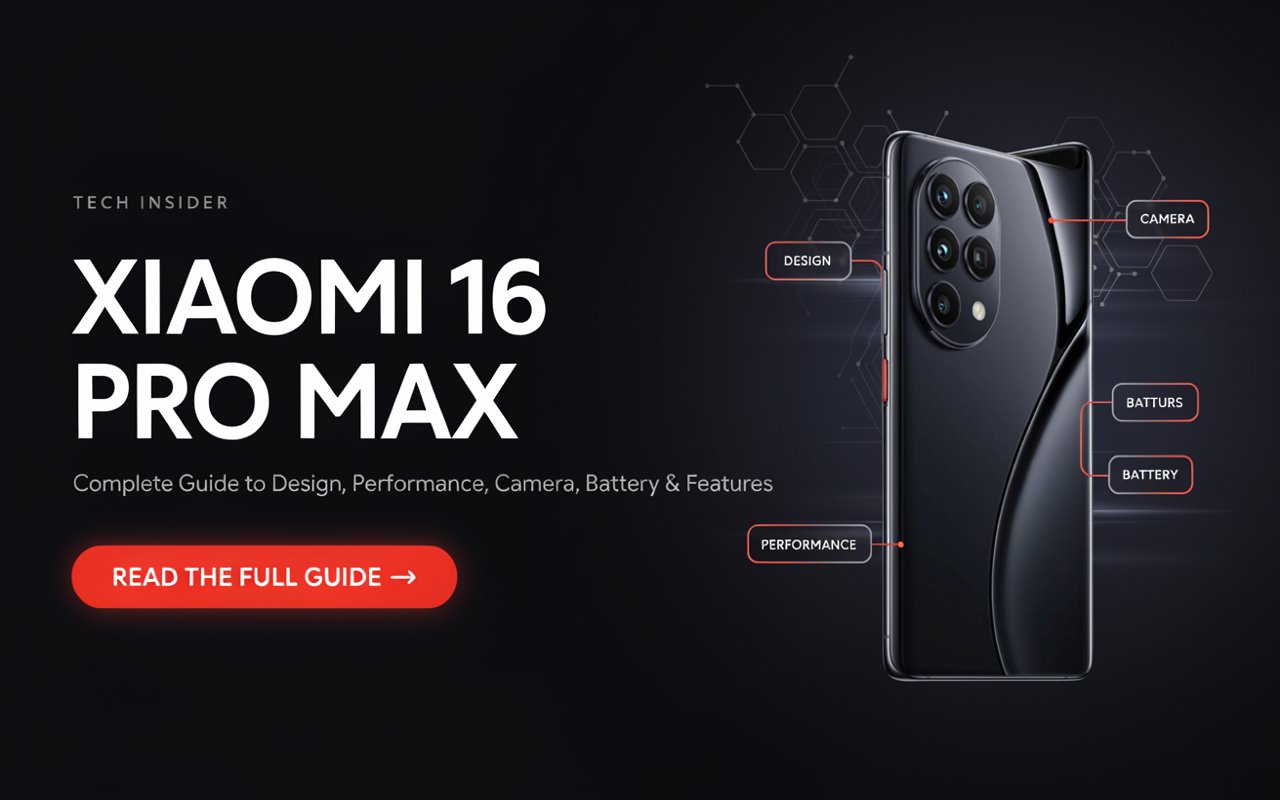
The smartphone world is full of rumors, leaks, and changing product names. Few flagship launches demonstrate this better than the device once widely discussed as the Xiaomi 16 Pro Max. Before the Xiaomi 17 generation arrived, reports suggested that Xiaomi could introduce a larger Pro Max model with a massive display, advanced Leica cameras, flagship performance, and an unusually large battery.
However, there is an important point for readers to understand: Xiaomi did not officially release a phone under the Xiaomi 16 Pro Max name. Later reporting indicates that Xiaomi skipped the 16 generation and moved to the Xiaomi 17 series instead.
That does not make the rumored device uninteresting. Quite the opposite. The specifications reported during the development period give us an interesting look at what Xiaomi was considering for its next-generation flagship hardware.
So, what was expected from the Xiaomi 16 Pro Max? How powerful was it supposed to be? What camera improvements were rumored? And what happened to the device?
Let’s explore everything in detail.
Xiaomi 16 Pro Max: What Was Expected?
The name Xiaomi 16 Pro Max appeared in numerous leaks and unofficial specifications during 2025. Reports suggested that Xiaomi was considering a new top-tier model positioned between the regular Pro smartphone and the Ultra range.
According to early reports, the phone was expected to feature a large display, a powerful Qualcomm processor, a triple-camera system, Leica imaging technology, and a large silicon-carbon battery. Some reports also suggested that Xiaomi was experimenting with a secondary display integrated into the rear camera area.
This would have made the device quite different from an ordinary flagship.
Think of it like a concept car. A manufacturer can test an ambitious design and advanced technologies before deciding which ideas should become part of the final production lineup. The rumored 16 Pro Max appears to have represented that kind of ambitious direction.
A Quick Reality Check
Because the phone was never officially launched under that name, specifications published online should not be treated as confirmed Xiaomi specifications.
Different websites have reported different figures, including battery capacity, display size, operating system, camera sensors, and chipset details.
Therefore, readers should separate:
- Official specifications
- Reliable leaks
- Unconfirmed rumors
- Expected pricing
This distinction is especially important when researching a phone that never received an official retail launch.
Design and Build Quality
One of the most interesting rumors surrounding the larger Pro Max model involved its physical design.
Reports suggested Xiaomi could introduce a large flagship with a premium metal frame, glass construction, and a substantial camera module. The device was expected to follow the premium design language associated with Xiaomi’s high-end smartphones.
The large rear camera area would likely have been one of the phone’s most recognizable features.
Large Camera Module
The camera system was expected to occupy a significant portion of the rear panel because Xiaomi was reportedly preparing larger image sensors and advanced optical hardware.
That is not necessarily a bad thing.
A larger camera system can provide room for bigger sensors, additional lenses, stabilization hardware, and other imaging components.
In other words, the camera bump is sometimes the price we pay for better photography.
Premium Protection
Unofficial specifications also mentioned water and dust resistance, with some sources listing IP68 protection. However, because the device was not officially released, such specifications should be treated as rumored rather than guaranteed.
For any flagship phone, durability matters.
A premium smartphone is something most people carry everywhere. It goes into pockets, bags, cars, offices, restaurants, and outdoor environments. Protection against everyday dust and accidental exposure to water can therefore be extremely valuable.
Display: A Large, High-Resolution Experience
A flagship Pro Max model would naturally be expected to offer a large display.
Reports commonly suggested a screen around the 6.8-inch range, with some listings mentioning a resolution of 1440 × 3200 pixels and a 120Hz refresh rate.
An LTPO OLED panel was also widely mentioned.
Why OLED Is Important
OLED displays are particularly attractive for premium smartphones because they can produce deep blacks and strong contrast.
When you’re watching a movie, viewing photographs, or using a dark interface, those characteristics can make the screen look more immersive.
OLED technology also allows manufacturers to create very thin displays, which helps smartphone designers maintain a premium appearance.
120Hz Refresh Rate
A 120Hz refresh rate was another commonly reported feature.
A higher refresh rate makes scrolling and supported animations appear smoother than traditional 60Hz displays.
You might notice the difference while:
- Scrolling through social media
- Browsing websites
- Moving through menus
- Playing compatible games
- Watching supported content
The phone would therefore have been well suited to people who spend a lot of time consuming media.
Brightness
Some unofficial listings claimed extremely high peak brightness figures, with values around 3,000 nits appearing in reports.
However, peak brightness numbers should always be interpreted carefully.
Manufacturers often measure peak brightness under specific conditions. Everyday brightness can be lower depending on the display mode, ambient lighting, content, and software.
Still, strong brightness would have been useful for outdoor use.
Performance and Snapdragon Processing Power
Performance was expected to be another major attraction.
Early reports associated the rumored device with Qualcomm’s Snapdragon 8 Elite platform, while later-generation rumors and naming confusion resulted in some websites listing different processors.
This is one reason it is important not to treat every online specification page as official.
Why Flagship Processing Matters
A powerful processor does much more than make benchmark scores look impressive.
It affects how quickly applications launch, how smoothly demanding games run, how efficiently the phone handles image processing, and how comfortably you can multitask.
Imagine having a powerful engine in a car. You may not use maximum power every time you drive, but having extra performance available means the vehicle does not have to work as hard when you need acceleration.
A modern flagship processor works in a similar way.
Gaming
For gamers, powerful hardware can be particularly useful.
Modern Android games can demand significant processing and graphics resources. A flagship chipset can provide the performance necessary for high graphics settings and smooth gameplay.
However, sustained performance also depends on cooling.
A smartphone can become warm during long gaming sessions, particularly when the processor, display, network connection, and battery are all working heavily.
So raw processor speed is only one part of the gaming experience.
Leica Camera System and Photography
Camera technology was expected to be one of the strongest aspects of the rumored device.
Xiaomi’s collaboration with Leica has become an important part of its premium smartphone photography strategy. Reports surrounding the 16 Pro Max suggested that the phone could receive larger and more advanced camera sensors.
Main Camera
One report suggested that the phone could use a 50MP SmartSens 590 sensor measuring approximately 1/1.28 inches. The same report noted that this would be slightly larger than the sensor reportedly used in the Xiaomi 15 Pro.
A larger sensor can potentially collect more light.
That becomes particularly important when photographing at night or indoors.
More light can give the image-processing system additional information to work with, potentially improving detail, dynamic range, and noise control.
Telephoto Camera
A new telephoto system was also rumored.
Reports suggested a 50MP sensor around 1/1.95 inches behind a periscope-style telephoto lens.
A periscope camera is useful because it allows manufacturers to achieve greater optical reach without making the phone dramatically thicker.
This can be valuable for:
- Portrait photography
- Wildlife
- Concerts
- Sports
- Architecture
- Travel photography
Ultra-Wide Photography
An ultra-wide camera would complement the primary and telephoto lenses.
Imagine standing inside a narrow room and trying to capture the entire space. A normal camera may not be wide enough.
An ultra-wide lens lets you include more of the scene.
For travelers, this can be especially useful for landscapes and architecture.
Possible Rear Display
Perhaps the most unusual rumored feature was a second display on the back of the phone.
Leaked images reportedly showed a secondary screen integrated into the camera module, recalling the unusual rear-display approach previously associated with the Xiaomi Mi 11 Ultra.
This would have made the phone considerably more distinctive.
What Could a Rear Display Do?
A secondary screen could potentially be useful for:
- Taking selfies with the rear cameras
- Showing notifications
- Displaying the time
- Controlling music
- Showing widgets
- Providing camera controls
- Previewing photographs
The biggest practical advantage could have been photography.
The rear cameras are normally much better than the front camera. A rear screen could allow you to use those stronger cameras while still seeing yourself in the frame.
For portrait and group photography, that could be genuinely useful.
Is It Just a Gimmick?
That depends on implementation.
A feature is not useful simply because it looks futuristic.
If Xiaomi had integrated meaningful controls into the display, it could have become a practical photography tool. If it were mostly decorative, many users might rarely use it.
That distinction separates innovative design from novelty.
Battery Life and Charging
Battery capacity was another area where the rumored device attracted attention.
Different sources published different battery figures. Earlier reports mentioned capacities around 6,100mAh, while later leaks associated the larger Pro Max concept with a much larger 7,500mAh silicon-carbon battery.
The conflicting figures demonstrate why unofficial specifications need to be treated carefully.
Silicon-Carbon Battery Technology
Silicon-carbon battery technology has become increasingly interesting in smartphone design because it can allow manufacturers to increase energy density without making the battery physically enormous.
That can give phones more battery capacity while still maintaining relatively practical dimensions.
A large battery would have been particularly useful for a device with:
- A large high-resolution display
- A powerful processor
- Advanced cameras
- High-speed connectivity
- Gaming capabilities
Fast Charging
Reports also suggested high-speed charging, with some later listings mentioning 100W wired charging.
Fast charging can make a big difference in everyday life.
Suppose you realize your battery is almost empty shortly before leaving home. A fast charger can provide considerably more energy during a short charging session than a conventional charger.
Wireless charging may also appeal to users who value convenience.
HyperOS and Android Experience
Software is just as important as hardware.
Xiaomi’s modern smartphones use HyperOS, the company’s software platform designed to provide a connected experience across phones and other Xiaomi devices.
Unofficial Xiaomi 16 Pro Max listings have mentioned different Android and HyperOS versions depending on when they were published. Some early reports listed Android 15 and HyperOS 2, while later material mentioned Android 16 and HyperOS 3.
Again, this is a reminder that those listings should not be treated as official specifications.
Everyday Software
For users, the important question is not simply which version number appears on the box.
What matters is how the software performs.
A good smartphone interface should make everyday actions straightforward:
- Opening applications
- Managing notifications
- Changing settings
- Editing photographs
- Sharing files
- Controlling connected devices
- Customizing the home screen
AI Features
AI has become an increasingly important part of smartphone software.
Modern flagship phones can use on-device and cloud-based intelligence for tasks such as writing assistance, image editing, transcription, search, translation, and productivity.
However, AI availability can differ by country and software version.
Therefore, buyers should always verify which features are available in their specific market.
Storage, RAM, and Connectivity
A premium Pro Max phone would naturally be expected to offer generous memory.
Unofficial listings have mentioned configurations such as 12GB and 16GB RAM, alongside 256GB and 512GB storage options. Some reports also speculated about higher-capacity versions.
Why Storage Matters
High-resolution photographs and video files can consume storage surprisingly quickly.
If you regularly record 4K or higher-resolution footage, 256GB can disappear faster than expected.
For heavy users, 512GB or more can therefore provide valuable breathing room.
Modern Connectivity
The rumored device was expected to support modern 5G connectivity, Wi-Fi, Bluetooth, NFC, GPS, USB-C, and other common flagship features.
Some unofficial listings also mention Wi-Fi 7 support.
For ordinary users, these technologies may not sound exciting, but they influence everyday experiences such as faster wireless downloads, stable connections, wireless accessories, navigation, contactless functions, and file transfers.
Xiaomi 16 Pro Max Price and Availability
This is where the story becomes especially important.
Numerous websites have published estimated prices for the Xiaomi 16 Pro Max, including figures in Pakistani rupees and other currencies. But because Xiaomi did not officially launch a smartphone under this name, those prices should not be treated as official retail prices.
Some websites initially expected a launch around early 2026, but later reporting established that Xiaomi moved to the Xiaomi 17 generation instead.
Should You Trust Online Listings?
Be careful.
A webpage saying “coming soon” does not necessarily mean the manufacturer confirmed the product.
Before purchasing any expensive smartphone, check:
- Official manufacturer announcements
- Authorized retailer listings
- Warranty information
- Model number
- Regional software support
- Network compatibility
- Return policy
This is especially important for phones advertised through unofficial import channels.
Xiaomi 16 Pro Max vs. Xiaomi 15 Pro
If you already own a Xiaomi 15 Pro, should you have waited for the rumored 16 Pro Max?
The answer is complicated because the latter never became an official product.
The Xiaomi 15 Pro was a real flagship with a Snapdragon 8 Elite platform, Leica camera system, large battery, premium display, and HyperOS. The rumored 16 Pro Max appeared to build upon those ideas with a larger form factor, potentially larger camera sensors, and a much larger battery.
For someone who already owns the 15 Pro, the rumored improvements would have been attractive but not necessarily essential.
For a new buyer, however, it makes more sense to compare currently available Xiaomi flagships rather than purchasing a phone based on an unofficial name.
Xiaomi 16 Pro Max vs. Xiaomi 17 Pro Max
This is perhaps the most useful comparison for people searching for the older name.
Current reporting identifies the Xiaomi 17 Pro Max as the actual successor in Xiaomi’s flagship naming sequence. The 17 Pro Max launched in China in September 2025 and brought a large 6.9-inch 120Hz display, a secondary 2.9-inch rear AMOLED display, Snapdragon 8 Elite Gen 5 hardware, a 7,500mAh battery, 100W wired charging, 50W wireless charging, and Leica-branded cameras.
In other words, several ideas associated with the rumored 16 Pro Max eventually appeared in the real Xiaomi 17 Pro Max.
That makes the 16 Pro Max story particularly interesting.
It was not simply a case of a rumored phone disappearing. Some of the rumored direction appears to have evolved into the next-generation product.
Pros and Cons of the Rumored Device
Because the phone was never officially launched, these should be considered potential strengths and limitations rather than a formal product review.
Potential Advantages
- Large premium display
- Flagship-level performance
- Advanced Leica photography
- Larger camera sensors
- Powerful telephoto capabilities
- Very large battery
- Fast charging
- High RAM and storage options
- Potential rear display
- Premium construction
- Modern connectivity
Potential Disadvantages
- Large physical size
- Potentially high price
- Camera module could be bulky
- Specifications varied significantly between leaks
- International availability was uncertain
- Software features could vary by region
- No official Xiaomi 16 Pro Max retail model was released
Final Verdict
The Xiaomi 16 Pro Max is an interesting example of how smartphone rumors can evolve into real products.
Although the phone was widely discussed online, Xiaomi ultimately did not officially release a device under the Xiaomi 16 Pro Max name. Current reporting indicates that the company skipped the 16 generation and moved to the Xiaomi 17 series.
That means buyers should be cautious with websites that present the 16 Pro Max as an officially launched smartphone.
Still, the rumored specifications were impressive. Reports pointed toward a large high-resolution display, powerful Snapdragon hardware, advanced Leica photography, larger sensors, a huge battery, fast charging, and potentially a rear display.
Interestingly, several of these concepts appeared in the actual Xiaomi 17 Pro Max.
For someone researching the Xiaomi 16 Pro Max today, the best approach is therefore to treat the name as a rumored or skipped-generation model and investigate the Xiaomi 17 Pro Max when looking for the real successor.
Ultimately, a smartphone should be judged by what you can actually buy, use, and receive support for—not simply by an impressive specification sheet circulating online.
Frequently Asked Questions
1. Was the Xiaomi 16 Pro Max officially released?
No. Current reporting indicates that Xiaomi skipped the 16 generation and moved to the Xiaomi 17 series. The Xiaomi 16 Pro Max was a widely reported and rumored model rather than an officially released retail smartphone.
2. What happened to the Xiaomi 16 Pro Max?
The rumored model appears to have been replaced by Xiaomi’s next-generation naming strategy. The Xiaomi 17 Pro Max became the actual large Pro Max flagship and incorporated several features that had previously been associated with 16 Pro Max rumors.
3. What camera was the Xiaomi 16 Pro Max rumored to have?
Reports suggested a triple-camera setup using 50MP-class sensors, with rumors pointing toward a larger SmartSens main sensor and a larger periscope telephoto sensor. These specifications were never confirmed as official Xiaomi 16 Pro Max specifications.
4. How large was the rumored Xiaomi 16 Pro Max battery?
Different leaks reported different capacities. Earlier listings mentioned approximately 6,100mAh, while later reports suggested a much larger 7,500mAh silicon-carbon battery. Because the device was never officially released, there is no single confirmed battery specification for a Xiaomi 16 Pro Max.
5. What phone should you consider instead of the Xiaomi 16 Pro Max?
If you are searching for the phone that ultimately occupied the next Pro Max generation, the Xiaomi 17 Pro Max is the more relevant model. Current reporting identifies it as the actual successor, with a large display, rear secondary screen, flagship Snapdragon hardware, Leica cameras, 7,500mAh battery, and fast charging.