
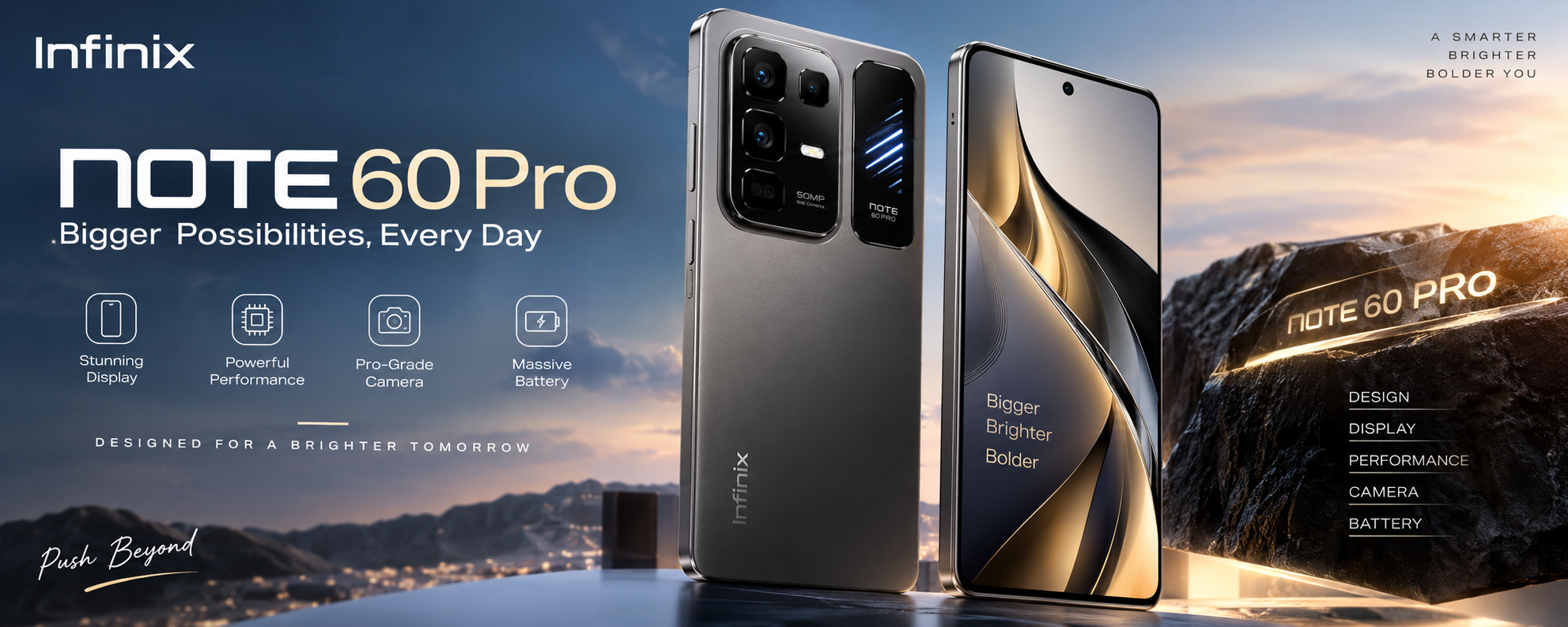
But specifications alone do not tell the whole story. What matters is how these features come together when you use the phone every day. Is the display actually useful? Can the processor handle gaming? Is the camera reliable at night? And does the large battery make a meaningful difference?
Let’s take a detailed look.
1. Infinix Note 60 Pro at a Glance
The Note 60 Pro is positioned as a feature-rich mid-range smartphone. Its hardware focuses heavily on three areas: screen quality, battery endurance, and everyday performance.
The official Infinix specifications list a 6.78-inch 1.5K AMOLED panel with a refresh rate reaching 144Hz. Under the hood, the phone uses Qualcomm’s Snapdragon 7s Gen 4 5G platform. It also includes a 6,500mAh battery and support for 90W wired charging.
Here are some of the major specifications:
- Display: 6.78-inch 1.5K AMOLED
- Refresh rate: Up to 144Hz
- Processor: Snapdragon 7s Gen 4 5G
- Rear camera: 50MP main camera with OIS + 8MP ultrawide
- Front camera: 13MP
- Battery: 6,500mAh
- Wired charging: Up to 90W
- Wireless charging: Up to 30W
- Software: Android 16 with XOS 16
- Connectivity: 5G, Wi-Fi 6, Bluetooth 5.4, NFC
- Protection: Gorilla Glass 7i and IP64-rated resistance
- Audio: JBL-tuned dual speakers
Infinix also advertises three major Android version upgrades for the device, giving it a longer software life than some previous budget-focused models.
2. Design and Build Quality
The first thing you notice about a phone is its physical design, and this is an area where Infinix has clearly tried to make the Note 60 Pro stand out.
The phone measures roughly 162.4 × 77.2 × 7.4mm and weighs around 201 grams. Despite carrying a large 6,500mAh battery, the body remains relatively slim.
That combination is impressive because a large battery can easily turn a phone into a bulky device.
Think of it like fitting a large water tank into a relatively compact car. You want more capacity without making the entire vehicle difficult to handle. The Note 60 Pro attempts something similar with its battery and slim body.
Premium materials also play an important role. Depending on the market and configuration, the phone features an aluminum frame and glass surfaces, with Gorilla Glass 7i protecting the front. It is also rated IP64 for protection against dust and water splashes.
Color choices include finishes such as Mist Titanium, Deep Ocean Blue, Solar Orange, Mocha Brown, Torino Black, and Frost Silver, although availability can vary by market.
Active Matrix Display
One of the phone’s most unusual design elements is the Active Matrix Display positioned around the rear camera area.
Rather than simply using the back for decoration, Infinix uses this area for visual notifications and customizable effects. It gives the phone a distinctive identity and makes it look different from many conventional smartphones.
For someone who likes a phone that looks different without relying entirely on an enormous camera module, this could be an appealing touch.
3. The 1.5K 144Hz AMOLED Display
The display is arguably one of the strongest parts of the Note 60 Pro.
The phone has a 6.78-inch AMOLED screen with a resolution of 1208 × 2644 pixels, which Infinix markets as a 1.5K display. It can operate at refresh rates of up to 144Hz.
Why does that matter?
The higher refresh rate delivers smoother scrolling, animations, and overall screen movement. You can notice the difference while scrolling through social media, moving between menus, browsing websites, and playing games.
Instead of feeling like a basic budget display, the screen is designed to provide a noticeably smoother experience.
The AMOLED panel also helps with contrast and colors. Deep blacks make movies and photographs look more immersive, while the high pixel density provides sharp text and detailed images.
Infinix lists support for a peak brightness level of up to 4,500 nits under specified conditions, with 1,600 nits HBM brightness. It also advertises 100% DCI-P3 color coverage, Ultra HDR support, and high-frequency PWM dimming.
Of course, peak brightness figures should not be confused with sustained everyday brightness. Real-world visibility depends on the environment and display mode.
A Screen Made for Entertainment
If you spend hours watching YouTube, Netflix, short videos, or browsing social platforms, the large AMOLED panel makes sense.
The combination of:
- Large screen size
- High resolution
- AMOLED technology
- 144Hz refresh rate
- HDR support
- Slim bezels
creates a strong multimedia experience.
The phone also supports JBL-tuned dual speakers and Hi-Res audio features, making it better suited to entertainment than a device with a basic single speaker.
4. Snapdragon 7s Gen 4 Performance
One of the biggest changes with this generation is the processor.
The Note 60 Pro uses the Qualcomm Snapdragon 7s Gen 4, a 4nm mobile platform with 5G connectivity. It represents Infinix’s move toward Qualcomm silicon in the Note series.
The processor combines performance-oriented Cortex-A720 cores with efficiency-focused Cortex-A520 cores, paired with an Adreno GPU.
What does that mean for ordinary users?
For everyday tasks, the phone should have plenty of power for:
- Social media
- Web browsing
- Video streaming
- Messaging
- Photography
- Navigation
- Office applications
- Multitasking
Opening applications and moving between tasks should feel substantially more comfortable than on entry-level hardware.
Gaming Performance
Gaming is another important part of the package.
The high refresh rate display and Snapdragon platform make the phone particularly interesting for mobile gaming. Infinix also promotes a 3D IceCore VC cooling system designed to help maintain performance during extended sessions.
However, expectations should remain realistic.
A mid-range Snapdragon platform is not automatically equivalent to a flagship processor. Demanding games may require reduced graphics settings if you want consistently high frame rates.
The good news is that the phone has the ingredients gamers generally want: a fast display, capable chipset, large battery, and thermal management.
5. Camera System and Photography
The camera setup takes a more practical approach than simply filling the back of the phone with sensors.
The primary camera is a 50MP sensor with optical image stabilization, while an 8MP ultrawide camera adds a wider perspective.
OIS is particularly useful because it physically helps compensate for small movements when taking photographs.
That can be helpful when:
- Shooting indoors
- Photographing at night
- Taking pictures of people
- Capturing handheld video
- Photographing in lower light
Daylight Photography
In good lighting, the main camera should be the sensor you rely on most.
Daylight gives the sensor plenty of information to work with, allowing the phone to produce detailed images with good exposure.
The ultrawide camera is useful when you need to fit more into a frame. For example, it can be helpful when photographing architecture, landscapes, groups, or large rooms.
However, as with most phones in this category, the primary camera is likely to offer the strongest overall image quality.
Night Photography
Low-light photography is more demanding because the camera receives less light.
This is where optical stabilization becomes useful. By reducing the effects of hand movement, the system can help produce sharper images when the shutter needs to remain open longer.
Infinix markets the camera system as a 50MP Night Master setup, emphasizing low-light photography.
Still, don’t expect every night photograph to look like it was taken with an expensive flagship. Computational processing, lighting conditions, and subject movement all affect the final result.
6. Battery Life and Fast Charging
If there is one specification that immediately stands out, it is the battery.
The Note 60 Pro carries a 6,500mAh battery, which is larger than what many mainstream smartphones offer.
For people who spend significant time away from a charger, this can be one of the phone’s biggest advantages.
Heavy users can benefit from the additional capacity, while lighter users may find that the phone can comfortably last through a full day and potentially longer depending on their usage.
90W Charging
A large battery is only half the story. Charging speed matters too.
The phone supports up to 90W wired charging, while Infinix also lists 30W wireless charging.
In practical terms, fast charging means you don’t necessarily have to leave the phone connected for hours.
A short charging session before leaving home can provide a meaningful boost.
The device also supports reverse charging features, allowing it to provide power to other compatible devices.
Battery Self-Healing Technology
Infinix also highlights battery self-healing technology as part of the phone’s endurance package.
The broader idea is simple: battery technology is not just about capacity. Long-term health, charging behavior, heat management, and software optimization also affect how a phone performs over time.
7. Software and Smart Features
The Note 60 Pro comes with Android 16 and XOS 16.
XOS adds Infinix’s own interface and software tools on top of Android.
For everyday users, the most important thing is not the name of the interface. It is whether the software feels intuitive.
You get familiar smartphone functions such as:
- App management
- Customization
- Privacy controls
- Multitasking
- Notifications
- Personalization
- AI-assisted features
Infinix is also emphasizing AI features as part of XOS 16. The company’s global information states that the device is designed around Infinix AI and receives three major Android version upgrades.
That software support is particularly important because buying a phone is no longer simply about how fast it feels on day one. A good smartphone should remain useful for years.
8. Connectivity and Everyday Features
The Note 60 Pro is designed to cover most modern connectivity requirements.
It supports 5G, Wi-Fi 6, Bluetooth 5.4, NFC, GPS, USB Type-C, and dual-SIM functionality. Some market listings also specify eSIM support.
This makes the phone versatile for people who use their smartphone as a central device for work, entertainment, communication, and travel.
The inclusion of NFC can be useful for supported contactless functions, while the infrared feature listed in some specifications can allow the phone to control compatible appliances.
The under-display fingerprint sensor also provides a convenient way to unlock the device.
These features may not sound exciting individually, but together they make a phone easier to live with.
9. Audio and Entertainment Experience
A smartphone with a beautiful display can still feel disappointing if its audio system is weak.
Fortunately, the Note 60 Pro includes dual speakers tuned by JBL, along with Hi-Res audio and wireless audio support.
This is particularly useful if you regularly watch videos without headphones.
For gaming, stereo audio can also help create a more immersive experience because sound is not coming from only one side of the device.
Music listeners may appreciate the additional audio support as well.
Again, the idea is that Infinix is treating the phone as an entertainment device rather than simply a communication tool.
10. Infinix Note 60 Pro Price and Value
Price is where the Note 60 Pro becomes particularly interesting.
Current Pakistani listings vary depending on the seller, configuration, and warranty. One current Infinix Pakistan listing places the device around Rs. 116,999–119,999, while WhatMobile lists Rs. 120,999.
Because smartphone prices can change quickly, buyers should verify the current price, storage configuration, and warranty before purchasing.
At this level, the phone competes in a crowded part of the market.
Its value comes from the combination rather than one specification alone:
You get a high-refresh-rate AMOLED display, a relatively powerful Snapdragon platform, a large battery, fast wired charging, wireless charging, OIS, 5G, stereo audio, and distinctive styling.
That is a compelling package.
However, buyers should also consider whether they prioritize camera quality, gaming, software updates, compact size, or brand reputation above raw specifications.
11. Pros and Cons of the Note 60 Pro
No smartphone is perfect, and the Note 60 Pro is no exception.
Pros
- Excellent 1.5K AMOLED display
- Up to 144Hz refresh rate
- Snapdragon 7s Gen 4 5G processor
- Large 6,500mAh battery
- 90W wired charging
- 30W wireless charging
- 50MP main camera with OIS
- JBL-tuned stereo speakers
- Distinctive Active Matrix rear display
- IP64 protection
- Modern connectivity
- Android 16 and XOS 16
Cons
- Around 200g, so it is not a lightweight phone
- Camera versatility is more limited than some camera-focused competitors
- Peak brightness figures do not represent typical sustained brightness
- Heavy gaming can still generate heat
- USB connectivity is not positioned as a flagship-level data solution
- Pricing varies significantly between sellers and markets
The important thing is to judge these weaknesses in context.
For example, a 200-gram phone may sound heavy on paper, but the weight partly comes from the unusually large battery.
12. Is the Infinix Note 60 Pro Worth Buying?
So, should you buy it?
For the right user, yes.
If your priorities are a large and smooth display, strong battery life, fast charging, respectable gaming performance, and plenty of everyday features, the Note 60 Pro makes a strong case for itself.
It is especially attractive for people who consume lots of video, play mobile games, browse social media, or simply want a phone that can last through a demanding day.
It is less compelling for someone whose number-one priority is having the best possible camera system in the price range.
The biggest strength of the phone is balance. Rather than concentrating everything on one feature, Infinix has created a device that tries to be good at many things.
And that may be its most important selling point.
Conclusion
The Infinix Note 60 Pro represents an ambitious step for Infinix’s mid-range smartphone lineup. Its 1.5K 144Hz AMOLED display, Snapdragon 7s Gen 4 processor, 6,500mAh battery, 90W charging, OIS camera, JBL audio, and Active Matrix design give it a feature list that looks considerably more expensive than a conventional budget phone.
It is not a perfect flagship replacement, and buyers should not expect flagship-level results in every category. But that is not really the point.
The phone is designed to deliver a premium-feeling everyday experience without pushing entirely into flagship pricing. If screen quality, battery endurance, fast charging, gaming, and overall versatility matter to you, it is certainly a smartphone worth considering.
Frequently Asked Questions
1. What processor does the Infinix Note 60 Pro use?
The phone uses Qualcomm’s Snapdragon 7s Gen 4 5G chipset. It is a 4nm platform designed to provide a balance between performance and efficiency.
2. How large is the Infinix Note 60 Pro battery?
The device has a 6,500mAh battery and supports up to 90W wired charging. It also supports up to 30W wireless charging according to Infinix’s specifications.
3. Does the Infinix Note 60 Pro have a 144Hz display?
Yes. It features a 6.78-inch 1.5K AMOLED display with a refresh rate that can reach 144Hz.
4. How good is the Infinix Note 60 Pro camera?
The primary rear camera is a 50MP sensor with OIS, accompanied by an 8MP ultrawide camera. OIS can help improve stability, particularly for handheld photography in challenging lighting.
5. What is the Infinix Note 60 Pro price in Pakistan?
Current listings vary. Infinix Pakistan currently lists the phone around Rs. 116,999–119,999, while another current Pakistani listing gives Rs. 120,999. Prices can change based on the seller, configuration, and warranty, so checking the latest official or authorized price before buying is recommended.