
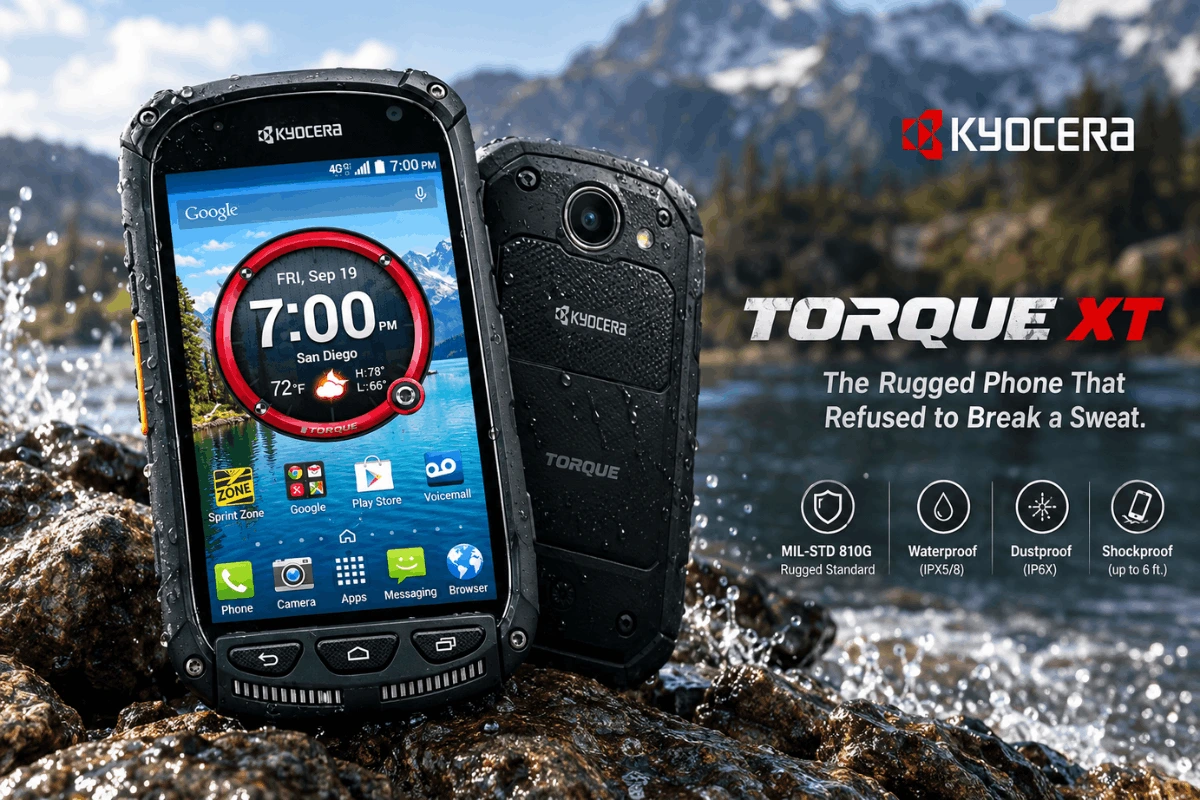
Some phones try to impress you with glass and glamour. The Kyocera Torque XT tried something different: it tried to survive you. Dropped it? Fine. Got caught in the rain? Also fine. This was never a phone built for Instagram photos. It was built for people who actually use their phones like tools, not accessories.
Launched by Sprint on October 17, 2014, the Torque XT wasn’t chasing flagship glory. It entered the market with military-grade credentials, engineered to resist water, dust, shock, vibration, temperature swings, and humidity. In an era obsessed with thin bezels, this phone proudly wore its bulk like armor.
Kyocera Torque XT: Built Like a Tank (Almost Literally)
Let’s start with what made the Torque XT different from every soap-bar smartphone on the shelf.
The device carried IP67 water and dust resistance, backed by MIL-STD-810 certification, the same durability standard the U.S. military uses to test equipment. That’s not marketing fluff. That’s a real benchmark.
Its predecessor, the original Kyocera Torque, could withstand water up to a meter deep for 30 minutes and still operate in temperatures ranging from -4°F to 122°F. The Torque XT inherited that same rugged DNA, wrapped in an updated body.
Weighing about 5.94 ounces (168.5 grams) and measuring 128.5 x 68.4 x 12.9 mm, this was never going to slip unnoticed into skinny jeans. It had presence, the kind that construction workers, delivery drivers, and outdoor enthusiasts actually appreciated.
“Watch the Kyocera Torque XT in action as it takes on real-world drops, dust, and water to see how tough this rugged phone really is.”
Kyocera Torque XT Specifications at a Glance
| Feature | Details |
|---|---|
| Release Date | October 17, 2014 |
| Carrier | Sprint |
| Display | 4.0″ IPS LCD, 480 x 800 px, ~233 PPI |
| Chipset | Qualcomm Snapdragon S4 Plus MSM8960 |
| Processor | Dual-core 1.2 GHz Krait |
| GPU | Adreno 225 |
| RAM | 1 GB |
| Storage | 4 GB internal (no microSD slot) |
| Rear Camera | 5 MP, autofocus, LED flash |
| Front Camera | 1.3 MP |
| Battery | 2500 mAh, Li-Ion |
| OS | Android 4.4.2 KitKat |
| Connectivity | Wi-Fi b/g/n, Bluetooth 4.0, NFC, GPS/A-GPS |
| Durability | IP67, MIL-STD-810 certified |
| Weight | 168.5 g |
| Dimensions | 128.5 x 68.4 x 12.9 mm |
| Colors | Black only |
This table alone tells you everything about the Torque XT’s philosophy: modest specs, maximum toughness.
Display and Design: Function Over Fashion
By today’s standards, an 800×480 display sounds modest. By 2014 rugged-phone standards, it was perfectly reasonable, and it got the job done for texting, calls, and basic browsing.
Here’s the funny part: rugged phones rarely win beauty contests, and the Torque XT wasn’t pretending otherwise. It came in a single color, black, because when your phone might survive a construction site fall, “rose gold” isn’t really the priority.
Kyocera Torque XT Performance: What’s Under the Hood
Don’t expect flagship muscle here. The Kyocera Torque XT ran on a Qualcomm Snapdragon S4 Plus MSM8960 chipset, paired with a dual-core 1.2 GHz Krait processor and an Adreno 225 GPU.
It shipped with 1GB of RAM and 4GB of internal storage, which even in 2014 felt tight. According to Sprint’s own support documentation, the Torque XT did not actually include a functional microSD card slot. A spacer sat in its place instead, so buyers hoping to expand storage later were often surprised.
The phone ran Android 4.4.2 KitKat out of the box, solid for its time, though obviously dated by current software standards.
Kyocera Torque XT Camera: Simple, Not Spectacular
A 5MP autofocus rear camera with LED flash handled photography duties, alongside a 1.3MP front-facing camera for the occasional selfie or video call. Reviewers noted the camera setup as functional rather than flashy. This was never a phone marketed toward photography enthusiasts.
Think of it this way: if you needed to document a job site issue or snap proof of delivery, the Torque XT camera handled it. If you wanted magazine-cover shots, you looked elsewhere.
Battery Life That Matched the Lifestyle
A 2500 mAh Li-Ion battery powered the device, which paired well with the modest processor and smaller display. Rugged-phone users typically prioritize reliability over raw capacity, and the Torque XT delivered steady, dependable performance without needing constant charging breaks.
The Feature That Actually Stood Out: Smart Sonic Receiver
Here’s where Kyocera got genuinely clever. The original Kyocera Torque was the first phone in the U.S. to feature Kyocera’s Smart Sonic Receiver, a bone-conduction technology designed to deliver clearer sound in noisy environments, and the Torque XT carried the same feature forward.
Instead of relying purely on a traditional speaker, this tech transmitted sound vibrations through the cheekbone. Translation: if you were standing near a jackhammer, a construction site, or a loud factory floor, you could still hear your call clearly. That’s not a gimmick. That’s smart engineering aimed at real-world noise problems.
Connectivity and Everyday Usability
The Torque XT supported NFC, Bluetooth 4.0, Wi-Fi 802.11 b/g/n, and GPS with A-GPS assistance. It also offered compatibility with Sprint’s Direct Connect walkie-talkie service, a nod toward workplace and team communication.
Downloads could reach speeds up to 100 Mbps depending on the carrier network, which was respectable performance for a mid-range device of that era.
Who Was the Kyocera Torque XT Really For?
Let’s be honest, this was never a phone for everyone, and that was the entire point.
It made sense for outdoor workers who needed a phone that survives drops, dust, and rain, construction and industrial teams needing clear calls in loud environments, Sprint customers wanting Direct Connect walkie-talkie functionality, and budget-conscious buyers who prioritized durability over premium specs.
On the other hand, it probably wasn’t the right pick for mobile photographers or content creators, gamers needing high-end processing power, or anyone prioritizing sleek, lightweight design.
Where to Find a Kyocera Torque XT Today
Since Sprint discontinued this device years ago and it no longer ships new from official retailers, anyone wanting one now needs to look at the secondhand market. eBay remains the most common source for used or refurbished units, while Swappa offers a marketplace focused specifically on used phones, often with better quality control than general auction sites. Local classifieds or phone repair shops sometimes carry old carrier stock or trade-ins as well, making them worth checking for anyone nearby.
Keep in mind that since this device runs Android 4.4.2, it won’t support most modern apps, security updates, or current Play Store requirements. It’s best suited today for collectors, backup devices, or very specific rugged-use cases rather than daily smartphone use.
FAQ
1:Is the Kyocera Torque XT waterproof?
It’s water-resistant, not fully waterproof. It carries an IP67 rating, meaning it can survive submersion in water up to 1 meter deep for around 30 minutes.
2:Does the Kyocera Torque XT support 4G LTE?
Yes, it supported LTE connectivity through Sprint’s network at the time of release.
3:Can you expand storage with a microSD card?
No. Despite early confusion, Sprint confirmed the Torque XT does not include a functional microSD slot. A spacer occupies that space instead.
4:What Android version does the Kyocera Torque XT run?
It ships with Android 4.4.2 KitKat, which is no longer supported with security updates.
5:Is the Kyocera Torque XT still worth buying today?
Only for very specific use cases: as a rugged backup device, a collector’s item, or a basic-use phone. It’s not recommended as a primary smartphone due to outdated software.
Final Verdict
The Kyocera Torque XT never tried to be a flagship, and that honesty is exactly what made it likeable. It offered genuine military-grade durability, a clever bone-conduction speaker feature, and dependable battery performance, all wrapped in a phone that didn’t care if you dropped it in a puddle.
It wasn’t fast. It wasn’t fancy. But if your job or lifestyle demanded a phone that survives real-world abuse, the Torque XT quietly did its job: no drama, no cracked screens, just steady reliability.