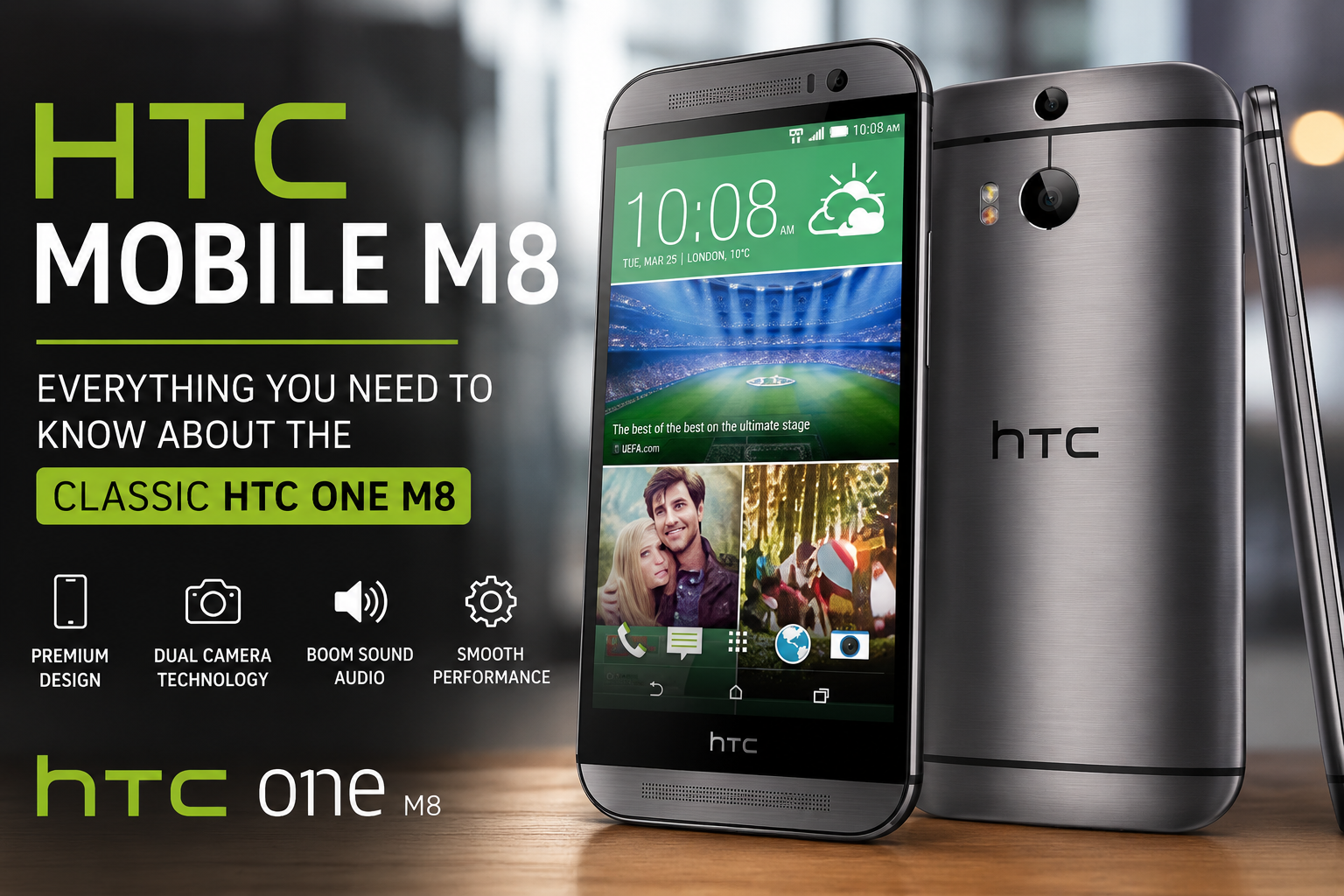
The HTC One M8, often searched simply as “HTC mobile M8,” was one of the most recognizable Android smartphones of its generation. Released in 2014, it arrived at a time when smartphone makers were competing heavily on screen quality, processing power, cameras, and design. HTC took a slightly different approach: instead of focusing only on specifications, it put a huge emphasis on premium construction, audio, software, and a distinctive camera system.
The result was a phone that still attracts attention from technology enthusiasts and people looking for an affordable older handset. But what made the M8 special, and does it still make sense to consider one today?
1. HTC One M8 Design: A Phone That Still Looks Premium
Design was arguably one of the strongest parts of the HTC One M8.
At launch, HTC positioned the device as a carefully crafted flagship, using a high-quality metal unibody surrounding a 5-inch Full HD display. HTC said approximately 90% of the phone’s body was metal, an increase from the previous-generation HTC One.
A distinctive aluminum body
The curved aluminum back gave the phone a premium appearance that separated it from many plastic Android smartphones of the period.
The device measured approximately 146.36 × 70.6 × 9.35 mm and weighed 160 grams.
The rounded back also helped the phone sit naturally in the palm.
Imagine holding a small piece of carefully machined metal rather than a lightweight plastic gadget. That was part of the appeal of the M8.
Reviews from the time frequently praised its build quality. WIRED, for example, highlighted the metallic construction, curved shape, and comfortable feel in the hand.
A few design compromises
The polished metal finish looked attractive, but it could also feel slippery. The larger body and curved edges made the phone comfortable for some users while making one-handed operation more challenging for others.
The display bezels were also noticeably larger by today’s standards.
That is not surprising. Smartphone designs have changed dramatically since 2014, and modern phones generally provide much more screen area within a similar physical footprint.
Still, if you appreciate classic smartphone design, the M8 has a character that many newer devices lack.
2. Display Quality: Full HD Entertainment in Its Era
The HTC One M8 featured a 5-inch Full HD display with a resolution of 1920 × 1080 pixels. Contemporary specifications and reviews identified it as a Super LCD 3 panel.
Sharp images and comfortable viewing
For 2014, a 1080p screen on a 5-inch phone was considered a strong combination.
Text looked sharp, photographs appeared detailed, and Full HD video could be enjoyed at its native resolution.
Today, you can find phones with larger screens and much higher refresh rates, but the M8’s display remains perfectly understandable when viewed in its historical context.
The important thing is to judge the phone according to what it was designed to deliver rather than comparing it directly with a 2026 flagship.
Good for everyday media
The screen was well suited to:
- Watching videos
- Browsing websites
- Reading messages
- Viewing photographs
- Playing games
- Using social media
The 5-inch size also made the device more compact than many current large-screen smartphones.
For someone who prefers a smaller handset, that can still be appealing.
3. Performance and Hardware: Flagship Power for 2014
Under the hood, the HTC One M8 was equipped with hardware that was considered high-end when it launched.
The phone used Qualcomm’s Snapdragon 801 processor with a quad-core CPU and 2GB of RAM. HTC’s specifications list the Snapdragon 801 and 2GB memory, while contemporary reviews reported clock speeds around 2.3GHz depending on the model or region.
Smooth performance at launch
For its time, the hardware was more than capable of handling everyday applications.
Users could browse the web, send messages, stream media, use social networks, and play games without the phone feeling underpowered.
Contemporary reviews generally praised its speed. WIRED described the processor as powerful, while other reviewers also recognized the M8 as a fast flagship device for its generation.
Why performance feels different today
The situation is very different now.
Modern applications are more demanding, operating systems have evolved, and security requirements have changed. As a result, an M8 that felt extremely fast in 2014 will naturally feel much slower beside a current smartphone.
This is an important distinction for anyone considering purchasing one today.
The M8 can still handle basic tasks, but it should not be treated as a modern performance phone.
It is better viewed as an older Android device with historical appeal.
4. Storage and microSD Expansion
Storage was another useful feature of the HTC One M8.
Depending on the version, the phone came with 16GB or 32GB of internal storage, and HTC included a microSD card slot supporting cards of up to 128GB.
Why expandable storage mattered
In 2014, smartphone storage was relatively limited compared with today’s devices.
People stored photographs, music, videos, and applications directly on their phones, so expandable memory could be extremely useful.
A microSD card allowed users to increase available storage without replacing the phone.
For people who wanted to carry large collections of photographs or music, this was a practical advantage.
An advantage for media users
The M8 was particularly suited to users who liked keeping files locally.
You could store:
- Music
- Photos
- Videos
- Documents
- Offline maps
- Some applications
This feature also gave the phone additional flexibility compared with devices that relied entirely on fixed internal storage.
5. HTC UltraPixel Camera: A Different Approach
The camera is probably the most controversial part of the HTC One M8.
Instead of following the megapixel race, HTC continued its UltraPixel approach.
The main camera used a 4MP sensor with large 2.0-micrometer pixels, an f/2.0 lens, and a 28mm-equivalent focal length.
Why only 4MP?
At first, 4MP might sound extremely low.
But HTC’s philosophy was different.
Rather than putting millions of smaller pixels onto a sensor, the company used fewer, larger pixels designed to capture more light.
It was a bit like choosing a few large windows instead of many tiny windows. The idea was to let more light into the room.
This approach could work reasonably well in certain lighting conditions, especially when photographs were viewed at normal sizes.
The problem with detail
The low resolution also had disadvantages.
When compared with phones offering higher-resolution cameras, the M8 could produce less fine detail, particularly in bright conditions where rival cameras could capture more information.
DPReview and other contemporary reviewers noted that the camera’s imaging capabilities were interesting, but image quality did not consistently match the best competing smartphones of the time.
So while the UltraPixel concept was innovative, it was not a universal solution.
6. Duo Camera and Depth Effects
The M8 introduced another unusual feature: a second rear camera sensor.
However, this secondary sensor was not designed to capture a conventional second photograph.
Instead, it captured depth information that the software could use to create effects.
Changing focus after taking a photograph
One of the most talked-about features was HTC’s UFocus.
It allowed users to apply a shallow-depth-of-field effect after taking a photograph.
The idea was simple: take the picture first, then use the depth information to alter the appearance of the background.
HTC also introduced effects such as Foregrounder and Seasons, which used depth information to create additional visual effects.
This was an early example of computational photography becoming a bigger part of smartphone cameras.
An interesting idea with limitations
The concept was creative, but it was not perfect.
Because the effect depended on software interpreting depth information, complicated subjects could sometimes produce unnatural results.
The second sensor also did not improve basic image resolution.
In other words, the Duo Camera was innovative, but it did not automatically make every photograph better.
7. Front Camera and Video Capabilities
The HTC One M8 included a 5MP front-facing camera with a wide-angle lens and HDR support. It could also record 1080p video.
Designed for selfies and calls
In 2014, a 5MP front camera was a respectable feature.
It was useful for:
- Selfies
- Video calls
- Social media
- Portrait photographs
- Casual video recording
The wide-angle design could also help fit more people into a selfie.
Of course, modern smartphone cameras have moved far beyond these specifications.
Today’s devices commonly offer more advanced image processing, higher-resolution sensors, autofocus systems, and computational tools.
Nevertheless, the M8’s front camera was part of a broader attempt by HTC to make the device suitable for social and personal photography.
8. BoomSound Speakers: One of the M8’s Biggest Strengths
If there is one area where the HTC One M8 remains particularly memorable, it is audio.
The phone featured front-facing stereo BoomSound speakers positioned above and below the display.
HTC promoted BoomSound heavily as a major part of the phone’s entertainment experience.
Why front-facing speakers mattered
Think about how most phones are designed today.
Speakers are often positioned along the bottom or hidden behind small openings.
The M8 took a different approach.
By placing its stereo speakers on the front, HTC directed sound toward the user.
This could make watching videos and playing games more enjoyable.
Contemporary reviewers frequently praised the M8’s speakers. Ars Technica called them among the best smartphone speakers available at the time, while other reviews similarly highlighted the audio experience.
A great choice for media
If you enjoy watching videos without headphones, the M8’s speaker design was a genuine advantage.
Music, movies, podcasts, and games all benefited from the stronger front-facing audio presentation.
This remains one of the reasons the M8 is remembered fondly by longtime Android users.
9. Battery Life and Charging
The HTC One M8 included a 2,600mAh non-removable battery.
For a 2014 smartphone, this was a reasonable capacity.
Everyday endurance
Contemporary testing generally found the battery capable of getting through a normal day, although actual results depended on usage.
Activities such as:
- Gaming
- Video streaming
- Mobile data
- GPS
- High screen brightness
- Camera use
could naturally reduce battery life.
DPReview reported that the 2,600mAh battery provided enough power to get through the day under typical use.
The battery problem today
If you are buying a used M8 now, battery health is much more important than the original capacity.
Lithium-ion batteries naturally lose capacity over years of use.
A second-hand device may therefore have significantly less endurance than it did when new.
This is one of the biggest things to check before buying an old M8.
If the battery drains rapidly, shuts down unexpectedly, or becomes unusually warm, replacement may be necessary.
10. HTC Sense and Software Experience
The M8 launched with Android 4.4 KitKat and HTC Sense 6.
HTC Sense was the company’s customized Android interface.
A more personalized Android experience
Sense added its own visual design, applications, widgets, settings, and features.
HTC described Sense 6 as a cleaner and more customizable interface, with color themes and other personalization options.
One of the most recognizable features was BlinkFeed, which provided a stream of news and social content directly on the home screen.
The interface helped give HTC phones a distinctive identity rather than making them look like generic Android devices.
Software limitations today
This is where the age of the M8 becomes very obvious.
The original software is now extremely old.
Modern applications may no longer support the phone properly, and security updates are no longer comparable to those available on current smartphones.
For this reason, using an M8 as a primary phone in 2026 requires caution.
It can be interesting as a secondary device or nostalgia piece, but it is difficult to recommend as a main smartphone for modern banking, sensitive accounts, or demanding applications.
11. Connectivity and Everyday Features
For its era, the HTC One M8 offered a strong selection of connectivity features.
Specifications included Wi-Fi, Bluetooth 4.0, NFC, GPS-related positioning support, and 4G LTE on compatible variants.
4G connectivity
The M8 was designed during the transition toward widespread 4G LTE adoption.
That meant users could access much faster mobile data than older 3G devices where supported networks were available.
However, network compatibility differed between carrier versions.
This is especially important when purchasing a used M8 today.
A phone designed for one market may not support every LTE band used by your local carrier.
Sensors and useful hardware
The M8 also included several sensors, including an accelerometer, proximity sensor, ambient light sensor, gyroscope, and barometer.
These sensors supported everyday functions such as screen rotation, automatic brightness, motion detection, and location-related applications.
For 2014, this was a well-equipped flagship.
12. Is the HTC One M8 Still Worth Buying?
Now we reach the most important question.
Should you actually buy an HTC One M8 today?
The answer depends heavily on your reason for buying it.
For collectors and HTC fans
The M8 can be an interesting piece of smartphone history.
Its aluminum construction, distinctive camera system, BoomSound speakers, and HTC Sense interface represent an important period in Android development.
For collectors, that makes it more interesting than a random old smartphone.
For basic secondary use
An M8 may still be useful for simple tasks if you find one in good condition.
You might use it as:
- A music player
- A media device
- A backup phone
- A Wi-Fi-only device
- A retro Android handset
- A photography experiment
But expectations should remain realistic.
For a primary smartphone
This is where the M8 becomes difficult to recommend.
The hardware is old, the battery in used units may be degraded, the software is outdated, and modern applications may not work properly.
Security is another major concern.
If you rely on your smartphone for banking, work accounts, two-factor authentication, or other sensitive services, a modern device with current security support is a much safer choice.
Conclusion
The HTC One M8 was an important smartphone for HTC and for the wider Android market.
Its aluminum body, curved design, front-facing BoomSound speakers, Full HD display, Snapdragon 801 processor, expandable storage, and unusual Duo Camera made it stand out when it launched in 2014.
Its biggest strengths were not necessarily about having the highest numbers. Instead, HTC focused on creating a phone with personality.
The camera experiment was ambitious, although the 4MP main sensor had clear limitations. The metal construction and speakers, however, were genuine highlights, and contemporary reviewers repeatedly praised those aspects.
Today, the M8 is best appreciated as a classic Android phone rather than a modern smartphone. If you are buying one for nostalgia, collecting, experimentation, or basic secondary use, it can still be interesting.
But if you need a dependable primary phone in 2026, newer hardware and current software support make far more sense.
Frequently Asked Questions
1. What is the HTC One M8?
The HTC One M8 is a flagship Android smartphone released by HTC in 2014. It featured a 5-inch Full HD display, Snapdragon 801 processor, 2GB of RAM, a metal body, BoomSound stereo speakers, and HTC’s Duo Camera system.
2. How many megapixels does the HTC One M8 camera have?
The main rear camera uses a 4MP UltraPixel sensor with 2.0-micrometer pixels, while the front-facing camera is 5MP. The secondary rear sensor captures depth information rather than functioning as a conventional second camera.
3. Does the HTC One M8 have expandable storage?
Yes. The HTC One M8 includes a microSD card slot, with HTC’s specifications supporting cards of up to 128GB in addition to the phone’s internal storage.
4. Is the HTC One M8 still good in 2026?
It can still be interesting as a secondary or collector’s device, but it is outdated as a primary smartphone. Its old hardware, aging batteries, and obsolete software make modern phones a much better choice for everyday use.
5. Was the HTC One M8 good for music and videos?