The smartphone world moves quickly. A phone that once represented affordable modern technology can look very different when compared with today’s devices. The HTC Desire 510 is a good example. Released in 2014, it was designed as an affordable smartphone that brought 4G LTE connectivity and a 64-bit processor to a more accessible price range.
At the time, HTC positioned the device as an affordable way to experience faster mobile internet, while also offering a compact design, Android software, expandable storage, and a removable battery. HTC officially announced the Desire 510 in August 2014, highlighting its 4G connectivity, 4.7-inch display, and focus on affordable performance.
But what made the HTC 510 phone interesting, and does it still make sense today?
The answer depends on what you expect from an older smartphone. It obviously cannot compete with modern flagship devices in display quality, camera technology, processing power, or software support. However, it remains an interesting piece of HTC’s smartphone history and can still appeal to collectors, technology enthusiasts, or people looking for a simple secondary handset.
Let’s take a closer look at what the HTC Desire 510 offered and where it stood out.
1. What Is the HTC Desire 510?
An affordable 4G smartphone from HTC
The HTC Desire 510 was introduced as a budget-friendly member of HTC’s Desire family. Rather than competing directly with premium phones such as HTC’s flagship One series, it focused on providing useful features at a lower cost.
One of its biggest selling points was 4G LTE connectivity. In 2014, fast mobile internet was becoming increasingly important, but LTE phones were still relatively expensive in many markets. HTC wanted to make the technology more accessible.
The company described the device as a compact smartphone with a 4.7-inch display and 4G capability, designed for browsing, streaming, downloading applications, and staying connected while away from Wi-Fi.
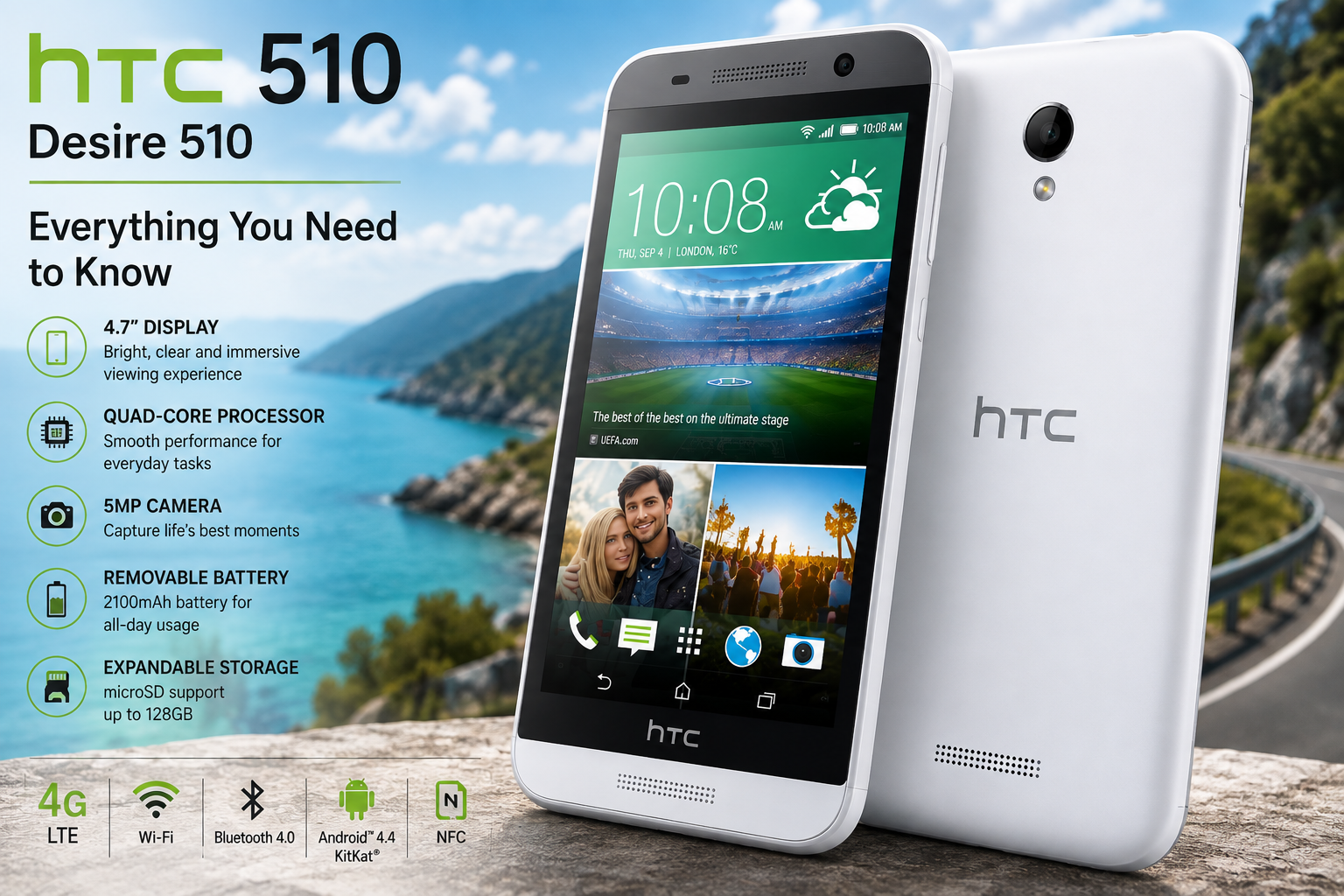
The hardware included a Qualcomm Snapdragon 410 quad-core processor, 1GB of RAM, 8GB of internal storage, a microSD card slot, and a 2,100mAh removable battery. Qualcomm’s launch material also confirmed Android 4.4 KitKat and a 5MP rear camera capable of 1080p video recording.
In simple terms, the Desire 510 was built around a straightforward idea: provide the essential smartphone experience while keeping the price relatively low.
2. Design and Build Quality
Compact by today’s standards
One of the first things that stands out about the HTC Desire 510 is its size.
The phone measures approximately 139.9 × 69.8 × 10mm and weighs around 158 grams.
That may not sound particularly small today, but smartphone design has changed dramatically. Modern phones commonly feature much larger displays and thinner bodies, whereas a 4.7-inch screen was considered a comfortable size in 2014.
The Desire 510 used a plastic body rather than the premium metal construction found on some higher-end HTC models.
That does not necessarily mean it felt cheap.
HTC was known for paying attention to the physical design of its phones, and contemporary reviews generally considered the Desire 510 reasonably well built. PhoneArena described the phone as solidly constructed and comfortable to use.
The compact shape also made one-handed use relatively easy.
Think about the difference between carrying a small notebook and a large tablet. Both can display information, but the smaller device is easier to hold and carry. The same idea applied to smartphones of this era.
Physical controls
The phone included a power button and 3.5mm headphone jack on the top, while the microUSB port was positioned along the bottom.
That combination will look familiar to anyone who remembers smartphones from the early 2010s.
Today, headphone jacks and removable batteries have become much less common, which makes devices like the Desire 510 interesting from a historical perspective.
3. The 4.7-Inch Display
Compact, but clearly a budget panel
The HTC Desire 510 featured a 4.7-inch touchscreen with a resolution of 854 × 480 pixels. That worked out to approximately 208 pixels per inch.
When the phone launched, this resolution was acceptable for an inexpensive device, but it was also one of its clearest compromises.
Contemporary reviews criticized the screen for its low resolution, limited viewing angles, and relatively weak color presentation. PhoneArena described the display as one of the phone’s biggest weaknesses, while TechRadar also noted that the screen was not particularly impressive.
That criticism makes sense when viewed through a modern lens.
Today’s smartphones commonly offer Full HD or higher resolutions, while OLED and AMOLED panels are widespread. Modern displays can provide sharper text, stronger contrast, richer colors, and better viewing angles.
The Desire 510 simply belongs to another era.
Was the display usable?
Yes.
For basic activities such as messaging, calling, browsing, reading short articles, and using simple applications, the screen was functional.
However, watching high-quality videos or viewing detailed photographs was not the phone’s strongest area.
If you are buying an HTC 510 phone today, the display should therefore be considered one of its limitations rather than one of its attractions.
4. Snapdragon 410 Performance
A processor that mattered in 2014
The Desire 510 was powered by Qualcomm’s Snapdragon 410 processor.
The chip featured four Cortex-A53 CPU cores running at up to 1.2GHz and an Adreno 306 GPU. It also supported 64-bit processing.
This was significant because the Desire 510 was among the early Android smartphones to bring a 64-bit mobile processor to consumers.
At the time, the move toward 64-bit smartphone processors was an important development. Qualcomm specifically highlighted the Snapdragon 410’s support for both 32-bit and 64-bit processing.
For everyday tasks in 2014, the processor was reasonably capable.
Users could browse the web, switch between applications, stream media, use social networks, and play lightweight games.
PhoneArena’s testing found the device surprisingly responsive for an entry-level smartphone, while Notebookcheck also described its overall performance as good for its class.
How does it compare today?
This is where expectations need to be realistic.
Modern entry-level phones are dramatically faster than the Desire 510. Current applications are also more demanding than the software available in 2014.
As a result, an HTC 510 phone may feel slow when running modern websites and applications.
The Snapdragon 410 is therefore best understood as historically interesting rather than powerful by today’s standards.
5. RAM and Storage
Limited by modern standards
The Desire 510 came with 1GB of RAM and 8GB of internal storage.
Eight gigabytes may sound extremely small today, but smartphone applications were considerably smaller in the device’s launch era.
Even then, however, storage was one of the phone’s limitations.
The good news was that HTC included a microSD card slot. Contemporary specifications indicate support for expandable storage, with some references listing capacities of up to 128GB.
That gave users an affordable way to store additional photographs, music, videos, and other files.
The removable storage option was particularly useful because the internal storage could fill quickly.
Why does 1GB of RAM matter?
RAM allows a smartphone to keep applications and processes available for quick access.
With only 1GB, multitasking was naturally limited.
You could use several applications, but switching between many demanding apps could cause slower performance or reloads.
Again, that was fairly normal for an affordable 2014 smartphone.
Today, however, most users would find 1GB extremely restrictive.
6. 4G LTE Connectivity
The feature that helped define the phone
If there was one area where the Desire 510 had a particularly strong selling point, it was connectivity.
HTC marketed the device around 4G LTE, presenting it as an affordable way to access faster mobile data.
This was important because LTE networks were expanding rapidly during the period.
Faster mobile data meant users could:
- Load websites more quickly
- Stream music more comfortably
- Download applications faster
- Watch online video
- Use social media away from Wi-Fi
- Share files more conveniently
HTC’s official announcement specifically emphasized fast downloading, streaming, and web browsing over 4G.
PhoneArena’s testing also found the device capable of strong 4G performance for its class, with a theoretical download rate of up to 42.2Mbps under the supported configuration.
Of course, 4G performance depended heavily on the carrier, network bands, location, and signal quality.
Is 4G still useful?
In some places, yes.
However, network compatibility should be checked carefully before buying an old Desire 510 today.
Different carrier versions supported different LTE bands, and some networks have changed or retired older technologies over time.
That means an old phone that worked perfectly on one network years ago may not work the same way today.
7. Camera Performance
A basic camera for basic photography
The HTC Desire 510 included a 5MP rear camera and a VGA front camera. Qualcomm’s specifications confirmed the 5MP main camera and 1080p video recording capability.
At the time, a 5MP camera was common on inexpensive phones.
But photography was not one of the Desire 510’s strongest areas.
Contemporary reviews were particularly critical of image quality. PhoneArena described the camera as disappointing, pointing to weak exposure, washed-out images, and limited detail.
That does not mean the camera was useless.
It could still capture:
- Quick snapshots
- Simple documents
- Basic outdoor photographs
- Casual pictures
- Short videos
However, users interested in photography would have found better alternatives even in the same general price range.
The camera app was better than the camera hardware
Interestingly, PhoneArena praised HTC’s camera application for being quick, stylish, and easy to use even though it criticized the actual image quality.
This highlights an important lesson about smartphone cameras.
A good camera experience requires both hardware and software.
A powerful camera sensor cannot automatically produce excellent photographs, and a well-designed application cannot completely overcome weak hardware.
8. Battery Life and Removable Battery
One of its more practical advantages
The Desire 510 included a 2,100mAh removable battery.
By today’s standards, that capacity sounds small.
But the phone’s modest display resolution and relatively low-power hardware meant that it could deliver respectable battery life for its era.
PhoneArena recorded approximately 6 hours and 59 minutes of screen-on time in its battery test, while TechRadar also praised the phone’s battery performance during everyday use.
Notebookcheck recorded around 9 hours and 30 minutes in its Wi-Fi browsing test, although results naturally varied according to the testing method.
The removable battery was a major advantage
Perhaps more interesting today is the fact that the battery could be removed.
Modern smartphones generally use sealed batteries.
With the Desire 510, a user could remove the battery and replace it if necessary.
That was particularly useful for people who traveled frequently or wanted to carry a spare battery.
Imagine having a second fuel tank ready to go when your first one runs empty. That was essentially the convenience removable batteries provided.
The downside was charging speed. PhoneArena recorded a full charging time of approximately three and a half hours in its testing.
Fast charging as we know it today was not yet a standard feature.
9. Android 4.4 KitKat and HTC Sense
The software experience was part of HTC’s identity
The Desire 510 launched with Android 4.4 KitKat and HTC’s Sense interface.
HTC Sense was one of the company’s most recognizable software features.
Rather than offering completely stock Android, HTC customized the interface with its own visual design, applications, widgets, and features.
One of the notable additions was HTC BlinkFeed.
BlinkFeed displayed news and social updates directly on the phone’s home screen. HTC said it integrated information from more than 1,000 media partners along with social feeds such as Facebook and Twitter.
For users in 2014, this could make the home screen feel more dynamic.
Instead of opening multiple applications to check news or social updates, users could see selected information in one location.
Software limitations today
This is one of the biggest reasons the Desire 510 is no longer suitable as a primary modern smartphone.
Android 4.4 is extremely old.
Many current applications require newer Android versions, modern security features, or updated services.
Security support is another concern.
An old smartphone that no longer receives current security updates should not be trusted with sensitive activities such as banking or handling important private information.
For modern use, the software age is a much bigger limitation than the processor itself.
10. Audio and Headphone Experience
A familiar setup for smartphone users
The HTC Desire 510 included a traditional 3.5mm headphone jack.
For anyone who still prefers wired headphones, this is convenient.
There is no need for a USB adapter or wireless connection.
The phone also supported standard Bluetooth connectivity for compatible wireless accessories.
Its audio capabilities were designed around the expectations of an affordable smartphone from 2014.
You could listen to music, watch videos, play games, and make calls.
However, users should not expect the audio experience of a modern premium phone with advanced stereo speakers and sophisticated audio processing.
Again, the device needs to be judged within its original context.
11. Connectivity and Other Features
Surprisingly complete for an affordable phone
Although inexpensive, the Desire 510 included many of the connectivity features people expected from a smartphone.
Depending on the version and market, specifications included:
- 4G LTE
- 3G
- Wi-Fi
- Bluetooth 4.0
- GPS
- GLONASS
- microUSB
- 3.5mm headphone jack
- NFC
- MicroSD expansion
The inclusion of NFC was particularly interesting for a budget handset of its time.
GPS and GLONASS support also made the phone useful for navigation and location-based applications.
The device included an accelerometer and proximity sensor as well.
These features may seem ordinary now, but they contributed to making the phone a reasonably complete smartphone package in its original market.
12. Calling and Everyday Communication
A phone that focused on the basics
At its core, the Desire 510 was still a phone.
Making calls, sending messages, browsing the internet, and staying connected were central to its purpose.
PhoneArena found call quality generally acceptable, although it noted that the earpiece was somewhat quiet and the microphone could sound slightly hollow.
The device also included noise cancellation through a dedicated microphone, which could help reduce background noise during calls.
For users in busy environments, that was a useful feature.
The phone was therefore not simply designed for entertainment. It was built to serve as a practical communication device.
13. Gaming and Multimedia
Capable for its time
The Snapdragon 410 and Adreno 306 GPU were designed to support basic gaming and multimedia applications.
Contemporary reviews found the phone capable of handling many everyday tasks and some games reasonably well for an entry-level device. Notebookcheck described its gaming performance as decent, while PhoneArena noted that the device was surprisingly speedy for its class.
Of course, modern games are much more demanding.
A current 3D game designed for modern Android hardware may not install, run correctly, or perform well on Android 4.4.
The phone is therefore best suited to older games and lightweight applications if you are using one today.
For its original audience, however, the combination of a quad-core processor, 4G connectivity, and expandable storage made it a reasonable multimedia device.
14. Strengths of the HTC Desire 510
What did the phone do well?
Despite its limitations, the Desire 510 had several strengths.
Affordable 4G
The biggest advantage was LTE connectivity at a relatively accessible price. HTC specifically marketed it as a way to make 4G more widely available.
Good performance for its class
The Snapdragon 410 provided respectable performance for an entry-level 2014 smartphone.
Removable battery
The removable 2,100mAh battery gave users flexibility that modern phones rarely provide.
Expandable storage
The microSD slot helped compensate for the limited 8GB internal storage.
Compact design
The 4.7-inch display and relatively compact body made one-handed use easy compared with many modern large-screen phones.
HTC Sense
The Sense interface gave the phone a distinctive software identity and included features such as BlinkFeed.
15. Limitations of the HTC 510 Phone
Where does it fall short?
The phone’s weaknesses become much clearer when compared with today’s smartphones.
Low-resolution display
The 854 × 480 resolution was one of the phone’s most criticized features.
Basic camera
The 5MP rear camera and VGA front camera were adequate for simple photographs but disappointing compared with even inexpensive modern phones.
Limited RAM
With only 1GB of RAM, modern multitasking is likely to be difficult.
Small internal storage
Eight gigabytes is extremely restrictive for current applications and media.
Old Android version
Android 4.4 KitKat is far beyond its normal supported lifespan.
No modern charging technology
The phone uses microUSB and does not offer modern fast-charging capabilities.
Network compatibility concerns
Although the phone supported 4G LTE, individual variants were designed for specific network bands. Buyers considering one today should carefully check compatibility with their carrier.
These limitations mean that buying the phone in 2026 requires a very different justification than buying it in 2014.
16. HTC Desire 510 vs Modern Smartphones
How much has changed?
The difference between the Desire 510 and today’s smartphones is enormous.
A modern budget phone can offer:
- High-resolution displays
- Multiple cameras
- Much larger batteries
- Faster charging
- Several gigabytes of RAM
- Hundreds of gigabytes of storage
- Modern Android versions
- 5G connectivity
- Advanced image processing
- Biometric security
- USB-C
- High-refresh-rate displays
The Desire 510 has none of these modern advantages in the same form.
Yet that does not make the phone meaningless.
Technology is not always about having the newest product. Sometimes older devices provide insight into how the industry developed.
The Desire 510 represents a period when manufacturers were transitioning from 3G toward 4G, from 32-bit to 64-bit processors, and from relatively simple smartphones toward the increasingly powerful mobile computers we use today.
17. Is the HTC 510 Phone Worth Buying Today?
It depends entirely on your purpose
If you are looking for a primary smartphone for modern daily life, the answer is generally no.
The old Android software, limited RAM, small storage capacity, outdated display, basic cameras, and uncertain network compatibility make it difficult to recommend as a main device today.
However, there are circumstances where it might still be interesting.
For collectors
HTC enthusiasts may appreciate owning a phone from the company’s Desire era.
For retro technology fans
The device represents an important stage in the development of affordable 4G smartphones.
For experimentation
Some technology enthusiasts enjoy exploring older Android hardware.
As a backup phone
This is only sensible if the device works with your current carrier and you do not need modern applications or security features.
For nostalgia
Sometimes the reason to own an old phone is simply because you remember using one.
And there is nothing wrong with that.
18. What Should You Check Before Buying One?
Condition matters more than specifications
If you are considering purchasing an HTC Desire 510 today, don’t judge it only by the specifications.
Check the physical condition carefully.
Look at:
- Screen condition
- Battery health
- Charging port
- Buttons
- Camera lens
- Speaker
- Headphone jack
- SIM slot
- microSD slot
- Back cover
- Network compatibility
The removable battery is particularly important.
An original battery may now be many years old, so its capacity could be significantly reduced.
A replacement battery may be necessary.
You should also verify that the particular model supports the LTE bands used by your carrier.
Finally, do not assume that an old phone will support current applications simply because it can connect to the internet.
Internet access and application compatibility are two different things.
19. The Legacy of the HTC Desire 510
A small phone with an important place in HTC’s history
The Desire 510 was never intended to be HTC’s ultimate flagship.
Its importance came from a different direction.
It helped demonstrate that features such as 4G LTE and 64-bit mobile processing could move into more affordable smartphones.
HTC’s official announcement emphasized bringing 4G to more consumers, while Qualcomm highlighted the Snapdragon 410’s 64-bit capabilities and multimedia performance.
That makes the phone more interesting than its specifications might initially suggest.
It was part of a broader transition in the smartphone industry.
Affordable phones were becoming faster. Mobile networks were becoming faster. Applications were becoming more sophisticated. Storage was expanding. And manufacturers were experimenting with new processors and software experiences.
The Desire 510 was one small piece of that much larger transformation.
Conclusion
The HTC 510 phone, better known as the HTC Desire 510, was an affordable 4G smartphone designed for a very different mobile landscape. Released in 2014, it combined a Snapdragon 410 processor, 4G LTE connectivity, a 4.7-inch display, 1GB of RAM, 8GB of storage, microSD expansion, a 2,100mAh removable battery, and HTC Sense software.
Its strongest qualities were its affordable LTE connectivity, reasonable performance for its era, compact body, removable battery, and expandable storage.
Its biggest weaknesses were the low-resolution display, basic cameras, limited memory, restricted internal storage, and outdated software. Contemporary reviews consistently identified the screen and camera as significant compromises.
Today, the phone is best viewed as a piece of smartphone history rather than a serious competitor to modern devices.
It shows how far mobile technology has come.
What once seemed like a fast and capable 4G smartphone is now a reminder of an earlier chapter in Android’s evolution. And sometimes, that is exactly what makes an old phone worth remembering.
Frequently Asked Questions
1. What is the HTC 510 phone?
The HTC 510 phone generally refers to the HTC Desire 510, an affordable Android smartphone released by HTC in 2014. It featured 4G LTE connectivity, a 4.7-inch display, Snapdragon 410 processor, 1GB RAM, and 8GB internal storage.
2. Does the HTC Desire 510 support 4G?
Yes. The HTC Desire 510 was specifically marketed as an affordable 4G LTE smartphone. However, compatibility with a modern carrier depends on the exact model and supported network bands.
3. How much RAM does the HTC Desire 510 have?
The Desire 510 comes with 1GB of RAM. It also includes 8GB of internal storage and supports expandable storage through a microSD card.
4. What camera does the HTC Desire 510 have?
The phone has a 5MP rear camera capable of recording 1080p video and a VGA front-facing camera. Its camera hardware was considered one of the weaker aspects of the phone in contemporary reviews.
5. Is the HTC Desire 510 still worth buying?