Buying a new phone in 2026 is no longer just about choosing the model with the biggest screen or the highest camera megapixel count. Modern smartphones have become powerful enough to handle photography, gaming, work, entertainment, banking, social media, and even many tasks that once required a laptop.
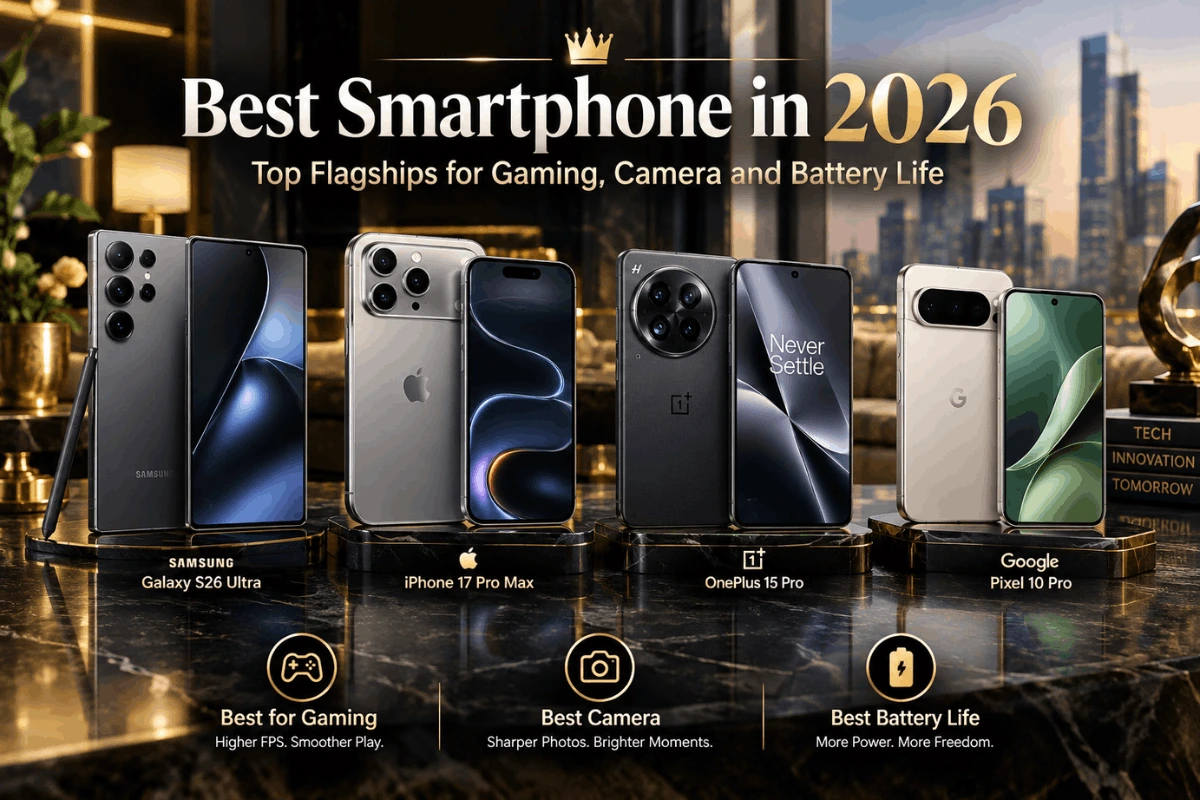
So, which phone deserves your money? There is no single answer for every person, but some devices clearly stand above the competition. As of August 2026, the iPhone 17 Pro Max is rated as the best overall smartphone by Tom’s Guide, while the Samsung Galaxy S26 Ultra is a leading Android choice and its top camera pick.
This guide looks beyond specifications and focuses on what actually matters when you use a phone every day: performance, cameras, battery life, display quality, software, durability, artificial intelligence, gaming, and long-term value.
Why Choosing the Right Smartphone Matters
A smartphone is something most of us use from morning until night. We check messages, watch videos, take photographs, attend meetings, browse websites, shop online, use maps, listen to music, and communicate with friends and family.
That makes the buying decision more important than it may initially appear.
A phone can have impressive specifications on paper and still feel disappointing in everyday use. Think of a smartphone like a car. A powerful engine is useful, but a good car also needs comfortable seats, reliable brakes, efficient fuel use, and a design that suits the driver. Smartphones work in much the same way.
The best choice depends on your priorities. Someone who records videos for social media may prefer an iPhone, while a photography enthusiast or Android power user may prefer Samsung. A person who wants Google’s software and computational photography may find the Pixel series more attractive.
For that reason, the smartest approach is not simply asking, “Which phone has the highest specifications?” Instead, ask, “Which phone gives me the features I will actually use?”
The Top Flagship Choices in 2026
The premium smartphone market is dominated by several familiar names, but three devices deserve particular attention: the iPhone 17 Pro Max, Samsung Galaxy S26 Ultra, and Google Pixel 10 Pro XL.
iPhone 17 Pro Max
The iPhone 17 Pro Max remains one of the strongest choices for people who want excellent performance, video recording, battery life, and long-term software support.
Apple equips it with the A19 Pro processor, a 6.9-inch OLED display with adaptive refresh rates up to 120Hz, and a sophisticated 48MP camera system.
Its camera system is particularly attractive to people who shoot a lot of video.
The biggest advantage, however, is the complete experience. If you already use a Mac, iPad, Apple Watch, or AirPods, the phone becomes even more convenient because the devices work together closely.
Samsung Galaxy S26 Ultra
For Android users, the Galaxy S26 Ultra is arguably the most complete package available.
Samsung gives it a 6.9-inch Dynamic AMOLED 2X screen with a 120Hz adaptive refresh rate, a Snapdragon 8 Elite Gen 5 for Galaxy processor, a 200MP main camera, two telephoto cameras, and S Pen support.
One of its most interesting additions is Privacy Display. When activated, it can make information on the screen difficult for people viewing from the side to see. This is particularly useful when checking messages, passwords, banking information, or other private material in public places.
The phone also combines a 5,000mAh battery with charging of up to 60W, according to Samsung’s specifications.
For someone who wants one device that can do almost everything, this is a remarkably capable option.
Google Pixel 10 Pro XL
The Pixel 10 Pro XL takes a different approach. Instead of competing only through raw hardware, Google places considerable emphasis on software, photography, and AI-powered features.
It features a 6.8-inch LTPO OLED display, 16GB of RAM, a 5,200mAh battery, up to 1TB of storage, and charging up to 45W. Google also supports Qi2-certified wireless charging at up to 25W.
Its biggest attraction is the clean Android experience and Google’s image-processing technology. For people who prefer point-and-shoot photography, Pixel phones can be especially appealing because the software does much of the hard work automatically.
Display Quality: More Than Just a Big Screen
Your display is the part of the phone you look at constantly, so it deserves serious attention.
Most premium devices now use OLED or AMOLED panels. These displays can produce deep blacks, strong contrast, vivid colors, and excellent viewing angles. A 120Hz refresh rate also makes scrolling and animations feel considerably smoother than older 60Hz screens.
The Galaxy S26 Ultra has a 6.9-inch Dynamic AMOLED 2X display with a 120Hz adaptive refresh rate and peak brightness of up to 2,600 nits.
The iPhone 17 Pro Max offers a 6.9-inch OLED panel with ProMotion technology supporting adaptive refresh rates up to 120Hz. Apple also lists an outdoor peak brightness of up to 3,000 nits.
But brightness is not everything.
Color accuracy, viewing angles, touch response, screen reflection, resolution, and automatic refresh-rate adjustment all influence the experience. If you frequently watch Netflix, YouTube, sports, or movies, a high-quality display can make your phone feel dramatically more enjoyable.
Gamers should also pay attention to refresh rate and touch responsiveness. A smooth display will not magically make you better at a game, but it can make fast-moving action feel more responsive.
Camera Performance for Photos and Video
Cameras have become one of the biggest reasons people upgrade their phones.
But there is a common mistake here: assuming that more megapixels automatically mean better photographs.
They do not.
A camera’s image sensor, lens quality, stabilization, processing, exposure control, autofocus, and software can matter just as much as resolution.
The Galaxy S26 Ultra is particularly impressive from a hardware perspective. Samsung lists a 200MP main camera, 50MP ultra-wide, 10MP 3x telephoto, and 50MP 5x telephoto camera. It also supports optical-quality zoom at selected ranges and digital zoom up to 100x.
That makes Samsung especially versatile for landscapes, portraits, distant subjects, travel photography, and night scenes.
The iPhone 17 Pro Max takes a different route. Its 48MP Pro Fusion camera system includes a 48MP main camera, 48MP ultra-wide, and 48MP telephoto camera with 4x optical and 8x optical-quality telephoto options.
For video, Apple’s approach remains especially attractive. The combination of stabilization, processing, autofocus, and recording features makes the phone a strong choice for creators who want to record professional-looking footage without carrying dedicated equipment.
Pixel phones, meanwhile, remain compelling for people who value computational photography. Google’s software can enhance details, exposure, portraits, and difficult lighting conditions automatically.
So which camera is best?
If you want maximum versatility, Samsung is hard to ignore. If video is your priority, the iPhone is an excellent choice. If you want smart point-and-shoot photography, Pixel deserves serious consideration.
Performance and Gaming
Nobody wants to spend premium money on a phone that becomes slow after a year or struggles with demanding applications.
Fortunately, flagship smartphones in 2026 are extremely powerful.
The Galaxy S26 Ultra uses Qualcomm’s Snapdragon 8 Elite Gen 5 for Galaxy platform, customized for Samsung devices. Samsung says the processor is designed to improve CPU, GPU, and NPU performance.
The iPhone 17 Pro Max uses Apple’s A19 Pro chip with a six-core CPU, six-core GPU, and 16-core Neural Engine. It also supports hardware-accelerated ray tracing.
For everyday activities, both are far more powerful than most people need.
Web browsing, social media, video calls, streaming, editing photographs, and multitasking are handled comfortably. The real difference becomes clearer when you move into demanding gaming, professional video editing, large file handling, and other intensive workloads.
Gamers should consider more than peak benchmark scores. Thermal management is important because sustained workloads can cause a device to become hot and reduce performance.
Storage is also worth considering. If you download large games, record lots of 4K video, or keep thousands of photographs, 128GB can become restrictive surprisingly quickly.
For heavy users, 256GB is a sensible starting point, while creators may prefer 512GB or more.
Battery Life and Charging
Battery anxiety can ruin an otherwise excellent smartphone experience.
Fortunately, flagship phones have become much better at lasting through a full day.
Samsung’s Galaxy S26 Ultra has a typical 5,000mAh battery, and Samsung rates it for up to 31 hours of video playback under its testing conditions. The phone supports up to 60W wired charging and up to 25W wireless charging.
The Pixel 10 Pro XL has a typical 5,200mAh battery, with Google advertising 24-plus-hour battery life and up to 100 hours using Extreme Battery Saver.
Apple’s approach is different because battery capacity alone does not tell the complete story. The combination of its chip, operating system, display management, and hardware optimization helps deliver strong endurance.
When comparing phones, look at your own usage.
If you spend several hours gaming or recording video every day, your battery requirements will be very different from someone who mainly sends messages and checks social media.
Charging speed is equally important. A phone that charges rapidly can make a smaller battery much easier to live with because even a short charging session can add substantial usable time.
Software, AI, and Everyday Features
Hardware gets most of the attention in advertisements, but software determines how you interact with the phone every day.
Apple’s iOS is known for its straightforward interface and close integration with Apple’s ecosystem. The iPhone 17 Pro Max also includes Apple Intelligence features.
Samsung’s software provides a broader set of customization and productivity features. Galaxy AI adds another layer of tools, while the S Pen gives the Ultra model capabilities that most conventional smartphones do not offer.
Google takes a particularly software-focused approach with Pixel devices. Its phones emphasize Google’s services, AI tools, photography processing, voice features, and a clean Android interface.
Artificial intelligence is increasingly becoming part of normal smartphone use. Instead of being treated as a separate feature, it is gradually appearing inside search, photography, writing, translation, communication, editing, and organization.
Still, do not buy a phone simply because it has an impressive list of AI features.
Ask yourself whether you will actually use them.
A feature that saves you five minutes every day can be valuable. A feature you try once and forget about is mostly marketing.
Design, Durability, and Comfort
A phone can have the best processor in the world and still be unpleasant if it is too large or uncomfortable.
The Galaxy S26 Ultra measures 7.9mm thick and weighs 214 grams. It uses an Armor Aluminum frame and has an IP68 rating for resistance against dust and water.
The iPhone 17 Pro Max weighs 233 grams and has an IP68 rating. Apple uses an aluminum unibody design with Ceramic Shield 2 on the front and Ceramic Shield on the back.
These are large premium phones, and that matters.
If you regularly use your phone with one hand, put it into tight pockets, or prefer compact devices, an Ultra or Pro Max model may feel excessive.
On the other hand, large phones are fantastic for reading, editing documents, watching movies, playing games, and multitasking.
A good case is also worth considering. Even a durable flagship can be damaged by a serious drop, and replacing a premium screen can be expensive.
Best Choice for Different Types of Users
There is no universal winner because people use phones differently.
Best overall: The iPhone 17 Pro Max is a strong choice for people who want premium performance, excellent video, long-term usability, and a polished ecosystem. Current expert testing from Tom’s Guide places it at the top overall.
Best Android flagship: The Galaxy S26 Ultra is arguably the most complete Android package, combining a huge display, powerful hardware, flexible cameras, S Pen support, AI features, and a built-in privacy screen.
Best camera-focused Android: The Galaxy S26 Ultra stands out because of its combination of high-resolution main imaging and multiple telephoto cameras. Tom’s Guide currently rates it as its best camera phone.
Best for Pixel fans: The Pixel 10 Pro XL remains an excellent choice for people who value Google’s software, AI capabilities, and computational photography. Its 6.8-inch display and 5,200mAh battery make it suitable for heavy daily use.
Best foldable experience: Samsung’s Galaxy Z Fold 8 is a strong option if you want a phone that can transform into a larger productivity device. Current testing has praised its lighter design, multitasking, and nearly invisible crease.
Best budget approach: You do not necessarily need to spend more than $1,000. Current testing highlights the Pixel 10a as a strong affordable option, while other mid-range models can provide excellent displays, cameras, and battery life for considerably less money.
How to Choose the Right Phone for You
Before buying, write down the three features you care about most.
Are you a photographer? Prioritize camera quality and storage.
Do you play demanding games? Look for strong sustained performance, cooling, battery endurance, and a responsive display.
Do you use your phone for work? Consider multitasking, file management, screen size, accessories, and productivity features.
Are you always travelling? Battery life, charging speed, camera quality, durability, and connectivity should move higher on your list.
Do you already own several Apple products? Staying with the iPhone may make more sense because of ecosystem integration.
Do you prefer customization and flexibility? Android offers more choice, with Samsung and Google providing particularly strong premium options.
And remember: the most expensive phone is not automatically the best phone for you.
Spending an extra few hundred dollars for features you never use is like buying a sports car when all you need is a reliable car for commuting. It may be impressive, but it does not necessarily make your life better.
Price, Value, and Long-Term Ownership
Price is one of the most important factors when buying a flagship.
The Galaxy S26 Ultra and Pixel 11 Pro XL are positioned around the premium $1,299 starting point in the U.S., while the iPhone 17 Pro Max starts at $1,199 according to current comparisons and listings. Prices can vary significantly by country, storage capacity, taxes, promotions, and retailer.
However, the purchase price is only part of the equation.
A phone that lasts five years can provide better value than a cheaper device that needs replacement after two years.
Look at software support, repairability, battery health, storage, build quality, and accessory availability before making a decision.
Promotions can also change the value equation. Samsung, for example, has offered substantial discounts and trade-in savings on its flagship devices during 2026.
If you are not in a hurry, waiting for a major sale can sometimes save a meaningful amount of money.
Final Verdict
The smartphone market in 2026 is exceptionally competitive, and that is good news for buyers. You no longer need to accept major compromises simply because you choose Android or iOS.
For the broadest premium experience, the iPhone 17 Pro Max is a superb choice, particularly for people who prioritize performance, video, battery life, and Apple’s ecosystem. Current expert testing places it at the top overall.
For Android users, the Samsung Galaxy S26 Ultra is arguably the most complete package. Its powerful processor, 6.9-inch display, versatile camera system, S Pen, large battery, fast charging, AI features, and Privacy Display give it an unusually broad feature set.
The Google Pixel 10 Pro XL remains an appealing alternative for people who value Google’s software and photography experience.
Ultimately, the right phone is the one that fits your habits rather than simply winning a specification sheet. Think about how you use your device every day, decide which features actually matter, set a realistic budget, and then choose accordingly.
A great smartphone should make your daily life easier—not make you wonder why you spent so much money on features you never use.
Frequently Asked Questions
1. What is the best smartphone to buy in 2026?
The iPhone 17 Pro Max is currently rated as the best overall phone by Tom’s Guide, while the Samsung Galaxy S26 Ultra is one of the strongest choices for Android users. Your preferred operating system and the features you value most should determine the final choice.
2. Is the Samsung Galaxy S26 Ultra better than the iPhone 17 Pro Max?
Neither is universally better. The Galaxy S26 Ultra offers a highly versatile camera system, S Pen support, extensive customization, and Android flexibility. The iPhone 17 Pro Max is particularly strong in performance, video, battery life, and Apple’s ecosystem.
3. Which phone has the best camera in 2026?
The Samsung Galaxy S26 Ultra is currently rated by Tom’s Guide as the best camera phone. Its 200MP main sensor, ultra-wide camera, and dual telephoto setup provide considerable flexibility for different types of photography.
4. Is it worth buying a flagship phone in 2026?
A flagship can be worthwhile if you keep your phone for several years, take lots of photos and videos, play demanding games, or need strong performance for work. However, affordable and mid-range phones can provide excellent value if your requirements are modest.
5. Should I choose an iPhone or Android phone?
Choose an iPhone if you prefer Apple’s ecosystem, simple software experience, strong video capabilities, and close integration with other Apple products. Android is a better fit if you want greater customization, more hardware choices, multitasking flexibility, or features such as the S Pen. The best option ultimately depends on how you use your phone.