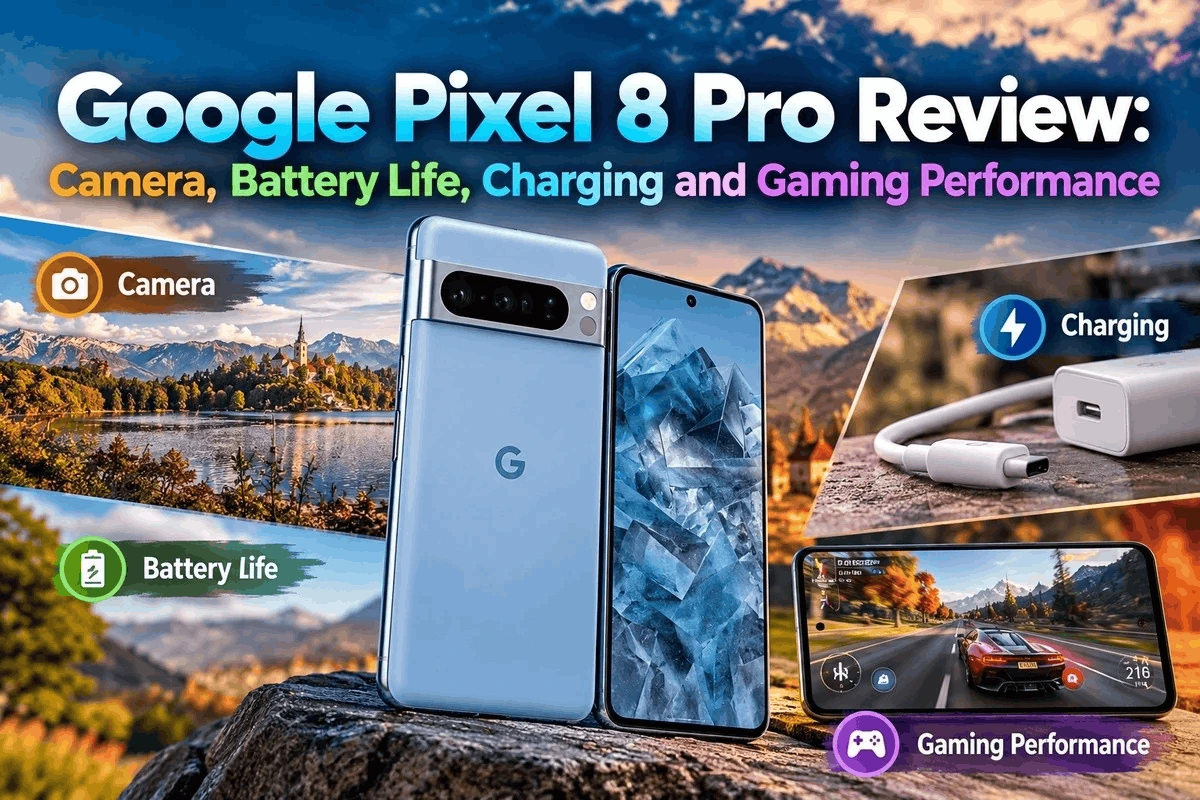
The Google Pixel 8 Pro arrived in October 2023 with an unusual sales pitch. Instead of chasing the highest benchmark score, Google emphasized photography, practical software features, and long-term support. That approach remains interesting at a sensible price.
But a great camera cannot rescue an inconvenient battery, and fancy editing tools will not stop a game from dropping frames. This review examines its strengths, limitations, and ideal buyer.
Google Pixel 8 Pro Specifications at a Glance
The phone combines a 6.7-inch LTPO OLED display with a 1–120Hz refresh rate, Google’s Tensor G3 processor, 12GB of RAM, and storage options ranging from 128GB to 1TB, depending on the market. Its rear cameras include 50MP main, 48MP ultrawide, and 48MP telephoto sensors. A 10.5MP front camera handles selfies.
Other headline features include a 5,050mAh battery, up to 30W wired charging, 5x optical zoom, IP68 water and dust resistance, stereo speakers, and wireless charging. According to Google’s official Pixel 8 Pro specifications, it launched with Android 14 and has seven years of update support from 2023.
Design and Build Quality: Premium Without Being Flashy
The Pixel 8 Pro has a matte glass back, an aluminum frame, and Google’s distinctive camera bar. Unlike a cluster of individual camera rings, the horizontal bar gives the phone an instantly recognizable appearance. It also makes clear that photography sits at the center of Google’s design priorities.
Google uses Gorilla Glass Victus 2 on the front and back, while the IP68 rating provides resistance to dust and water under specified test conditions. That does not make underwater selfies advisable. Resistance can deteriorate with wear or repairs, and liquid damage is not covered by Google’s standard warranty.
Display Quality: Bright, Sharp and Smooth
The Super Actua LTPO OLED panel measures 6.7 inches and carries a 1344 × 2992 resolution. Its adaptive refresh rate ranges from 1Hz to 120Hz, allowing supported content to look smooth without running at the highest rate constantly.
Google quotes peak brightness of up to 2,400 nits under specific conditions. Peak figures do not describe continuous brightness across the whole screen, but the display’s strong brightness capability helps when checking directions or taking photos outdoors.
Tensor G3 Performance and Everyday Use
Google’s Tensor G3 powers the Pixel 8 Pro alongside 12GB of RAM. It handles routine activities such as messaging, switching between apps, browsing, taking photos, and watching videos comfortably. Most buyers will notice the responsive interface more than benchmark results.
Tensor G3 also supports the computational photography and machine-learning features that distinguish Pixel phones. Google clearly prioritized its software experience, rather than building a dedicated gaming processor that dominates every graphics test.
That trade-off matters. Independent reviewers found that competing flagship chips from the same generation could deliver stronger sustained graphics performance. Under extended demanding workloads, the Pixel can heat up and reduce performance.
Pixel 8 Pro Camera Review: Three Useful Rear Cameras
The camera system deserves attention because its lenses serve genuinely different purposes. The 50MP main sensor has optical image stabilization and handles everyday photography. Its image processing emphasizes balanced exposure and detail, particularly when scenes contain both bright skies and darker foregrounds.
The 48MP ultrawide camera fits landscapes, buildings, and larger groups into the frame. Autofocus also enables Macro Focus for detailed close-up subjects. That versatility matters more than a pointless extra camera.
A separate 48MP telephoto camera provides 5x optical zoom with stabilization. Optical zoom matters because the dedicated lens captures distant subjects without relying entirely on digital enlargement. It suits distant architecture, portraits, and wildlife.
How Good Is the 5x Zoom?
At 5x, the telephoto lens supplies genuine optical magnification. Google also advertises Super Res Zoom up to 30x, which uses computational processing and digital enlargement. Those are not equivalent claims: 30x does not mean the phone contains a 30x optical lens.
For practical photography, stay near the optical zoom range when image quality matters most. Higher zoom levels can help identify a distant sign or frame an occasional shot, but fine textures can become less reliable. Stable hands, good lighting, and realistic expectations make a bigger difference than the largest number on the zoom slider.
Night Photography and Editing Features
Night Sight helps brighten low-light photographs, while Google’s processing can preserve a usable balance between shadows and highlights. Still, moving subjects remain challenging, and extremely dark scenes cannot magically reveal details the sensor never recorded.
The phone also introduced tools such as Best Take and Magic Editor. Best Take can help produce a more satisfactory group picture from compatible images. Magic Editor offers selective adjustments, but editing capabilities and availability depend on software and service conditions.
Video Recording and Stabilization
The rear camera system supports 4K recording at up to 60 frames per second. Optical and electronic stabilization help reduce handheld movement, while the available video options suit family clips, travel footage, and social media content.
Video Boost and Night Sight Video expand the phone’s processing options, although certain functions depend on cloud processing and compatible software. They are not identical to recording every enhanced result instantly on the device.
Battery Life: What Does 5,050mAh Deliver?
The Pixel 8 Pro contains a typical 5,050mAh battery. Google’s original claim was more than 24 hours under its specified testing conditions, with up to 72 hours possible through Extreme Battery Saver. That second figure involves substantial restrictions and should not be mistaken for normal full-featured usage.
Independent experiences paint a practical picture. Android Authority reported getting roughly a day to a day and a half during its review, depending on activity. GSMArena recorded 16 hours and 25 minutes in a controlled Wi-Fi browsing test and 19 hours and 33 minutes during offline video playback. These are different testing methods, not guaranteed personal results.
For typical messaging, calls, browsing, maps, and occasional photography, a full day is a reasonable expectation for a healthy battery. Heavy gaming, mobile-data use, high screen brightness, and extended camera sessions can shorten that window. A secondhand device may perform differently because batteries lose capacity with age.
Charging Speed: Wattage, Charger and Time
The Pixel 8 Pro supports up to 30W wired charging using a compatible USB Power Delivery PPS charger. Google advertises approximately 50% charge in 30 minutes under its test conditions. Importantly, the charging adapter does not come in the retail box; buyers receive a USB-C cable instead.
In Android Authority’s charging test using Google’s 30W adapter, the phone reached 50% in 27 minutes and completed a full charge in 79 minutes. GSMArena measured 83 minutes, while Notebookcheck took 101 minutes using a different compatible charger. Temperature, adapter behavior, device activity, and battery condition help explain why results differ.
Expect roughly 80–100 minutes for a full charge under conditions similar to those tests, rather than treating any single laboratory figure as a promise. Wireless charging reaches up to 23W with Pixel Stand 2 or 12W with compatible Qi EPP chargers. Battery Share provides reverse wireless charging for compatible accessories.
Gaming Performance Test: Call of Duty, Genshin Impact and More
Gaming exposes the Tensor G3’s compromises more clearly than everyday browsing. In its hands-on gaming review, Gadgets 360 reported that Call of Duty: Mobile ran, but fast-paced play at demanding settings could show frame drops and sluggish touch response. The reviewer also noticed warmth after repeated matches at Ultra settings.
Notebookcheck found that demanding games generally worked well, although Genshin Impact occasionally stuttered. Its stress testing also showed some performance reduction under sustained load. Taken together, these findings suggest that the Pixel 8 Pro is capable of enjoyable gaming without being the strongest choice for players who demand consistently high frame rates.
For Call of Duty: Mobile, start with balanced graphics settings and prioritize stable performance over maximum visual effects. PUBG Mobile and lighter online titles should be less demanding in many scenarios, but the actual frame rate depends on game updates, selected settings, and thermal conditions. Offline games vary just as widely: a basic puzzle title is not comparable to an open-world 3D adventure.
Software Support, Security and Practical Features
One of the phone’s most compelling qualities is Google’s seven-year update commitment. Because the Pixel 8 Pro first became available in 2023, its original support commitment extends into 2030. That makes software longevity an important advantage for buyers who prefer keeping a device for several years.
Before buying a used or imported model, check carrier compatibility, battery health, screen condition, repair history, and warranty terms. For Pakistan-based buyers, confirming local network support and applicable registration requirements matters more than trusting a seller’s description alone.
Google Pixel 8 Pro Price in Pakistan and International Markets (2026)
The Google Pixel 8 Pro price in Pakistan varies depending on storage, condition, and PTA approval status. Recent October 2026 seller listings show that a used 128GB PTA-approved model costs around PKR 115,000, while brand-new PTA-approved variants are advertised between PKR 140,000 and PKR 160,000. Non-PTA models may cost less, with some 128GB listings around PKR 95,500. Internationally, the Pixel 8 Pro originally launched at $999 in the United States, £999 in the United Kingdom, ₹106,999 in India, and AU$1,699 in Australia. Current refurbished prices vary, with Google’s US Certified Refurbished Store listing the 128GB model at $649 and some UK refurbished listings starting around £226. These prices are indicative rather than guaranteed, so buyers should confirm the latest seller prices, battery condition, warranty, and PTA registration before purchasing.
Should You Buy the Google Pixel 8 Pro?
This phone makes sense for people who value photography, a strong display, clean software, and continued updates. Its versatile lenses can replace the need for constant digital cropping, while Google’s processing tools offer useful flexibility after a photo is taken.
However, its charging speed is modest beside some competing Android phones, and sustained gaming is not its strongest area. The size and weight will also discourage buyers seeking a compact device. Value therefore depends heavily on the condition and price of the particular unit available to you.
For additional smartphone comparisons and buying guidance, explore PHR Phone Hub. Treat promotional claims cautiously and prioritize independent tests, warranty details, and the features you actually use. A bargain is only a bargain if the phone meets your needs.
Frequently Asked Questions
1. How long does the Pixel 8 Pro battery last?
A healthy battery should generally support a full day of mixed use, although gaming, camera recording, poor reception, and high brightness reduce runtime. Independent testing shows variation between workloads, so no single screen-on-time figure applies to everyone.
2. Does the Google Pixel 8 Pro support 30W charging?
Yes. It supports up to 30W wired charging with a suitable USB PD PPS adapter, sold separately. Independent full-charge tests ranged from about 79 to 101 minutes, depending on the testing setup.
3. How far can the Pixel 8 Pro camera zoom?
Its 48MP telephoto camera offers 5x optical zoom. Super Res Zoom can extend magnification up to 30x through digital and computational techniques, but image detail generally becomes less dependable at extreme settings.
4. Can the Pixel 8 Pro run Call of Duty: Mobile smoothly?
Yes, it can run the game, but demanding graphics settings and longer sessions may produce frame drops or heat. Independent reviewers did not establish flawless performance at every setting, so competitive players should choose settings that favor stability.
5. Is the Pixel 8 Pro still worth buying?
It can be a good purchase at an appropriate price, particularly for photography and long software support. Check battery health, network compatibility, device condition, and warranty before buying an older or refurbished unit.
Conclusion
The Google Pixel 8 Pro is a thoughtful camera-focused flagship rather than a gaming-first powerhouse. Its 50MP main camera, 5x optical telephoto lens, bright OLED display, and lengthy update commitment remain meaningful strengths. Battery life is generally practical, but charging takes longer than some rivals and demanding games can reveal the Tensor G3’s limits.
Choose it for the photography tools, dependable everyday experience, and software longevity. Skip it if maximum gaming speed or exceptionally fast charging matters more. Buy based on realistic expectations, not advertising numbers.