
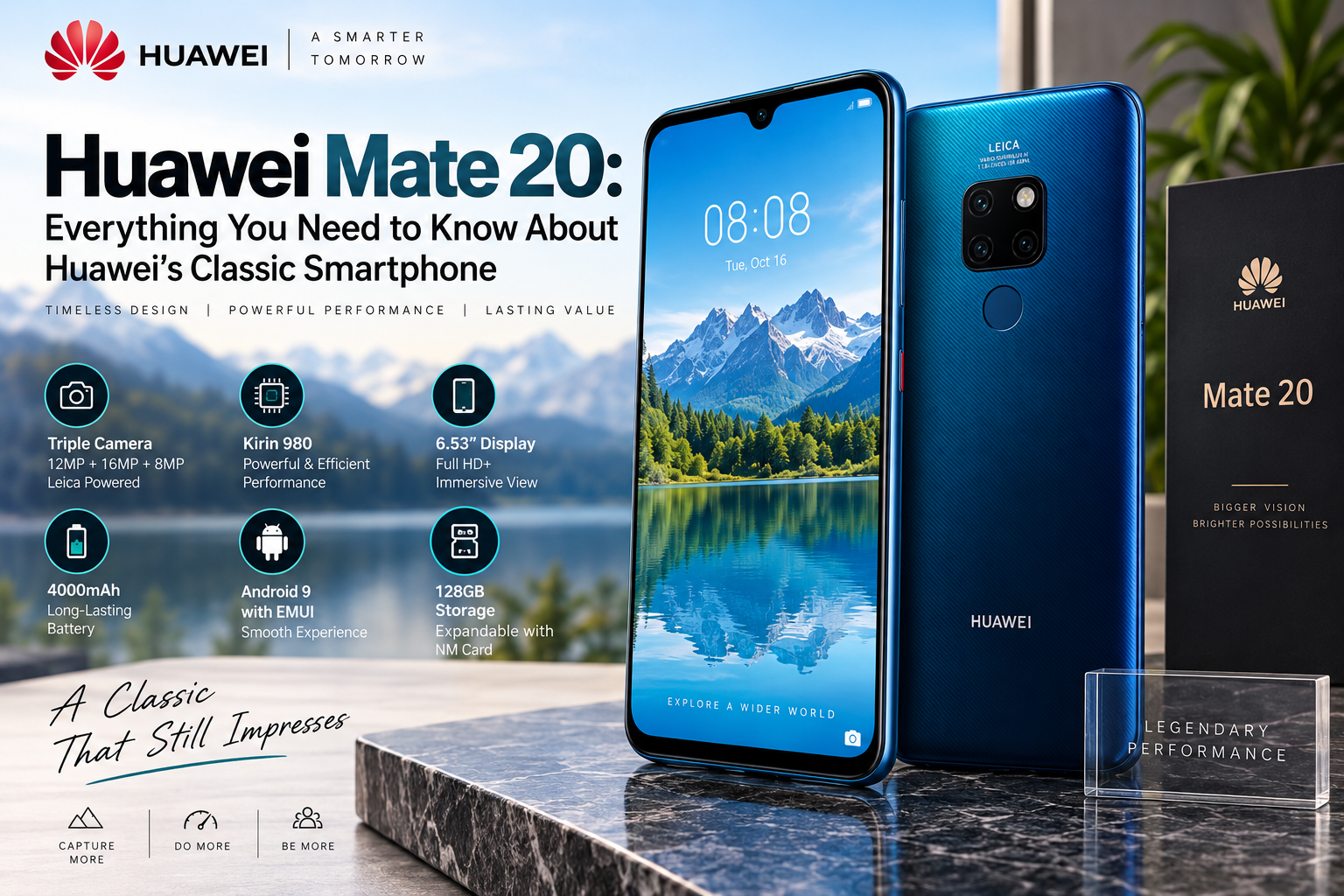
The smartphone market has changed dramatically over the years, but some phones continue to attract attention long after their original release. The Huawei Mate 20 is one of those devices. Introduced in 2018, it arrived at a time when Huawei was rapidly building a reputation for combining premium design, capable cameras, strong battery life, and competitive performance.
The Mate 20 was not simply another large-screen phone. It represented Huawei’s approach to creating a device that could handle everyday communication, photography, entertainment, and productivity without feeling overly complicated.
Even today, people may come across the Mate 20 in the used-phone market or wonder whether its specifications still make sense. So, what exactly made this phone popular, and how does it hold up now?
Let’s take a closer look at its design, display, cameras, performance, battery, software, connectivity, advantages, limitations, and overall value.
1. Huawei Mate 20 at a Glance
A flagship designed for everyday users
The Huawei Mate 20 was introduced as part of Huawei’s Mate 20 family, alongside higher-end models such as the Mate 20 Pro. While the Pro version received much of the attention, the standard Mate 20 offered a slightly different balance between features, price, and practicality.
It featured a large 6.53-inch LCD display with a 2244 × 1080 resolution. The screen used Huawei’s FullView design, which reduced the size of traditional bezels and provided a more immersive viewing experience.
Inside, Huawei equipped the phone with its Kirin 980 processor. At the time, this was an advanced 7nm mobile chipset designed to deliver strong performance while improving power efficiency.
The device also included a triple rear-camera system, a large battery, USB-C connectivity, and a glass-and-metal construction.
These features made the phone feel like a premium product without necessarily targeting the highest price category of the Mate family.
In simple terms, the Mate 20 was designed as an all-rounder.
It was like a reliable multitool: photography was important, performance mattered, battery life was a priority, and the phone still needed to feel comfortable for ordinary daily tasks.
2. Design and Build Quality
A distinctive look that still feels modern
One of the Mate 20’s most recognizable characteristics is its design.
Huawei used a glass back with a metal frame, giving the device a premium appearance. The phone was relatively large, but its curved edges helped make it easier to hold than its dimensions might suggest.
The rear camera arrangement was particularly distinctive.
Huawei placed the three cameras and flash inside a square-shaped module. At the time, this arrangement was unusual enough to make the phone immediately recognizable.
The fingerprint scanner was also located on the rear rather than underneath the display.
For users who prefer rear fingerprint readers, this placement can feel natural because your finger tends to rest near the sensor when holding the phone.
The Mate 20 was available in several colors depending on the market, including options such as Black, Midnight Blue, Twilight, Emerald Green, and Pink Gold.
The finish gave buyers some variety instead of forcing everyone into the same traditional black or silver design.
Practical design considerations
Although the phone looked premium, its glass construction meant that a protective case was a sensible investment.
A case could also improve grip because large glass phones can sometimes feel slippery.
The phone’s size may also be worth considering today. People who prefer compact smartphones may find it somewhat large, while users who enjoy watching videos and browsing on a bigger screen may appreciate the extra space.
3. Display Quality and Viewing Experience
Large screen for entertainment and everyday tasks
The Huawei Mate 20 featured a 6.53-inch LCD display with a 2244 × 1080 resolution.
That combination provided a large viewing area suitable for browsing websites, reading articles, watching videos, using social media, and playing games.
The display also used a small waterdrop-style notch at the top. Compared with the larger notches found on some smartphones of the same era, this approach allowed Huawei to keep more of the front surface available for content.
Colors were generally lively, and the FullView design made the display feel larger than traditional phones with thick bezels.
Of course, modern flagship phones have advanced considerably since the Mate 20 was released.
Many newer models use OLED or AMOLED panels with deeper blacks, higher refresh rates, and improved brightness.
That does not make the Mate 20 display unusable.
It simply means expectations have changed.
For ordinary activities such as reading, messaging, YouTube, browsing, and social media, the screen can still be perfectly serviceable.
LCD versus modern OLED screens
The biggest difference a modern user may notice is the panel technology.
An OLED screen can produce extremely deep blacks because individual pixels can turn off completely. An LCD panel uses a backlight, so blacks may appear less deep.
However, the Mate 20’s LCD display can still offer a pleasant viewing experience for everyday use.
If you are considering buying one today, display condition may actually matter more than the original specifications.
A used phone with scratches, dead pixels, discoloration, or screen damage can be far less enjoyable than a well-maintained unit.
4. Camera System
One of the phone’s biggest attractions
Huawei placed considerable emphasis on photography with the Mate 20.
The phone included a triple-camera setup developed in partnership with Leica. The rear system consisted of:
- A 12MP main camera
- A 16MP ultra-wide camera
- An 8MP telephoto camera
This combination gave users several ways to capture photographs.
The main camera was designed for everyday shooting.
The ultra-wide lens was useful when you needed to capture more of a scene, such as landscapes, buildings, groups, or indoor spaces.
The telephoto lens provided optical zoom capabilities for subjects farther away.
This was a significant advantage over smartphones that relied primarily on a single camera.
Why the ultra-wide camera mattered
The ultra-wide camera was particularly useful because it gave users another perspective.
Imagine standing in front of a large building. With a standard lens, you may need to walk backward to fit the entire structure into the frame.
Sometimes there simply isn’t enough space.
An ultra-wide lens solves that problem by capturing a broader view.
The same applies to travel photography.
Instead of choosing between the mountain and the surrounding landscape, you can often include more of the scene in one photograph.
Night photography
Huawei also invested heavily in low-light photography around this period.
The Mate 20 could use software processing to brighten darker scenes and balance exposure.
Modern phones have become even better at night photography, but the Mate 20 helped establish Huawei’s reputation for computational photography.
Front camera
For selfies and video calls, the phone included a 24MP front-facing camera.
That gave users plenty of resolution for everyday selfies, portraits, and social media content.
However, as with the rear cameras, image quality depends on lighting, software processing, and the condition of the device.
5. Performance and Kirin 980 Processor
Powerful hardware for its generation
The Mate 20 was powered by Huawei’s Kirin 980 processor.
This was an important chipset for Huawei because it was manufactured using a 7nm process. Smaller manufacturing processes can help improve efficiency and performance when the overall design is optimized correctly.
The processor included multiple CPU cores designed to handle different types of workloads.
For everyday users, the practical result was a phone capable of handling common tasks comfortably.
You could browse the internet, switch between applications, stream video, take photographs, communicate through messaging apps, and perform many productivity tasks without expecting the phone to struggle under normal conditions.
Gaming was also possible.
The experience naturally depends on the game, graphics settings, software version, and device condition.
A phone that was considered powerful in 2018 cannot compete directly with modern flagship processors.
That is simply the reality of technology.
Still, the Mate 20’s original hardware was strong enough to give it a relatively long useful life compared with many budget smartphones from the same period.
Everyday performance matters more than benchmark numbers
Specifications can be useful, but they do not always tell the complete story.
If you are considering a used Mate 20 today, the condition of the battery, storage, display, and software can have a greater impact on your experience than benchmark scores.
A well-maintained phone can feel much better than a heavily used one with degraded components.
6. Battery Life and Charging
A major strength of the Mate 20
Battery life was another area where Huawei placed considerable attention.
The Mate 20 included a 4,000mAh battery, which was a generous capacity for its generation.
The phone supported Huawei’s SuperCharge technology, allowing compatible charging equipment to replenish the battery relatively quickly compared with conventional charging methods of the time.
The combination of a large battery and an efficient chipset helped make the Mate 20 suitable for long periods of everyday use.
Depending on how you used it, a full charge could provide enough power for a substantial part of the day.
Heavy gaming, navigation, mobile data, high screen brightness, and video recording would naturally consume more energy.
Battery condition matters today
This is especially important if you’re looking at a second-hand Mate 20.
Lithium-ion batteries naturally lose capacity as they age.
A phone that originally offered excellent battery life may provide noticeably less runtime after several years.
If you buy a used unit, check:
- How quickly the battery percentage drops
- Whether the phone becomes unusually warm
- Whether it shuts down unexpectedly
- Whether charging works normally
- Whether the battery has already been replaced
A replacement battery from a reliable repair provider can sometimes make a significant difference.
7. Storage and Memory Options
Enough room for everyday content
The Huawei Mate 20 was commonly sold with 4GB or 6GB of RAM depending on the market, along with 128GB of internal storage on many configurations.
For its generation, that provided a solid amount of space.
Users could store photographs, applications, videos, documents, music, and other files without immediately worrying about running out of room.
Huawei also supported expandable storage through its proprietary NM Card format.
This is worth mentioning because NM Cards are different from the more common microSD cards used by many other Android smartphones.
If you are buying a used Mate 20 and want expandable storage, make sure you purchase a compatible NM Card rather than assuming any microSD card will work.
Storage can also become important for long-term use.
Modern applications can be considerably larger than applications from 2018, so available space may disappear faster than it did when the phone was new.
For basic users, however, 128GB can still be useful.
8. Software and Android Experience
EMUI was central to the Mate 20 experience
The Huawei Mate 20 originally launched with Android 9 Pie and Huawei’s EMUI interface.
EMUI changed the visual appearance and functionality of standard Android by adding Huawei-specific features, settings, customization tools, and applications.
For users already familiar with Huawei phones, the interface could feel comfortable and intuitive.
The Mate 20 was also released before the major restrictions that later affected Huawei’s relationship with Google.
That distinction is important.
The Mate 20 originally supported Google Mobile Services, meaning users could access familiar Google applications and services as part of the normal Android experience.
However, buying an older Huawei phone today requires some caution.
Software support for a device introduced in 2018 is naturally limited compared with current smartphones.
Security updates, application compatibility, and operating-system support may not match what modern phones offer.
This is one of the biggest disadvantages of choosing an older flagship.
Software longevity
Hardware can remain capable for years, but software eventually becomes the bigger concern.
A phone may still have a good camera and processor, yet newer applications may demand newer Android versions or security features.
Therefore, anyone considering the Mate 20 today should look at software compatibility as carefully as the hardware.
9. Connectivity and Communication Features
Designed for a connected world
The Mate 20 offered the connectivity features expected from a premium smartphone of its time.
These included cellular connectivity, Wi-Fi, Bluetooth, GPS, NFC, and USB-C.
The use of USB-C was particularly useful because the connector could be inserted in either direction.
NFC also enabled supported contactless functions and accessories.
Depending on the exact regional version, cellular bands and SIM configurations could vary.
This matters if you’re purchasing an imported model.
A phone that works perfectly with one carrier may have limited compatibility with another network.
Before buying a used or imported Mate 20, it is therefore sensible to check the model number and supported network bands.
Dual-SIM functionality
Some Mate 20 versions supported dual-SIM functionality.
For people who maintain separate personal and work numbers, or who travel frequently, dual-SIM support can be extremely convenient.
Instead of carrying two phones, you can potentially manage both numbers from one device.
The exact configuration depends on the regional model.
10. Audio, Biometrics, and Everyday Convenience
Small features can make a big difference
The Mate 20 included several practical features designed to improve everyday usability.
Its fingerprint scanner was positioned on the back, providing a quick way to unlock the phone.
Face-unlock functionality was also available through the front camera system, although users should understand that camera-based facial recognition may not offer the same level of security as more advanced 3D face-scanning systems.
The phone also included stereo audio capabilities, helping make videos and other media more enjoyable.
A 3.5mm headphone jack was another practical advantage.
Many modern flagship phones have removed the traditional headphone port, so some users may actually appreciate this older feature.
It means you can connect conventional wired headphones without an adapter.
That is a small detail, but sometimes small details make a phone more convenient.
11. Huawei Mate 20 vs. Mate 20 Pro
What was the difference?
It is easy to confuse the standard Mate 20 with the Mate 20 Pro.
Both phones belonged to the same generation, but they were not identical.
The Mate 20 Pro offered a more premium package, including an OLED display, a higher-resolution panel, a different camera configuration, wireless charging, reverse wireless charging, and more advanced biometric technology.
The standard Mate 20 took a more practical approach.
It had an LCD display, a rear fingerprint reader, a 4,000mAh battery, and a triple-camera setup that still offered impressive flexibility.
For many users, the standard version provided enough flagship features without paying the additional cost associated with the Pro model.
This difference is useful when shopping in the used market.
If you find both phones at similar prices, compare their condition carefully rather than assuming the Pro version is automatically the better purchase.
Battery health and overall physical condition can make a huge difference.
12. What Made the Huawei Mate 20 Popular?
A strong combination of features
The Mate 20 succeeded because it did not rely on a single feature.
Instead, Huawei combined several desirable qualities.
It offered:
- A large display
- A distinctive premium design
- Triple rear cameras
- Leica branding and camera tuning
- A capable processor
- Strong battery capacity
- USB-C
- NFC
- Google services at launch
- Expandable storage through NM Card
- A headphone jack
- Large internal storage options
That combination made it appealing to people who wanted a versatile smartphone.
Some phones excel at photography but compromise on battery life.
Others have huge batteries but weaker cameras.
The Mate 20 tried to provide a balanced experience.
That balance is probably the best way to describe its appeal.
13. Advantages of the Huawei Mate 20
Why it can still attract buyers
Even though the phone is several years old, it has qualities that may appeal to someone looking for an inexpensive used device.
Strong camera flexibility
The triple-camera system provides standard, ultra-wide, and telephoto perspectives.
Large battery
The 4,000mAh capacity was a strong feature for its generation.
Premium construction
The glass-and-metal body gives the phone a more expensive feel than many basic budget devices.
Large display
The 6.53-inch screen is useful for video, reading, browsing, and social media.
USB-C
The modern connector is convenient and widely used.
Headphone jack
Users can connect traditional wired headphones without a dongle.
Good original performance
The Kirin 980 was a powerful chipset when the phone launched.
Google services at launch
Unlike later Huawei devices affected by restrictions, the Mate 20 originally came with Google’s mobile ecosystem.
These strengths help explain why the phone remains recognizable among Huawei’s older flagship models.
14. Limitations to Consider Today
The age of the phone matters
The Mate 20 was impressive when it launched, but buying an older phone always involves compromises.
The first concern is software support.
A 2018 smartphone cannot reasonably be expected to receive the same level of long-term support as a current model.
Battery degradation is another concern.
Even if the phone looks excellent externally, the internal battery may have lost a meaningful amount of its original capacity.
Camera technology has also moved forward.
New smartphones can provide better night photography, faster focusing, improved video stabilization, and more sophisticated image processing.
The display is another area where newer devices have an advantage.
Modern phones commonly offer OLED panels and high refresh rates, while the Mate 20 uses a 60Hz LCD screen.
Performance is another consideration.
The Kirin 980 remains capable for many basic tasks, but modern mid-range and flagship processors are considerably faster.
Finally, spare parts and repair availability can vary depending on where you live.
Before buying an older phone, check whether replacement batteries, screens, and charging components are easily available.
15. Is the Huawei Mate 20 Still Worth Buying?
It depends on the price and your expectations
There is no universal answer.
If you need an inexpensive smartphone for calls, messaging, browsing, photography, and basic entertainment, a well-maintained Mate 20 can still be interesting.
However, it should be priced appropriately.
You should not pay modern flagship money for an eight-year-old phone.
If the Mate 20 costs nearly as much as a newer budget or mid-range device, the newer phone will often make more sense because it may provide longer software support, a newer battery, improved efficiency, and better compatibility with modern applications.
The Mate 20 becomes more attractive when its price reflects its age.
Who might still enjoy it?
It may suit:
- Casual smartphone users
- People looking for a large display
- Photography enthusiasts on a tight budget
- Huawei fans
- Users who want a headphone jack
- Buyers searching the second-hand market
- People who need a backup phone
It is less suitable for someone who wants the newest gaming performance, the longest possible software support, or the latest camera technology.
16. Tips for Buying a Used Huawei Mate 20
Check the phone carefully before paying
If you’re considering a second-hand unit, do not judge it only by appearance.
Start with the display.
Look for cracks, scratches, dead pixels, screen burn, or unusual discoloration.
Next, test every camera.
Open the main, ultra-wide, and telephoto cameras and make sure they focus properly.
Test the front camera as well.
Then inspect the battery.
If possible, use the phone for several minutes and watch how quickly the battery percentage falls.
Test the charging port and make sure the phone charges reliably.
Also test:
- Speakers
- Microphone
- Earpiece
- Wi-Fi
- Bluetooth
- GPS
- NFC
- Fingerprint scanner
- SIM connectivity
- Buttons
- Vibration motor
Check the storage and memory information in the settings menu.
Finally, verify that the phone has been properly reset and is not protected by another person’s account.
These simple checks can save you from buying a device with expensive hidden problems.
17. Huawei Mate 20 in Today’s Smartphone Market
An older flagship with a different kind of appeal
The smartphone market in 2026 is very different from the market in 2018.
Today’s affordable phones can offer features that were once reserved for expensive flagships.
Higher refresh rates, larger batteries, improved cameras, faster charging, and longer software support have become much more common.
That means the Mate 20 should not be evaluated as if it were a current flagship.
Instead, it should be viewed as an older premium smartphone.
And that perspective changes everything.
Its value is not necessarily in having the newest specifications.
Its value is in offering a collection of features that still work well for everyday tasks.
If you find one at a low price and in excellent condition, it can remain useful.
If you pay too much, however, a newer phone is probably the smarter choice.
18. Final Verdict
Is the Huawei Mate 20 still a good phone?
The Huawei Mate 20 remains an interesting chapter in smartphone history.
It combined a large display, premium construction, flexible cameras, strong battery capacity, capable performance, and a familiar Android experience into one device.
Its triple-camera system was particularly impressive for its generation, while the Kirin 980 provided enough power to handle demanding everyday activities.
Today, however, buyers need to consider its age.
Battery health, software support, application compatibility, camera performance, and overall condition are more important than they were when the phone was new.
If you find a well-maintained Mate 20 at an attractive second-hand price, it can still serve as a practical everyday or backup phone.
But if your budget allows you to buy a newer device at a similar price, the newer model may provide better long-term value.
Ultimately, the Mate 20 is like a well-built older car. It may no longer have the newest technology on the road, but if it has been cared for and the price is right, it can still get you where you need to go.
Frequently Asked Questions
1. When was the Huawei Mate 20 released?
The Huawei Mate 20 was officially introduced in 2018 as part of the Mate 20 smartphone family.
2. Does the Huawei Mate 20 have a good camera?
Yes. Its triple rear-camera system provides standard, ultra-wide, and telephoto shooting options. It was one of the phone’s major strengths when it launched.
3. What processor does the Huawei Mate 20 use?
The phone uses Huawei’s Kirin 980 processor, a 7nm chipset that was designed to provide strong performance and improved efficiency for its generation.
4. How large is the Huawei Mate 20 battery?
The Huawei Mate 20 has a 4,000mAh battery and supports Huawei SuperCharge technology with compatible charging equipment.
5. Does the Huawei Mate 20 support Google apps?
Yes. Unlike later Huawei smartphones affected by restrictions involving Google Mobile Services, the Mate 20 originally launched with Google’s mobile services and access to Google applications.
6. Does the Huawei Mate 20 have a headphone jack?
Yes. The standard Mate 20 includes a 3.5mm headphone jack, which allows users to connect wired headphones directly.
7. Does the Huawei Mate 20 support 5G?
No. The standard Huawei Mate 20 is a 4G LTE smartphone. It does not provide the 5G connectivity available on many newer devices.
8. Is the Huawei Mate 20 still worth buying?
It can be worthwhile as an inexpensive used phone if it is in good condition and priced appropriately. However, buyers should consider its age, battery condition, software support, and compatibility with modern applications before purchasing.
9. Does the Huawei Mate 20 have expandable storage?
Yes. The phone supports Huawei’s NM Card format for expandable storage rather than the more commonly used microSD format.
10. Is the Huawei Mate 20 good for gaming?
It was a capable gaming phone for its generation thanks to the Kirin 980 processor and large display. Today, however, newer smartphones offer substantially stronger gaming performance and graphics capabilities.
11. What is the difference between the Mate 20 and Mate 20 Pro?
The Mate 20 Pro offers several more premium features, including an OLED display, higher display resolution, wireless charging, reverse wireless charging, and more advanced biometric technology. The standard Mate 20 takes a more affordable and practical approach.
12. Should you buy a Huawei Mate 20 in 2026?
Only if you find it at a suitably low price and its condition is good. For long-term use, a newer phone will generally offer better software support, battery longevity, connectivity, and overall efficiency.