
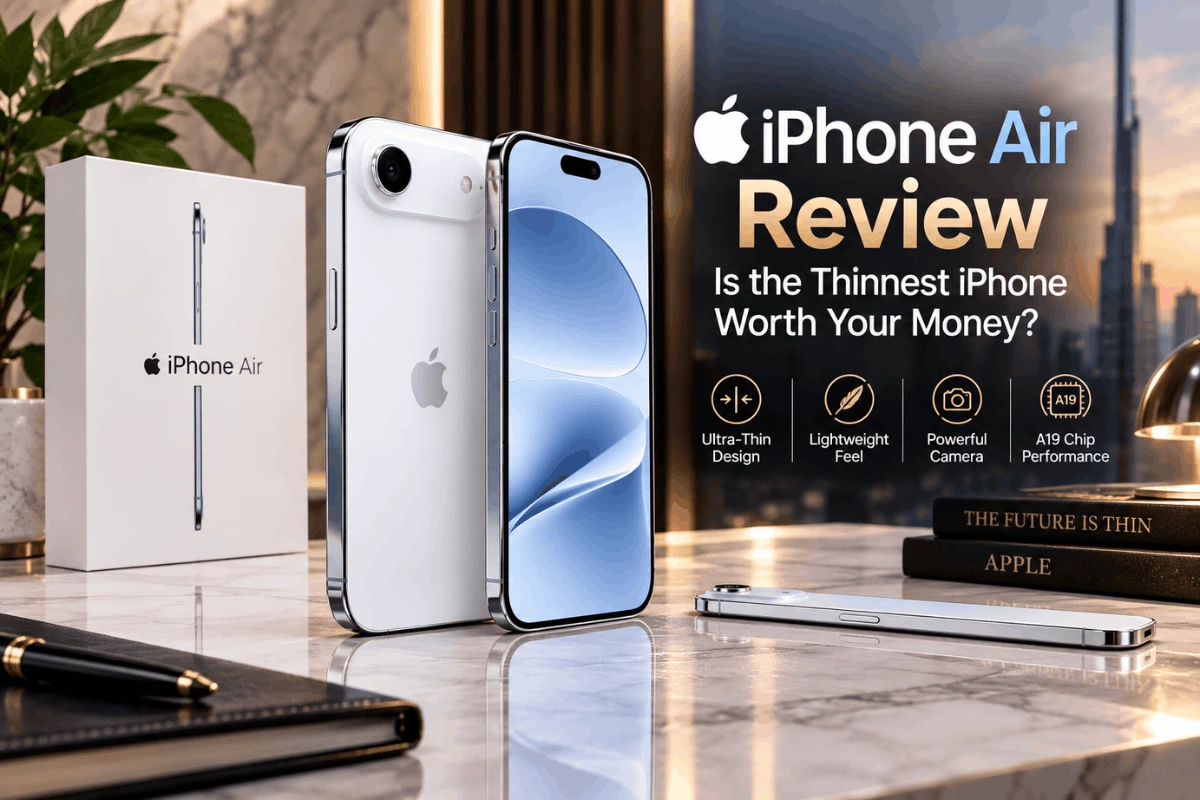
The smartphone market has become a little predictable. Bigger batteries, more cameras, heavier bodies, and increasingly powerful processors are common every year.
Introduced in 2025, the iPhone Air measures just 5.64mm thick and weighs 165 grams. It combines a 6.5-inch OLED display, ProMotion up to 120Hz, an A19 Pro chip, titanium construction, and a starting storage capacity of 256GB.
But is being extremely thin enough to justify its price? And what do you give up to achieve that slim design? Those are the more important questions. Let’s take a closer look at what this unusual iPhone offers and who should consider buying it.
What Makes the iPhone Air Different?
The biggest difference is immediately obvious when you pick it up. At only 5.64mm thick and 165 grams, the phone feels considerably lighter than many large flagship smartphones. Its body is 156.2mm tall and 74.7mm wide, giving you a generous screen without the feeling of carrying a brick in your pocket.
A phone designed around portability
Think of the design like a thin paperback book compared with a heavy hardcover. Both can contain plenty of information, but one disappears into your bag or hand much more easily.
That philosophy is central to this device. Apple has not simply taken a conventional phone and shaved a millimeter from its frame. The entire product has been designed around being thin and lightweight.
The result is especially noticeable when using the phone for long periods. Holding a lighter device while browsing social media, reading articles, taking photos, or messaging can be surprisingly comfortable.
The titanium frame also helps the phone maintain a premium feel. Apple pairs it with Ceramic Shield 2 on the front and Ceramic Shield on the back, while the device carries an IP68 rating for water and dust resistance.
Display: A Major Strength
If you spend a lot of time looking at your phone, the display may matter more than almost anything else. Fortunately, this is one area where the Air makes very few compromises.
The device features a 6.5-inch Super Retina XDR OLED display with a resolution of 2736 × 1260 pixels and a pixel density of 460 pixels per inch. It also includes Dynamic Island, Always-On display functionality, HDR, True Tone, and P3 wide color.
120Hz ProMotion makes everyday use smoother
One of the most important features is ProMotion, which supports adaptive refresh rates up to 120Hz.
You may not think about refresh rate while scrolling through a website, switching between apps, or navigating menus. Yet once you become accustomed to a fast, responsive screen, slower displays can feel noticeably less fluid.
The screen can also reach up to 3,000 nits of outdoor peak brightness according to Apple’s specifications. Its typical maximum brightness is listed at 1,000 nits, with HDR brightness reaching 1,600 nits.
That is useful for people who regularly use their phone outdoors. Whether you’re checking maps under bright sunlight or replying to messages while sitting outside, strong brightness can make a genuine difference.
The Always-On display is another convenient feature. Instead of fully waking the phone every time you want to glance at basic information, compatible information can remain visible.
For entertainment, the 6.5-inch size hits an interesting middle ground. It is larger than a compact flagship but not as enormous as some of the biggest premium phones.
Performance and the A19 Pro Chip
A thin phone does not necessarily have to be a slow phone. Apple proves that point with the A19 Pro chip.
The Air uses a six-core CPU with two performance cores and four efficiency cores, a five-core GPU with Neural Accelerators, and a 16-core Neural Engine. Hardware-accelerated ray tracing is also supported.
Fast enough for demanding everyday use
For normal activities, performance is more than sufficient. Apps open quickly, menus respond instantly, multitasking feels smooth, and demanding games can take advantage of the powerful hardware.
You can edit photos, stream high-resolution video, browse with numerous tabs, use productivity applications, and switch between demanding tasks without the phone feeling like it is struggling.
Reviews have also found the A19 Pro to be a strong performer in the Air, although sustained heavy workloads can produce some warmth because the device has less physical space for thermal management than thicker phones.
That is an important distinction. The Air is powerful, but its design priorities are different from those of a thick performance-focused flagship.
If you are a casual gamer, student, office worker, content consumer, or general smartphone user, there is little reason to worry about performance. The phone has enough processing power to remain capable for years.
For someone who spends hours playing demanding 3D games at maximum settings, however, a larger Pro model may make more sense because its physical design provides more room for cooling and a larger battery.
Camera System: Impressive, But Simplified
The camera setup is where the Air makes one of its clearest compromises.
Instead of providing a multi-camera system with separate ultra-wide and telephoto lenses, the device focuses on a single 48MP rear camera. The approach keeps the phone thin while still providing a capable primary camera.
Good everyday photography
For normal photography, the main sensor can produce impressive results. Family photos, food pictures, pets, documents, travel scenes, and social media content are all well within its comfort zone.
The limitation becomes more obvious when you want versatility.
An ultra-wide camera is useful for architecture, landscapes, large groups, and situations where you cannot physically move farther away. A dedicated telephoto camera, meanwhile, is valuable for portraits and distant subjects.
The Air asks you to choose simplicity over flexibility.
That is not necessarily a problem. Ask yourself how you actually use your phone camera. If you mostly point, shoot, and share pictures, the single-camera arrangement may be perfectly reasonable.
If photography is one of your main reasons for purchasing a flagship phone, though, the Pro models remain more attractive.
The front camera is more versatile
The front-facing camera is another strong part of the package. It is designed for selfies, video calls, and social content, while Apple’s software processing helps produce consistent results.
For people who frequently use video conferencing or create short-form content, the front camera can be more important than having an additional rear lens.
The bigger story here is not that the Air has a bad camera. It doesn’t. The issue is that it provides less camera versatility than similarly priced premium alternatives.
Battery Life and Charging
Battery life is probably the most important compromise to understand before buying.
A thinner body leaves less physical space for a large battery. Apple has worked to balance this through its processor, software optimization, and power management, but physics still matters.
Independent reviews have generally described battery life as solid rather than class-leading. TechRadar, for example, praised the phone’s design and performance while noting that battery endurance was not among its strongest areas.
Who will be comfortable with the battery?
If your daily routine involves messaging, browsing, photography, music, video streaming, and occasional gaming, the Air can be a practical all-day phone depending on your usage.
Heavy users should pay more attention.
Long gaming sessions, mobile photography, navigation, cellular data, high screen brightness, and video recording can drain a relatively slim device more quickly.
Charging is another area where the Air does not necessarily dominate. Reviews have criticized its charging speed compared with some competing flagship devices.
So why accept the compromise?
Because the Air is essentially making a trade: less physical bulk in exchange for some battery capacity and charging advantages.
For some buyers, that is a very good deal. For others, it will feel like the wrong priority.
Software and Apple Intelligence
The hardware is only half of the experience. Software is where the phone becomes something you use every day.
The Air runs Apple’s modern iOS platform and supports Apple Intelligence. Apple describes its AI features as being integrated across apps and experiences while emphasizing privacy protections.
A familiar and polished experience
If you already use an iPhone, the transition will feel natural. Messages, Photos, Safari, FaceTime, Apple Pay, iCloud, AirPods, and other parts of Apple’s ecosystem work together without requiring much setup.
For someone moving from Android, the experience can take some adjustment. The operating systems have different approaches to notifications, customization, file management, and multitasking.
The advantage is consistency. Apple controls the hardware and software together, which allows the company to optimize how the two interact.
The Air also benefits from a long software life compared with many smartphones. That matters because a phone costing around flagship money should not feel outdated after a short period.
Storage Options and Connectivity
Storage starts at 256GB, with 512GB and 1TB options also available.
256GB is a comfortable starting point
For most users, 256GB provides plenty of room for applications, photos, videos, downloaded content, and documents.
If you record large amounts of high-resolution video or keep your entire photo and video library locally, moving to 512GB or 1TB can make sense.
However, storage upgrades can become expensive. Before paying extra, consider how much space you actually use.
The Air is also built around modern wireless connectivity and Apple’s ecosystem. Depending on your market and carrier, connectivity features can vary, so buyers should check regional specifications before purchasing.
This is especially important for international buyers. Network bands, SIM functionality, eSIM support, and carrier compatibility can differ between markets.
Durability and Everyday Comfort
Thin phones naturally raise one question: Is it fragile?
That is a reasonable concern.
The Air uses titanium construction and Ceramic Shield materials, along with an IP68 rating. Apple lists resistance against dust and water under controlled laboratory conditions, including immersion to a maximum depth of six meters for up to 30 minutes.
That does not mean you should deliberately test it in a swimming pool.
Real-world durability also depends on drops, impacts, scratches, and how you treat the phone.
A case is still a sensible investment, especially because the slim body is one of the main reasons people buy the device in the first place. A good case can protect that design without adding too much bulk.
Long-term users have highlighted the lightweight construction as one of the phone’s most enjoyable qualities. Some owners who initially questioned the compromises have said that the comfortable form factor grew on them over time.
That tells us something interesting: specifications do not always describe the complete smartphone experience.
A phone can lose a camera or some battery capacity on paper and still become more enjoyable to use because it is simply easier to carry.
iPhone Air vs Pro Models
This is probably the most important comparison for buyers with a larger budget.
The Pro models are designed to offer a more complete flagship package. They generally prioritize camera versatility, battery capacity, sustained performance, and advanced hardware.
The Air takes a different route.
Choose the Air for design and portability
The Air makes sense if you care strongly about:
- A very thin body
- Low weight
- A large OLED display
- 120Hz ProMotion
- High-end processing power
- A premium titanium design
- A simpler camera system
- Comfortable everyday handling
The Pro models make more sense if you care about:
- Multiple rear cameras
- Optical zoom flexibility
- Longer battery endurance
- Heavy gaming
- Extended demanding workloads
- More advanced photography and video features
In other words, the Air is not simply a cheaper Pro.
It is a different idea.
Imagine choosing between a lightweight sports sedan and a large performance SUV. The SUV may have more equipment and greater capability, but the smaller vehicle might be more enjoyable every time you get behind the wheel.
That is the Air’s appeal.
Price and Overall Value
At launch, the Air started at $999 for 256GB in the United States, according to contemporary reviews.
That places it firmly in premium territory.
The question is therefore not whether the phone is good. It clearly is. The better question is whether its particular strengths matter enough to you.
As of 2026, the buying decision is also influenced by discounts, carrier promotions, storage configuration, and the availability of newer iPhone models. Current market listings show the Air competing with other high-end iPhones rather than occupying a traditional mid-range position.
This makes shopping around important.
When the Air represents good value
The Air can be worthwhile if you have always disliked heavy smartphones and want flagship performance without carrying a bulky device.
It can also appeal to people who care about design, portability, display quality, and everyday comfort more than having every possible camera feature.
When another iPhone is the better choice
If you want maximum battery life, the most flexible camera system, or the best overall performance package, a Pro Max model may be a stronger choice.
Current 2026 phone rankings also continue to place the iPhone 17 Pro Max among the strongest all-around smartphones, particularly for performance, cameras, and battery life.
The standard iPhone 17 can also make more sense for buyers who want strong flagship features without paying specifically for the Air’s ultra-thin design.
Who Should Buy the iPhone Air?
There is no universally perfect smartphone. The right choice depends on what you value.
Buy the Air if comfort matters to you
If you carry your phone everywhere, the difference between 165 grams and a much heavier flagship can become noticeable.
The phone is also appealing to people who prefer larger displays but dislike large, heavy devices.
It is especially suitable for everyday users
Students, professionals, travelers, social media users, and people who spend a lot of time reading or browsing can benefit from the combination of a large display and lightweight body.
The A19 Pro chip also gives the device plenty of headroom for demanding applications.
Photographers should think twice
If you regularly use ultra-wide photography or optical zoom, the single rear camera could become frustrating.
Similarly, users who spend most of their day away from chargers may prefer a thicker model with greater battery capacity.
Is the iPhone Air Still Worth Buying in 2026?
This is where things become interesting.
The Air remains an unusual smartphone because its most important advantage cannot be fully captured by a specification chart. Its thinness and weight affect every interaction.
Recent long-term reviews have continued to praise its lightweight design, while also pointing out the compromises involving battery life, camera versatility, and audio.
At the same time, reports indicate Apple has reconsidered the timing of a next-generation Air, with a new model reportedly moving toward early 2027 rather than a 2026 launch.
That could matter to shoppers.
If you are buying now and find a substantial discount, the existing model can be attractive. If you are not in a hurry, waiting may provide more choices as Apple’s next generation develops.
Ultimately, the Air is a phone for people who notice how a device feels, not just what its specification sheet says.
Final Verdict
The iPhone Air is one of Apple’s more interesting design experiments in recent years. Its combination of a 6.5-inch OLED display, 120Hz ProMotion, A19 Pro performance, titanium construction, and an exceptionally thin 5.64mm body creates a product that feels different from a conventional flagship.
Its weaknesses are equally clear. The single rear camera limits photographic flexibility, battery life is not class-leading, and charging performance is not its biggest selling point.
But those compromises are part of the story.
The Air is not trying to be the biggest, thickest, or most feature-packed iPhone. It is trying to make a premium smartphone feel almost weightless.
For someone who values portability, design, display quality, and strong everyday performance, that can be enough to make the Air genuinely compelling. For photographers, power users, and people who prioritize battery life above everything else, another model may be a better fit.
The smartest approach is simple: decide what you actually do with your phone before deciding which specifications you need.
Frequently Asked Questions
1. How thin is the iPhone Air?
The device is 5.64mm thick, making its ultra-thin construction one of its defining features. It weighs 165 grams and measures 156.2mm tall by 74.7mm wide.
2. Does the iPhone Air have a 120Hz display?
Yes. The 6.5-inch Super Retina XDR OLED display supports Apple’s ProMotion technology with adaptive refresh rates of up to 120Hz.
3. What processor does the iPhone Air use?
It uses Apple’s A19 Pro chip, featuring a six-core CPU, five-core GPU, and 16-core Neural Engine.
4. Does the iPhone Air have multiple rear cameras?
No. The rear system centers on a single 48MP camera. This provides strong everyday photography but does not offer the same multi-lens flexibility found on Apple’s higher-end Pro models.
5. Is the iPhone Air worth buying in 2026?
It can be, particularly if you value its extremely thin and lightweight design, high-quality display, and flagship-level performance. However, buyers who prioritize battery endurance, advanced photography, or maximum camera versatility should compare it carefully with the Pro models and current alternatives before purchasing.