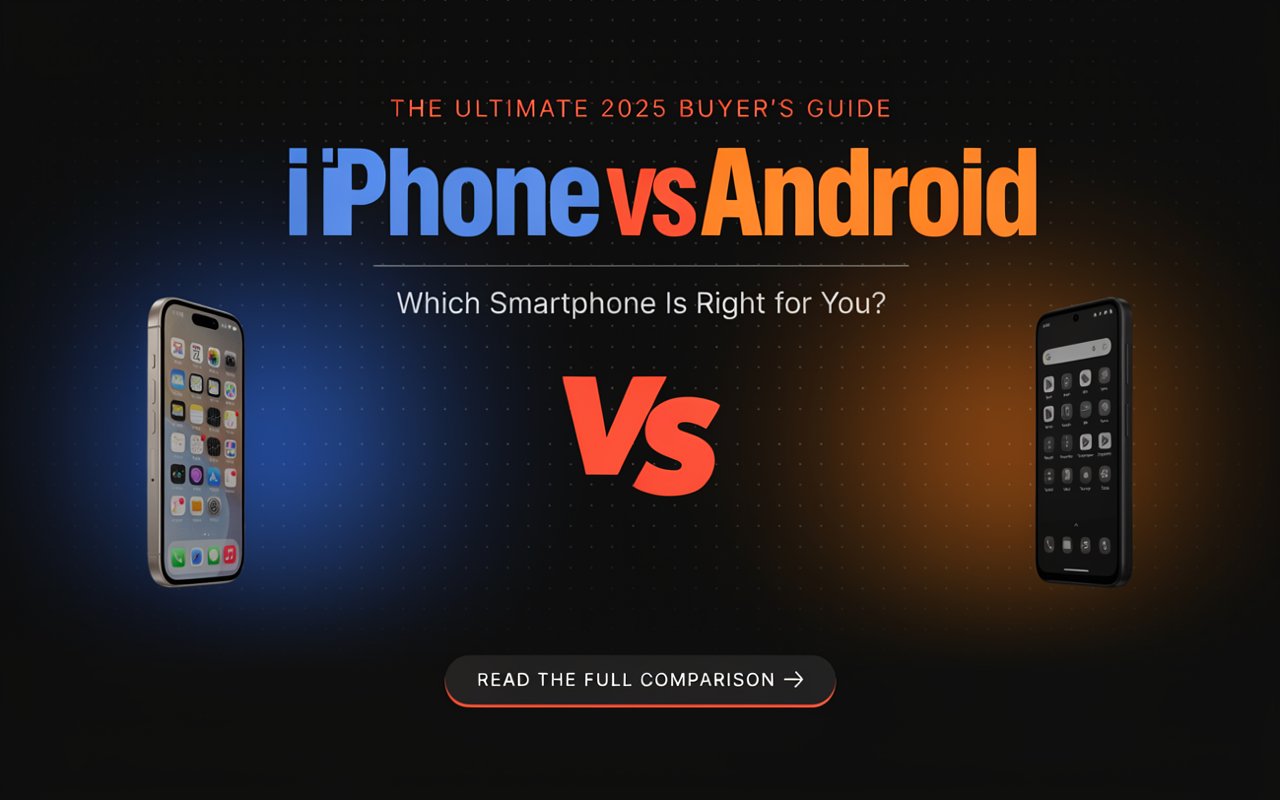
Choosing a new smartphone can feel surprisingly difficult. Both major platforms offer excellent cameras, fast performance, beautiful displays, long software support, and plenty of useful features. So, when it comes to iPhone vs Android, which one should you actually choose?
The answer is not as simple as saying one is better than the other. An iPhone may be ideal for someone who values simplicity, long-term software updates, and a tightly connected ecosystem. An Android phone, meanwhile, can be a better fit for someone who wants more customization, greater hardware variety, flexible pricing, or more control over how the phone works.
Think of the two platforms like different types of homes. One gives you a carefully designed experience where most things are already arranged for you. The other gives you more freedom to change the layout and choose exactly what suits you.
Let’s look at the biggest differences so you can decide which platform makes more sense for your everyday life.
iPhone vs Android: The Basic Difference
At the heart of the comparison are two operating systems: Apple’s iOS and Google’s Android.
Apple develops both the iPhone hardware and iOS software. Because the same company controls both sides, the experience is highly integrated. Apple decides how the operating system behaves, how its phones interact with other Apple products, and how many features are presented to users.
Android works differently. Google develops the core operating system, but manufacturers such as Samsung, Google, OnePlus, Xiaomi, Motorola, and others can customize it for their devices. This creates a much wider selection of phones with different designs, specifications, prices, and features.
The biggest practical difference is choice.
With an iPhone, your options are limited to Apple’s current and older models. That can make buying easier because there are fewer products to compare.
With Android, the market is much larger. You can choose from affordable phones, compact models, gaming devices, camera-focused handsets, foldable phones, and premium flagships.
Neither approach is automatically better. It depends on whether you prefer simplicity or flexibility.
Design, Build Quality, and Hardware Choices
Apple has traditionally focused on a consistent premium design language. Recent iPhones use high-quality materials, carefully finished frames, and durable glass. The overall design tends to feel polished and familiar across generations.
Android phones cover a much broader range.
You can find inexpensive models with plastic bodies, premium phones with glass and metal construction, and innovative devices with foldable displays. Manufacturers also experiment more aggressively with camera layouts, screen shapes, charging systems, cooling solutions, and other hardware features.
For premium construction, both platforms offer excellent choices.
A high-end Samsung Galaxy, Google Pixel, OnePlus, or another flagship Android phone can compete directly with an iPhone in build quality. At the same time, Android provides something Apple generally does not: a huge selection at different prices.
Someone spending a modest amount can still find an Android phone with a large display, multiple cameras, a high refresh rate, and a capable processor.
That makes Android particularly attractive to budget-conscious buyers.
Performance and Everyday Speed
Performance is another area where the difference is smaller than it once was.
Apple designs its own smartphone processors, and its high-end chips are known for strong performance and efficiency. iPhones generally feel responsive when opening applications, editing photos, recording video, browsing the web, and performing demanding tasks.
Android manufacturers use chips from companies such as Qualcomm and MediaTek, while Google and Samsung have also developed their own processor platforms for selected devices.
Does this mean iPhones are always faster?
No.
A premium Android phone can be extremely fast, and for everyday activities, most modern flagship phones provide more than enough power. The difference becomes more noticeable in specialized workloads such as intensive gaming, video editing, artificial intelligence features, or sustained performance.
There is another factor worth considering: optimization.
Because Apple controls the hardware and software together, it can optimize iOS specifically for its devices. Android has to work across a much broader hardware ecosystem.
However, modern Android manufacturers have become very good at optimization. For most users, both platforms provide smooth performance when choosing a reasonably modern phone.
Camera Quality: Which Platform Takes Better Photos?
Camera quality is one of the most important reasons people upgrade their phones.
The interesting thing is that there is no universal winner.
iPhones are widely appreciated for consistent photography and video recording. Apple puts significant emphasis on color processing, exposure, skin tones, stabilization, and video quality. If you frequently record videos for social media, travel, family events, or professional projects, an iPhone can be a particularly strong choice.
Android phones can be just as impressive, especially at the high end.
Some models emphasize detailed zoom photography. Others focus on computational photography, low-light performance, portraits, or extremely high-resolution sensors.
The camera experience depends heavily on the specific phone.
A premium Android model may outperform an entry-level or older iPhone in certain situations. Likewise, a current iPhone may produce more consistent results than a cheaper Android device.
Video is often one of the areas where iPhones remain especially attractive. They typically offer reliable stabilization, natural-looking footage, and strong audio recording.
For photography enthusiasts, Android may offer more experimentation. Some phones provide extensive manual controls, specialized shooting modes, advanced zoom systems, and additional camera options.
So instead of asking whether iPhone or Android has the better camera, ask a more useful question: Which specific phone has the camera features you actually need?
Software Experience and Ease of Use
iOS is excellent for people who want things to feel straightforward.
You can pick up an iPhone and quickly understand the basics. Apple’s interface has changed over the years, but its general approach remains familiar.
Android provides more flexibility.
Different manufacturers add their own interfaces and features. Samsung has its own software experience, Google keeps Android relatively close to its own vision, and other manufacturers add their own tools and design choices.
This means Android can feel very different depending on which phone you purchase.
Some people love this flexibility. Others find it confusing.
If you want a phone that mostly stays out of your way, iOS may be more appealing. If you enjoy changing your home screen, widgets, default applications, file handling, notifications, and other settings, Android usually gives you more freedom.
Customization and Personal Freedom
Customization is one of Android’s strongest advantages.
Android users can generally personalize their home screens, widgets, launchers, default applications, notification behavior, and other parts of the interface. Depending on the manufacturer and software version, there may be even more options.
You can make an Android phone feel distinctly yours.
iPhone customization has improved considerably, particularly through newer versions of iOS. Users can personalize home screens, lock screens, widgets, wallpapers, icons, and other elements.
However, Apple still maintains tighter control over the overall experience.
This difference can be described simply:
- iPhone gives you a polished environment with controlled flexibility.
- Android gives you a broader playground for personalization.
If you rarely change your phone’s appearance or settings, this distinction may not matter much.
But if customization is important to you, Android generally offers more freedom.
Apps, Messaging, and the Ecosystem
Apps are available on both platforms, and most major services support both iOS and Android.
You can use popular social networks, streaming platforms, banking services, productivity applications, games, and communication tools on either system.
The larger difference appears when you look at the ecosystem.
Apple has built a tightly connected group of products including the iPhone, iPad, Mac, Apple Watch, AirPods, and other services.
This ecosystem can make everyday tasks incredibly convenient.
You can start something on one Apple device and continue it on another. Photos, messages, files, passwords, and other information can synchronize across compatible devices.
Android has its own ecosystem advantages.
Google services work naturally across Android phones, Chromebooks, Windows computers, and the web. Samsung also offers a connected product ecosystem involving phones, tablets, watches, earbuds, and laptops.
Android also tends to work with a wider variety of accessories and devices.
If you already own several Apple products, an iPhone can make the most sense. If you use Google services heavily or own Windows hardware, Android may offer greater flexibility.
Software Updates and Long-Term Support
A smartphone is no longer something most people replace every year. Many buyers expect their device to last several years, which makes software support extremely important.
Apple has a strong reputation for supporting older iPhones with new versions of iOS for many years.
Long-term support is one of the strongest reasons to choose an iPhone.
Older devices can continue receiving security improvements and software features long after their original release.
Android has historically been more complicated because update policies vary between manufacturers and models.
The situation has improved significantly. Some premium Android phones now receive extended software support, with manufacturers competing more seriously on long-term updates.
Still, buyers should check the exact support policy for the model they are considering.
Don’t simply assume that every Android phone receives the same level of support.
If you plan to keep your smartphone for four, five, or more years, update availability should be part of your purchasing decision.
Battery Life and Charging
Battery life is another category where model choice matters more than operating system.
A large Android phone may include a physically larger battery, while an iPhone may achieve strong endurance through efficient hardware and software integration.
Real-world battery life depends on much more than battery capacity.
Screen brightness, processor efficiency, mobile signal strength, gaming, camera use, background applications, and software optimization can all affect how long a phone lasts.
Charging is where Android often has an advantage.
Many Android manufacturers offer very fast wired charging, while some premium models also provide powerful wireless charging options.
iPhones support fast charging as well, but Apple’s approach has generally been more conservative than some Android competitors.
If charging speed is a major priority for you, Android offers many attractive options.
If you simply need a phone that comfortably lasts through the day, both platforms have excellent choices.
Price and Value for Money
This is one of the clearest differences in the debate.
Apple positions the iPhone as a premium product, although older and lower-priced models can make the platform more accessible.
Android covers almost the entire smartphone market.
You can spend a small amount or a significant amount on an Android phone.
There are affordable Android devices for basic communication, mid-range models for everyday use, and expensive flagships competing directly with Apple’s top phones.
This variety means Android can offer excellent value for people who don’t want to spend flagship-level money.
However, price alone does not determine value.
An expensive phone that lasts for years, receives regular updates, retains useful performance, and has a strong resale market may represent better value than a cheaper device that needs replacement sooner.
iPhones often perform well in this broader calculation because of their long software support and strong resale demand.
Android can offer excellent value too, especially when manufacturers provide generous hardware at competitive prices.
Security, Privacy, and Reliability
Security matters more than ever because smartphones contain personal photographs, financial information, private messages, passwords, and other sensitive data.
Both iOS and Android have developed strong security systems.
Apple places significant emphasis on privacy controls, application permissions, tracking restrictions, and keeping users informed about how applications access personal information.
Android also provides extensive permission controls, security updates, application scanning, and privacy features.
The safest smartphone is not simply determined by its brand.
Keeping the operating system updated, installing applications from trusted sources, using strong authentication, and avoiding suspicious links are all important.
There are differences in how the two platforms handle applications and system access, but modern versions of both operating systems can provide a secure experience when used responsibly.
For most people, choosing between iPhone and Android should not be based solely on the assumption that one platform is completely secure and the other is not.
Gaming, Productivity, and Special Features
Smartphones have become miniature computers, so many people expect them to handle much more than calls and messages.
Both platforms are capable gaming devices.
iPhones benefit from powerful processors and strong game optimization. Apple’s hardware can deliver excellent performance in demanding titles.
Android offers greater hardware variety. Some gaming-focused phones include advanced cooling systems, high-refresh-rate displays, shoulder controls, large batteries, and specialized gaming software.
For productivity, both platforms are capable, but they approach flexibility differently.
iOS provides a polished experience and works particularly well with Apple’s other devices.
Android often gives users more control over file management, multitasking, default applications, external accessories, and other system functions.
Foldable phones are another major Android advantage.
If you want a phone that can transform into a tablet-sized device, Android currently offers far more choices.
This is a good example of why the comparison cannot simply be reduced to one operating system being better. Android manufacturers are willing to experiment with more form factors and unusual hardware designs.
Which One Should You Buy?
After comparing everything, the best choice comes down to your personal priorities.
Choose an iPhone if you value:
- A simple and consistent interface
- Long-term software support
- Strong video recording
- Integration with Apple products
- Excellent performance
- Consistent app experiences
- Strong resale value
- A polished user experience
Choose Android if you value:
- More price options
- Greater customization
- Fast charging
- Hardware variety
- Foldable phones
- More control over the system
- Wider choice of screen sizes
- More experimental features
But remember: you don’t have to choose based on brand loyalty.
Look at the specific phone.
A $400 Android phone and a $1,000 Android phone can offer dramatically different experiences. The same applies when comparing an older iPhone with a current flagship.
Your budget, existing devices, preferred apps, camera requirements, gaming habits, and expected ownership period should all influence your decision.
The Best Choice for Different Types of Users
For Apple ecosystem users: An iPhone is usually the natural choice because it works seamlessly with other Apple products.
For budget shoppers: Android generally provides more options and features at lower prices.
For photographers: Compare individual camera systems rather than choosing based only on operating system.
For video creators: iPhones are particularly attractive because of their strong video capabilities.
For customization enthusiasts: Android is usually the better fit.
For gamers: Both platforms can be excellent, but Android offers more gaming-specific hardware.
For long-term owners: Compare software support for the exact model before purchasing.
For people who dislike complicated settings: iOS may feel easier and more predictable.
Final Verdict: iPhone or Android?
So, which is better in the battle between iPhone and Android?
There is no universal winner.
The iPhone stands out for its simplicity, polished software, strong performance, long support, video capabilities, and Apple ecosystem. It is particularly appealing to people who want a phone that works smoothly without requiring much customization.
Android wins on flexibility, variety, customization, pricing, fast charging, experimental hardware, and choice. Whether you want an affordable everyday phone or an advanced foldable flagship, there is likely an Android device designed for you.
The smartest approach is to ignore the idea that one platform must defeat the other.
Your smartphone is a tool you use every day. The best one is the device that fits your habits, budget, and expectations.
If you already use a Mac, Apple Watch, and AirPods, moving to an iPhone may make your digital life easier. If you use Windows, Google services, or enjoy changing how your phone works, Android may be the more natural choice.
In other words, don’t ask, “Which phone is better for everyone?”
Ask, “Which phone is better for me?”
That small change in perspective can make the buying decision much easier.
FAQs
1. Is an iPhone better than Android?
Not necessarily. iPhones offer a polished experience, long software support, strong performance, and excellent ecosystem integration. Android provides more choice, customization, pricing options, and hardware variety. The better option depends on your needs.
2. Which is better for photography, iPhone or Android?
Both can produce excellent photos. iPhones are particularly strong for consistent photography and video, while some premium Android phones offer advanced zoom, photography controls, and impressive computational photography. Compare specific models rather than platforms alone.
3. Which has better battery life, iPhone or Android?
Battery life depends heavily on the individual model, display, processor, software, and usage habits. Both platforms have phones capable of lasting a full day or longer. Android generally offers more choices with very large batteries and extremely fast charging.
4. Is Android more customizable than iPhone?
Yes, Android generally provides greater customization. Users can change more aspects of the interface, default applications, launchers, widgets, and system behavior. iOS has expanded its customization options considerably but remains more controlled.
5. Should I switch from Android to iPhone or from iPhone to Android?
Consider your existing ecosystem first. If you rely heavily on Apple products, an iPhone may provide a smoother experience. If you want more hardware choices, customization, or charging flexibility, Android may be worth considering. Before switching, check whether the apps, accessories, and services you depend on work equally well on the other platform.