
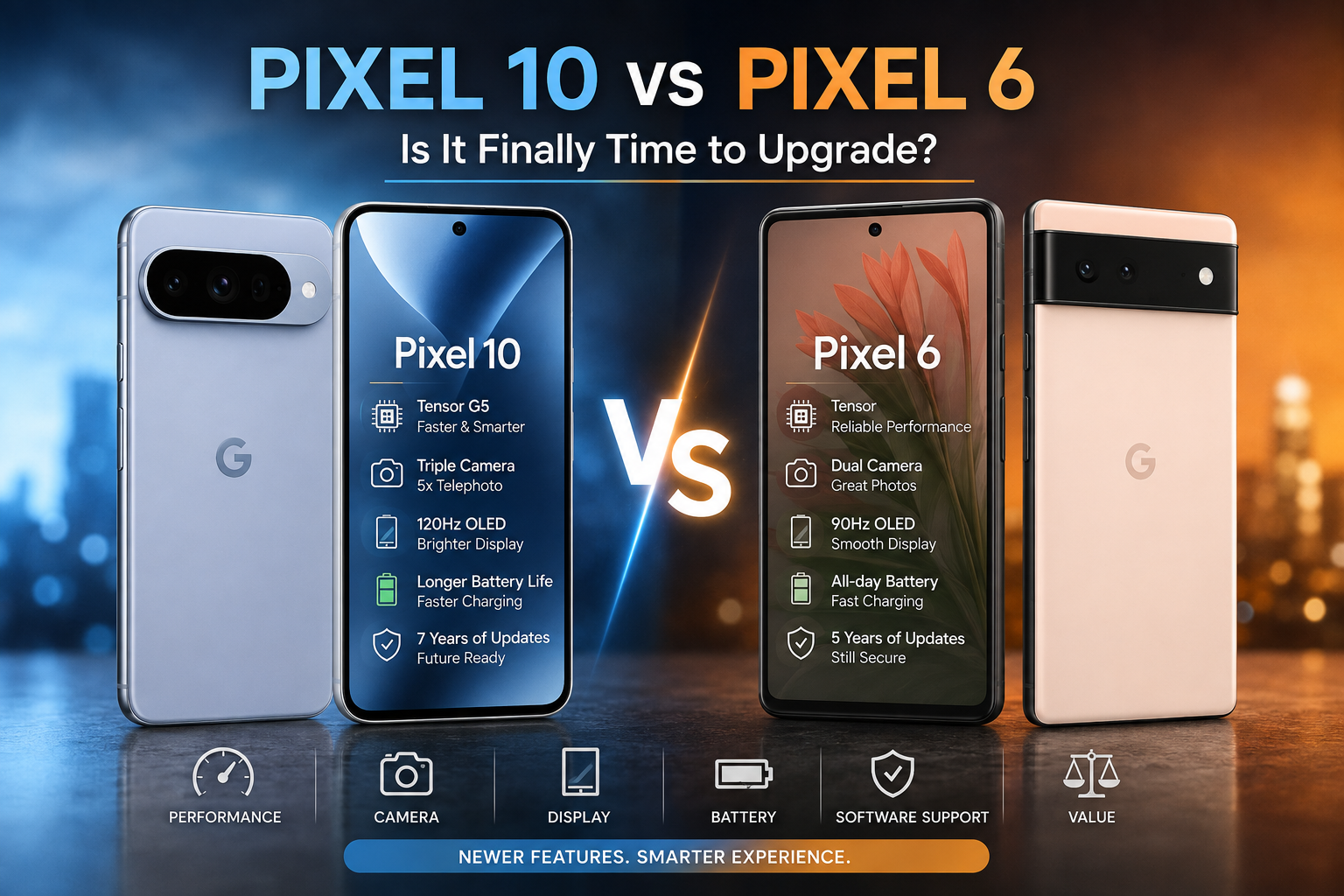
But does a newer phone automatically mean that every Pixel 6 owner should upgrade? Not necessarily.
A comparison between these two devices is a little like comparing a reliable car from several years ago with a modern version built on the same idea. The newer model may offer better efficiency, smarter technology, and more refined features, but the older one can still handle many everyday journeys.
The real question is not just which phone is newer, but whether the upgrade will make a meaningful difference in your everyday experience. It is whether the improvements in the newer generation will make a meaningful difference in the way you use your phone every day.
1. Pixel 10 vs Pixel 6: The Main Difference
The most obvious difference is the generation gap.
The Pixel 6 launched as a 2021 smartphone with Google’s original Tensor processor, 8GB of RAM, a 6.4-inch OLED display, and a dual-camera system. The Pixel 10, meanwhile, launched with the Tensor G5 processor, 12GB of RAM, a 6.3-inch OLED display with a 60–120Hz refresh rate, and a triple-camera system that adds a dedicated 5x telephoto lens.
This is not a minor year-to-year upgrade. Several generations separate the two devices, which means improvements have accumulated across almost every major area.
The Pixel 10 offers:
- A newer and more efficient processor
- More RAM for multitasking
- A brighter and smoother display
- A dedicated telephoto camera
- Faster and more capable AI features
- Improved battery capacity and charging options
- Qi2-compatible magnetic wireless charging
- Seven years of OS, security, and Pixel Drop updates
The Pixel 6 still remains capable of handling basic activities such as messaging, browsing, social media, navigation, photography, and video streaming. However, the newer device is clearly designed for users who want a more future-ready experience.
2. Design and Build Quality
The Pixel 6 introduced Google’s distinctive horizontal camera bar, a design decision that helped give Pixel phones a recognizable identity.
At the time, it looked very different from the usual smartphone design. The combination of a large camera bar and curved appearance made the phone stand out.
The Pixel 10 keeps Google’s recognizable visual identity but refines the overall design. Google describes it as having a satin-finish metal frame, polished glass back, and an updated version of the iconic camera bar. It also measures 152.8 × 72 × 8.6 mm and weighs 204 grams, compared with the Pixel 6 at 158.6 × 74.8 × 8.9 mm and 207 grams.
Which design feels better?
The Pixel 10 is slightly more compact and lighter, despite offering a similar-sized display. That can make it easier to handle and carry.
The Pixel 6, however, still has a unique appearance. If you already enjoy its design, upgrading solely for looks may not be necessary.
The real advantage comes from refinement rather than a complete redesign.
3. Display: A Brighter and Smoother Experience
The Pixel 6 features a 6.4-inch OLED display with a resolution of 1080 × 2400 pixels and a refresh rate of up to 90Hz.
The Pixel 10 uses a slightly smaller 6.3-inch OLED display with a resolution of 1080 × 2424 pixels, but its refresh rate reaches 120Hz. More importantly, Google rates it for up to 3,000 nits of peak brightness and up to 2,000 nits in HDR, while also using Gorilla Glass Victus 2 protection.
Why does this matter in daily use?
A higher refresh rate can make scrolling, animations, and general navigation feel noticeably smoother and more responsive.
Brightness can make an even bigger practical difference. Reading messages, checking directions, or viewing photographs outdoors becomes easier when the display remains visible in strong sunlight.
The Pixel 6 screen is still perfectly usable, but after several years of display development, the Pixel 10 provides a more polished viewing experience.
4. Performance: Tensor G5 vs the Original Tensor
The performance difference represents one of the strongest reasons to upgrade.
The Pixel 6 was Google’s first phone powered by its custom Tensor processor. It was an important step because it allowed Google to focus on machine learning and intelligent software features.
The Pixel 10 uses Tensor G5, Google’s fifth-generation Tensor chip. Google says the new processor provides a 34% faster CPU on average than Tensor G4 and includes a TPU that is up to 60% more powerful. It is also built on a newer 3nm process and is designed to handle more advanced on-device AI features.
Of course, the Pixel 6 is not suddenly unable to open everyday apps.
For activities such as:
- Messaging
- Browsing
- Social media
- Streaming
- Navigation
- Online shopping
the older phone can still do the job.
However, the difference becomes more noticeable when you multitask, edit photographs, use demanding applications, or take advantage of newer AI-powered features.
The Pixel 10 also has 12GB of RAM, compared with 8GB on the Pixel 6. More memory can help the newer phone manage multiple applications and heavier workloads more comfortably.
Think of the Pixel 6 as a dependable workstation and the Pixel 10 as a newer workspace with faster tools and more room to work. Both can complete everyday tasks, but the newer environment is better prepared for increasingly demanding software.
5. Camera Comparison: From Dual Cameras to a Triple-Camera System
The Pixel 6 helped establish Google’s reputation for combining strong camera hardware with computational photography.
Its rear camera system includes a 50MP main camera and a 12MP ultrawide camera. The phone supports Super Res Zoom up to 7x, although it does not have a dedicated telephoto lens.
The Pixel 10 expands the camera system considerably.
Google lists:
- 48MP wide camera with Macro Focus
- 13MP ultrawide camera
- 10.8MP 5x telephoto camera
- Super Zoom up to 20x
The front camera is also upgraded to a 10.5MP autofocus unit with 4K video support.
The telephoto lens is a major advantage
This is one of the clearest differences between the two phones.
The Pixel 6 relies heavily on digital zoom when you want to capture a distant subject. The Pixel 10 includes dedicated telephoto hardware with 5x optical zoom.
That can be useful for:
- Travel photography
- Sporting events
- Wildlife
- Concerts
- Architectural details
- Portraits from a greater distance
If photography is important to you, this upgrade alone can significantly change what you are able to capture.
6. Photography Software and Video Features
Camera quality is no longer determined only by megapixels.
Modern smartphones rely heavily on software and image processing.
The Pixel 10 benefits from Google’s newer camera technology and Tensor G5 processing. Google highlights features such as Camera Coach, Add Me, Auto Best Take, Macro Focus, Photo Unblur, Zoom Enhance, and editing tools connected with Google Photos.
The newer processor also supports improvements to image and video processing.
The Pixel 10 can record 4K video at up to 60 frames per second from its rear cameras, while the front camera also supports 4K recording at 30 or 60 frames per second.
The Pixel 6 can still take excellent photographs. In fact, many people may be completely satisfied with its camera for family pictures, travel, and social media.
The difference is that the Pixel 10 provides more flexibility.
It gives you another lens, more advanced editing tools, better zoom options, and newer AI-assisted photography features.
7. Artificial Intelligence: The Biggest Generational Shift
Artificial intelligence is where the gap between these phones becomes particularly noticeable.
The Pixel 6 was launched before generative AI became a central part of the smartphone experience.
The Pixel 10 was designed during an era when AI is deeply integrated into mobile software.
Tensor G5 is designed to run Google’s latest Gemini Nano model on the device. Google says this enables features such as Magic Cue, Voice Translate, Call Notes with actions, and Personal Journal, with availability varying by country, language, and feature.
What does this mean for ordinary users?
AI is most useful when it saves time.
Imagine your smartphone as a personal assistant sitting quietly beside you. A good assistant does not interrupt you every few seconds. Instead, it provides useful information when you need it.
That is the direction Google is moving toward with newer Pixel features.
The Pixel 10 can offer more advanced assistance with:
- Calls
- Translation
- Information
- Writing
- Photography
- Search
- Organization
Not everyone needs these tools. If you mainly use your phone for basic communication, the AI improvements may not change your life.
But for users who regularly interact with text, images, calls, and information, the difference can be substantial.
8. Battery Life and Charging
Battery technology has also improved over the generations.
The Pixel 6 has a typical battery capacity of 4,614mAh. Google originally rated it for beyond 24 hours of battery life and up to 48 hours with Extreme Battery Saver.
The Pixel 10 has a typical 4,970mAh battery and is rated for more than 24 hours of battery life, with up to 100 hours using Extreme Battery Saver. It can charge to up to 55% in around 30 minutes with a compatible 30W USB-C PPS charger or higher.
Battery health also changes the comparison
This is especially important for current Pixel 6 owners.
Even if the Pixel 6 had strong battery life when new, several years of charging can naturally reduce battery health.
A new Pixel 10 therefore benefits from both newer hardware and a completely fresh battery.
The Pixel 10 also supports Pixelsnap wireless charging with Qi2 certification at up to 15W. Google describes the Pixel 10 family as supporting built-in Qi2 wireless charging and magnetic accessories.
For someone tired of carrying cables everywhere, this can be a useful convenience upgrade.
9. Software Support and Long-Term Value
Software support is one of the biggest practical differences between buying an older and a newer phone.
The Pixel 6 launched with Android 12 and was originally promised at least five years of security updates from when it first became available on the Google Store in the United States.
The Pixel 10 launches with Android 16 and comes with seven years of OS, security, and Pixel Drop updates.
This matters for several reasons.
Longer support can help with:
- Security
- New Android features
- Application compatibility
- Device longevity
- Resale value
If you are buying a phone in 2026 and expect to keep it for several years, the Pixel 10 clearly has the stronger long-term position.
For an existing Pixel 6 owner, approaching the end of the original support window is another reason to think about upgrading.
10. Connectivity, Safety, and Security
The Pixel 6 was already a modern 5G smartphone when it launched.
The Pixel 10 builds on that foundation with newer connectivity technology and additional safety features.
Google lists Satellite SOS, Emergency SOS, Car Crash Detection, Safety Check, Crisis Alerts, and theft-protection features for the Pixel 10, although availability depends on location and supported services.
The newer phone also combines Tensor G5, the Titan M2 security chip, and other security layers.
Both devices include the Titan M2 security coprocessor, but the newer generation benefits from updated hardware and software built around Google’s current security approach.
For most users, these features may remain invisible until they are needed.
But that is exactly how good safety technology should work.
You may never need emergency assistance, theft protection, or advanced scam detection, but having those tools available can provide additional peace of mind.
11. Price and Overall Value
Price can completely change the decision.
The Pixel 6 may be available for much less than a new Pixel 10, especially through used or refurbished sellers. This can make it attractive for buyers who simply want an affordable Android phone with Google’s clean software and a capable camera.
The Pixel 10 starts at a premium price in markets where Google sells it directly. In the United States, Google’s store lists the base model from $799, although actual prices and promotions vary by country and retailer.
The Pixel 6 offers value if:
- You find it at a very low price.
- You mainly perform basic smartphone tasks.
- You do not need advanced AI features.
- You are satisfied with a 90Hz display.
- A dedicated telephoto camera is not important.
The Pixel 10 offers better long-term value if:
- You plan to keep the phone for several years.
- You want longer software support.
- You value improved AI tools.
- You take photographs regularly.
- Zoom photography matters to you.
- You want a brighter 120Hz display.
- You need stronger multitasking performance.
The cheapest phone is not always the best value.
A device that costs more initially but remains useful and supported for years may be the better long-term purchase.
12. Should You Upgrade From Pixel 6 to Pixel 10?
For many Pixel 6 owners, the answer is yes—but it depends on your current experience.
The upgrade is particularly worthwhile if your existing phone has:
- Declining battery life
- Performance issues
- Storage limitations
- Physical damage
- Camera limitations
- Software support concerns
The jump from the original Tensor chip to Tensor G5 is significant from a generational perspective. The Pixel 10 also brings more RAM, a brighter 120Hz display, a telephoto camera, newer AI capabilities, Qi2 wireless charging, and much longer future software support.
Keep your Pixel 6 if:
Your phone still performs well, the battery remains healthy, and you are satisfied with its camera and software experience.
There is no rule saying that you must replace a phone simply because a new model exists.
Upgrade to the Pixel 10 if:
You want your next phone to last longer, perform better, capture more versatile photographs, and take advantage of Google’s newest AI and software features.
For someone upgrading from a Pixel 6, the Pixel 10 represents a much more meaningful step forward than a typical one-year smartphone update.
Conclusion
The Pixel 6 and Pixel 10 represent two very different stages in Google’s smartphone development.
The Pixel 6 was the beginning of the Tensor era. It introduced a bold design, powerful computational photography, and Google’s vision for a more intelligent Android phone.
The Pixel 10 builds on that foundation with Tensor G5, a smoother and brighter display, more RAM, a dedicated 5x telephoto camera, newer AI capabilities, improved charging, and seven years of software support.
The Pixel 6 is still capable of handling everyday tasks, so an upgrade is not necessary for everyone. But if you have been using it for several years, the accumulated improvements in the Pixel 10 can create a noticeably different experience.
In simple terms, the Pixel 6 is still a good old companion, while the Pixel 10 is built for the next chapter. If your current phone is beginning to feel slow, limited, or outdated, this is a generation gap large enough to make upgrading genuinely worthwhile.
Frequently Asked Questions
1. Is the Pixel 10 much better than the Pixel 6?
Yes. The Pixel 10 offers a newer Tensor G5 processor, 12GB of RAM, a 120Hz display, a dedicated 5x telephoto camera, newer AI features, improved charging options, and significantly longer remaining software support.
2. Is it worth upgrading from Pixel 6 to Pixel 10?
For many users, yes. The upgrade is especially worthwhile if your Pixel 6 has declining battery health, performance issues, limited storage, or if you want newer camera and AI capabilities.
3. Which phone has the better camera?
The Pixel 10 offers a more versatile camera system because it adds a dedicated 5x telephoto lens and supports up to 20x Super Zoom. The Pixel 6 still has a capable 50MP main camera and 12MP ultrawide camera, but it lacks dedicated telephoto hardware.
4. Does the Pixel 10 have better battery life than the Pixel 6?
The Pixel 10 has a larger typical battery capacity of 4,970mAh compared with 4,614mAh on the Pixel 6, along with newer hardware and updated power management. Real-world results will still depend on your usage and settings.
5. Should I keep my Pixel 6 or buy a Pixel 10?
Keep the Pixel 6 if it still meets your needs and you are satisfied with its performance. Choose the Pixel 10 if you want a longer-lasting device with stronger performance, better display technology, more advanced cameras, modern AI features, and seven years of software support.