
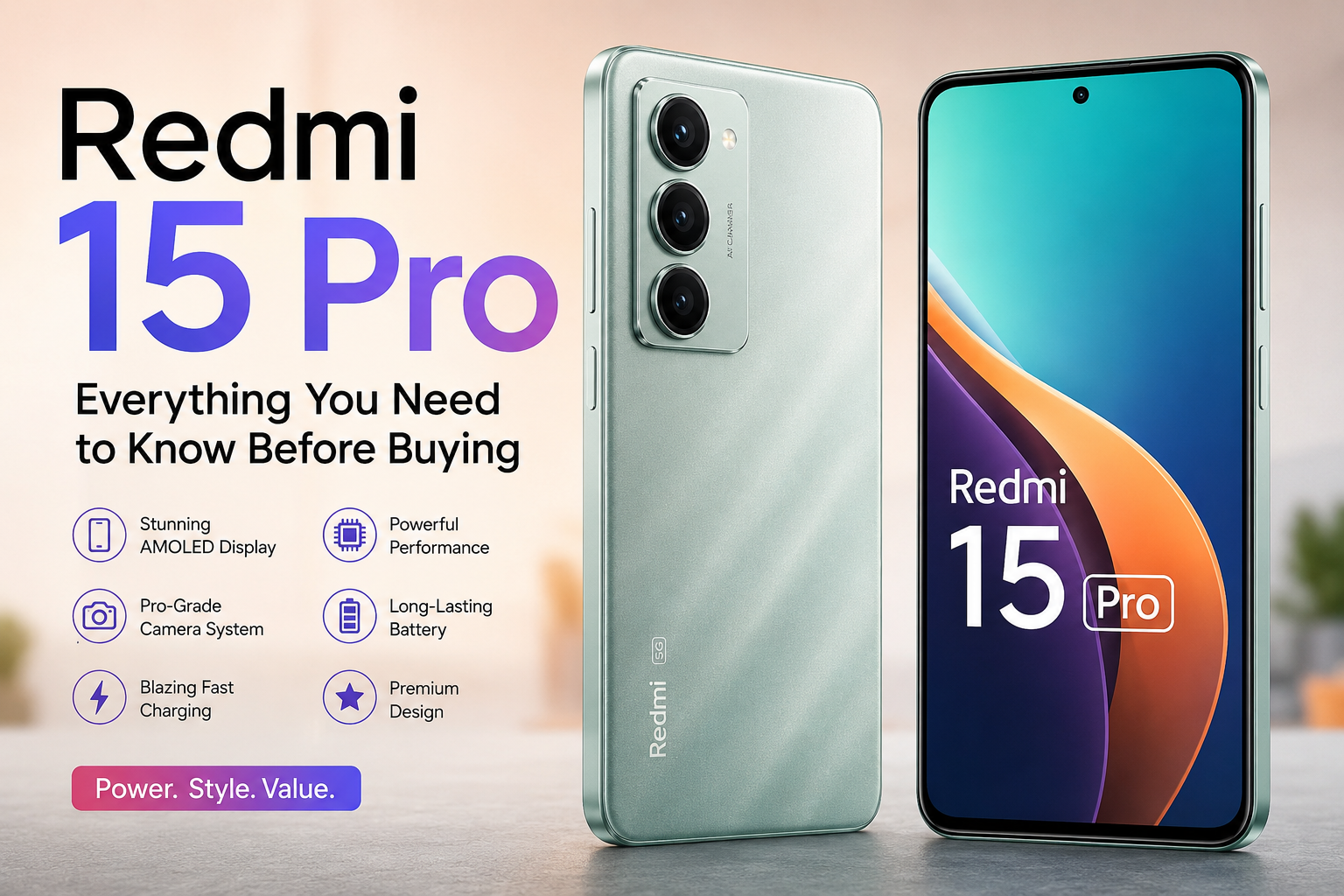
The smartphone market is packed with options, and choosing the right device can feel surprisingly difficult. Every new model promises a better camera, faster performance, a brighter display, and longer battery life. But when you are actually ready to spend your money, one question matters more than anything else: will this phone make your everyday life easier and more enjoyable?
The term Redmi 15 Pro is often used by people searching for a more advanced model in the Redmi 15 family. Xiaomi’s confirmed lineup includes the standard Redmi 15 series and the Redmi Note 15 Pro range, which offers more advanced features in areas such as display technology, cameras, performance, and charging.
For most buyers, the technical details only tell part of the story. You want to know how the phone feels in your hand, whether the screen looks good outdoors, how well it handles daily apps, whether the camera captures memorable moments, and whether the battery can keep up with your busiest days.
This guide explores the features that matter most when considering a Redmi 15 Pro-level smartphone. From design and display quality to cameras, performance, software, battery life, and long-term value, we will break everything down in simple language.
1. Understanding the Redmi 15 Pro Name and Product Range
Before looking at features, it is helpful to understand the naming situation.
Why the name can cause confusion
Smartphone manufacturers often release several models with similar names. A standard version may focus on affordability, while a Note or Pro version may offer stronger hardware and more advanced features.
This means buyers should never rely on the name alone.
A phone called “Pro” in an online listing may not always be an officially named product. Regional websites, retailers, and search terms can sometimes use simplified or inaccurate naming.
The safest approach is to check the exact model number and official product name before buying.
What separates a Pro-level model?
A more advanced Redmi device is generally expected to offer improvements in several important areas, such as:
- A higher-quality display
- Improved camera hardware
- Stronger processing power
- More memory or storage options
- Better durability
- Faster charging
- More advanced software tools
However, the best phone is not automatically the one with the word “Pro” in its name.
Think of buying a smartphone like buying a house. A bigger house may sound better, but it is only the right choice if the location, layout, and price also work for you.
In the same way, a phone should be judged by the complete experience rather than one label.
2. Design and Build Quality: Made for Everyday Life
Your smartphone is one of the few devices you carry almost everywhere.
You hold it while traveling, place it on your desk, use it during meals, take it to school or work, and rely on it for communication throughout the day.
Because of this, design is not simply about appearance.
A modern look with practical comfort
Modern Redmi phones often focus on large displays while using slimmer bezels and refined rear designs to create a more contemporary appearance.
A well-designed device should feel balanced in your hand. It should not feel unnecessarily heavy, awkward, or difficult to hold during long periods of use.
Of course, larger phones can provide a better entertainment experience, but there is always a trade-off.
A bigger screen is excellent for watching videos and playing games. On the other hand, a compact device may be easier to operate with one hand.
The ideal choice depends on your personal routine.
Durability matters too
A smartphone does not need to survive every possible accident, but basic protection against dust and accidental splashes can provide additional peace of mind.
Build quality also includes the small details.
Are the buttons easy to reach? Does the frame feel solid? Is the camera area well protected? Does the phone remain comfortable after an hour of watching videos?
These are the questions that often matter more after you have owned the device for several months.
3. Display Quality: One of the Most Important Features
The display is where almost your entire smartphone experience takes place.
Every message, photograph, video, website, and game passes through the screen.
That makes display quality much more important than many buyers realize.
Size and immersion
A larger screen can make a phone feel like a small portable entertainment center.
You can comfortably:
- Watch movies
- Browse websites
- Read articles
- Play games
- View photographs
- Use social media
- Join video calls
For users who spend several hours each day on their phones, screen size can have a significant impact on comfort.
However, size is only one part of the equation.
Resolution and visual detail
A higher-resolution display can make text appear sharper and images more detailed.
This can be especially useful when reading small text or watching high-quality video.
A good screen should provide a balance between sharpness, brightness, and power efficiency.
You do not necessarily need the highest possible resolution. What matters is whether the display looks clear and comfortable during normal use.
Smooth scrolling and refresh rate
Refresh rate has become an important feature in modern smartphones.
A higher refresh rate can make scrolling and supported animations feel smoother.
Picture yourself gliding effortlessly from one page of a book to the next. A responsive display can create a similar sense of smooth movement while navigating through apps and digital content.
Once you become accustomed to a fluid screen, returning to a traditional lower-refresh-rate display may feel noticeably less responsive.
For gaming and social media users, this can be a particularly welcome improvement.
4. Performance: How Well Does It Handle Daily Tasks?
Performance is often the first thing people think about when considering a new phone.
But performance is not just about running the most demanding game at the highest possible settings.
For most users, it is about everyday speed.
A smooth daily experience
You should be able to unlock your phone, open the camera, reply to messages, browse the internet, and switch between applications without unnecessary delays.
What truly matters is how smoothly the phone performs in everyday use.
A capable processor and sufficient memory can help improve activities such as:
- Web browsing
- Social media
- Video streaming
- Online shopping
- Messaging
- Navigation
- Photography
- Video calls
The average user does not need to understand every technical detail of a processor.
You simply want the phone to respond when you tap something.
Multitasking and memory
Modern smartphone users rarely stay inside one application.
You might open a messaging app, check a social media notification, watch a video, respond to an email, and return to your browser within minutes.
Adequate RAM can help the phone manage these activities more effectively.
More memory may be especially useful for people who regularly:
- Play mobile games
- Use several apps simultaneously
- Edit photographs
- Create videos
- Keep many browser tabs open
The right configuration depends on how heavily you use your device.
5. Camera Experience: More Than a Megapixel Number
The camera has become one of the biggest reasons people upgrade their phones.
Your smartphone is usually the camera you have with you when something unexpected happens.
A family gathering, a beautiful sunset, a vacation, or a memorable moment can appear at any time.
The main camera
A high megapixel number can be useful, but it does not automatically guarantee better photographs.
Camera quality also depends on:
- Sensor quality
- Lens design
- Image processing
- Stabilization
- Lighting conditions
- Software optimization
A good camera should make photography easy.
You should not have to understand professional camera settings simply to capture a clear photograph.
For most people, consistency is more valuable than complicated specifications.
Low-light photography
Taking photographs at night is more challenging because there is less available light.
Modern image processing can help brighten scenes, improve exposure, and reduce unwanted noise.
However, buyers should keep realistic expectations.
Even a phone with an impressive camera specification can perform differently depending on lighting conditions and software processing.
If photography is your highest priority, real-world camera samples are often more useful than simply comparing numbers.
Ultra-wide photography
An ultra-wide camera can be useful when you want to capture more of a scene.
It can help with:
- Landscapes
- Architecture
- Group photographs
- Travel images
- Indoor scenes
This flexibility can make a smartphone camera system more useful than a single-lens setup.
Selfies and video calls
The front camera is important for much more than selfies.
People now use it for online meetings, video calls, virtual classes, and social media content.
A good front-facing camera should provide clear facial detail and balanced lighting.
6. Battery Life: Can It Keep Up With Your Day?
Battery life is one of the most practical smartphone features.
A powerful phone is not particularly useful if you constantly need to search for a charger.
What affects battery performance?
Battery capacity is important, but it is not the only factor.
Real-world battery life depends on:
- Screen brightness
- Mobile network usage
- Gaming
- Video streaming
- Camera usage
- Background apps
- Software optimization
- Signal strength
Two phones with similar battery capacities can therefore deliver different results.
Efficient software and a well-optimized processor can help reduce unnecessary power consumption.
A phone that lasts beyond the morning
For many people, the ideal smartphone should comfortably survive a full day.
Heavy users may require even more.
If you regularly travel, play games, use navigation, watch videos, or depend on your phone for work, battery capacity becomes even more important.
A large battery is like carrying a larger water bottle on a long journey. You may not need all of it every day, but having extra capacity can provide reassurance when you are away from home.
7. Charging Speed and Everyday Convenience
A large battery is useful, but charging technology is equally important.
Imagine realizing that your phone is nearly empty just before leaving home.
Waiting several hours for a full charge would be frustrating.
Fast charging makes a difference
Fast charging can restore a useful amount of power in a relatively short period.
This is particularly useful for:
- Students
- Professionals
- Travelers
- Commuters
- Heavy smartphone users
However, faster is not always the only consideration.
Buyers should also consider the charging adapter included with the phone and the long-term health of the battery.
Different markets may also include different accessories inside the box.
Reverse charging
Some modern smartphones can also provide power to other compatible devices.
This can be useful for charging small accessories or helping another phone in an emergency.
While it may not be a feature you use every day, it can become extremely helpful when you need it.
8. Gaming and Entertainment Performance
Smartphones have become portable entertainment devices.
People use them to stream movies, listen to music, watch short videos, and play games.
A Redmi 15 Pro-level device should be evaluated according to the type of entertainment you enjoy most.
Casual and competitive gaming
Casual games generally do not require the most powerful hardware.
More demanding titles, however, can place significant pressure on the processor and graphics system.
Gaming performance depends on several factors:
- Processor speed
- Graphics capability
- Available RAM
- Cooling
- Display refresh rate
- Touch responsiveness
- Software optimization
A powerful processor can improve gaming, but sustained performance is also important.
A phone that performs brilliantly for five minutes but becomes too hot or slows down later may not provide the best experience.
Audio quality
Sound is another important part of entertainment.
Clear speakers can improve:
- Movies
- Games
- Music
- Podcasts
- Video calls
Support for enhanced audio features can also make headphones and compatible speakers more enjoyable.
9. Software and Smart Features
Hardware attracts attention, but software determines how you interact with your phone every day.
A good operating system should make the device feel simple rather than complicated.
Easy navigation
You should be able to quickly:
- Find applications
- Adjust settings
- Manage notifications
- Change wallpapers
- Organize files
- Control privacy options
A clean interface can make even a powerful phone feel more approachable.
The best software works quietly in the background. It helps you complete tasks without constantly demanding your attention.
AI-powered tools
Artificial intelligence has become increasingly common in smartphones.
Depending on the model and region, smart tools may assist with:
- Photo editing
- Object removal
- Image enhancement
- Search
- Writing assistance
- Voice functions
- Translation
- Productivity
These features can be useful, but they should not be the only reason to buy a phone.
A practical smartphone still needs a good display, reliable battery, capable processor, and dependable camera.
10. Storage and Memory: Thinking About the Future
Storage can disappear faster than you expect.
High-resolution photographs, long videos, large games, downloaded movies, and applications can quickly fill your phone.
How much storage do you need?
Your ideal storage capacity depends on your habits.
A lighter user may mainly store:
- Messaging apps
- Social media
- Photographs
- Documents
- A few games
A heavy user may also store:
- Large video files
- Offline movies
- Multiple games
- Editing projects
- Thousands of photographs
It is usually wise to think about how your storage needs may change over the next two or three years.
Your digital life rarely becomes smaller.
Expandable storage
Support for expandable storage can provide additional flexibility where available.
This can be useful for users who take many photographs or want to keep large files on their devices without relying entirely on cloud storage.
11. Connectivity and Security Features
A modern smartphone needs reliable connectivity.
The exact network support depends on the specific model and region, so buyers should always check compatibility before purchasing.
Mobile and wireless connections
Important connectivity features may include:
- 4G or 5G
- Wi-Fi
- Bluetooth
- GPS
- NFC
- USB Type-C
- Dual SIM support
A 5G-capable model can provide access to newer mobile networks where compatible coverage is available.
However, a 5G logo does not automatically guarantee fast speeds.
Your experience will still depend on:
- Network coverage
- Your carrier
- Signal strength
- Network congestion
- Your mobile plan
Security matters
Smartphones contain a large amount of personal information.
They may store your photographs, emails, passwords, banking apps, and important documents.
Convenient security features can therefore make a meaningful difference.
Fingerprint sensors and facial unlocking can help protect your information while keeping the device easy to access.
12. Is a Redmi 15 Pro-Level Phone Worth Buying?
The answer depends on your expectations and budget.
A more advanced Redmi model can be a strong option for users who want a balance between premium features and practical value.
Who should consider it?
This type of smartphone may be suitable for:
Everyday users: People who want smooth performance, a large display, reliable battery life, and good cameras.
Students: Users who need one device for communication, research, entertainment, online learning, and photography.
Content creators: People who regularly take photos, record videos, and edit content for social media.
Mobile gamers: Users who value responsive performance and a smooth display.
Long-term buyers: People who want enough storage and performance to keep the phone useful for several years.
Things to check before purchasing
Before making a final decision, compare:
- The exact model name
- Processor
- RAM
- Storage
- Display technology
- Camera system
- Battery capacity
- Charging speed
- Network compatibility
- Software support
- Local price
Do not assume that every version sold in every country has identical specifications.
Regional differences can affect storage options, network bands, charging accessories, and software features.
Conclusion
The Redmi 15 Pro search term points toward a growing interest in more advanced Redmi smartphones, but buyers should carefully confirm the exact official model before purchasing. The standard Redmi 15 range and the Redmi Note 15 Pro lineup can offer very different experiences, especially when it comes to display technology, cameras, performance, and connectivity.
The right smartphone is not necessarily the one with the biggest numbers or the most impressive marketing.
It is the one that fits naturally into your everyday routine.
If you spend most of your time watching videos, prioritize the display. If you take photographs regularly, focus on camera quality. If you travel often, battery life may matter most. And if you play demanding games, performance and cooling should move higher on your list.
By focusing on what you actually need instead of simply chasing the word “Pro,” you can make a smarter purchase and choose a phone that remains useful long after the excitement of buying it has passed.
Frequently Asked Questions
1. Is Redmi 15 Pro an official Xiaomi phone?
Buyers should verify the exact product name before purchasing. Xiaomi officially lists Redmi 15 models and Redmi Note 15 Pro variants, so online listings using the shorter “Redmi 15 Pro” name should be checked carefully.
2. Is a Redmi Pro model good for gaming?
Gaming performance depends on the exact processor, graphics hardware, RAM, cooling system, and display. More advanced models generally offer a better experience for demanding games than entry-level devices.
3. How important is the refresh rate?
A higher refresh rate can make scrolling, animations, and supported games appear smoother. It can improve the overall feeling of responsiveness, particularly for social media users and gamers.
4. How much storage should I choose?
The right amount depends on how you use your phone. Users who record many videos, download large games, or keep files offline should consider higher storage capacity.
5. Should I check regional specifications before buying?
Yes. Storage configurations, network compatibility, charging accessories, software features, and other specifications can vary between regions. Always confirm the exact model before making a purchase.