
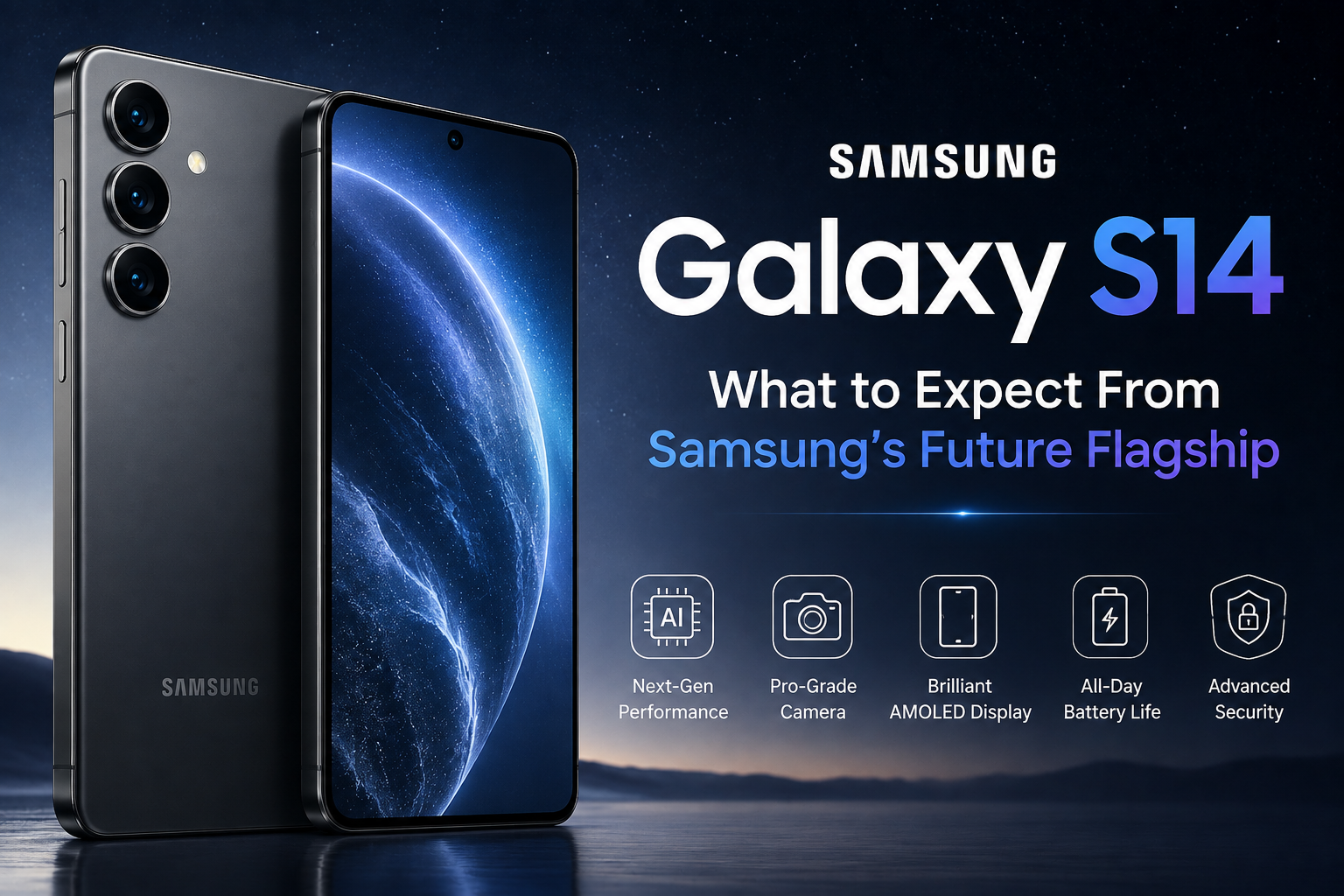
That doesn’t make the topic any less exciting or worth exploring. By looking at the direction of Samsung’s flagship smartphones and the technologies shaping the mobile industry, we can explore what a future device under the Galaxy S14 name could potentially offer. The following discussion separates reasonable expectations from confirmed facts, so readers can understand the possibilities without mistaking predictions for official information.
1. The Samsung Galaxy S14: Rumor, Expectation, or Future Possibility?
Before exploring possible features, it is important to separate confirmed information from speculation.
Samsung’s officially announced flagship lineup in 2026 is the Galaxy S26 series, which includes the Galaxy S26, S26+, and S26 Ultra. Samsung has not announced a Galaxy S14, so any specific claims about its hardware, camera, price, or launch date should not be treated as confirmed.
That said, future smartphones are shaped by current technology. The Galaxy S26 series already points toward several important areas of development, including Galaxy AI, advanced cameras, powerful processors, AMOLED displays, improved cooling, and stronger privacy features.
With that in mind, here is what a future Samsung flagship could potentially bring.
2. A More Refined Design
Slimmer without sacrificing strength
Smartphone design has reached an interesting stage. Most premium devices already look polished, which means future improvements may focus more on comfort and durability than dramatic visual changes.
Samsung’s current flagship direction includes slim designs, durable materials, and improved construction. The Galaxy S26, for example, uses Armor Aluminum and Corning Gorilla Glass Victus 2 while maintaining water resistance.
A future Galaxy S14 could potentially continue this approach with:
- A slimmer body
- Reduced weight
- Stronger glass
- Better scratch resistance
- Improved water protection
- A more integrated camera design
The difficult part is fitting increasingly powerful technology into a comfortable device. Users want a larger battery, better cameras, stronger cooling, and a bigger display—but they do not necessarily want a heavier phone.
It is like packing everything you need for a long trip into one small suitcase. The challenge is not simply adding more; it is making everything fit intelligently.
Comfort could become a bigger priority
A future flagship may focus on how the phone feels in the hand.
Better weight distribution, smoother edges, and improved grip could make a meaningful difference during everyday use. After all, a smartphone is something people carry and use for hours every day.
3. A Brighter and More Efficient Display
Display technology may continue to evolve
Samsung is already using Dynamic AMOLED 2X displays with adaptive refresh rates up to 120Hz across its current Galaxy S26 lineup.
Future display improvements could focus on:
- Higher brightness
- Better outdoor visibility
- Improved power efficiency
- More accurate colors
- Better eye comfort
- Adaptive refresh rates
- Enhanced privacy
Samsung has also begun exploring new approaches to screen privacy. The Galaxy S26 Ultra introduced a Privacy Display feature, showing that future display development may go beyond simply increasing brightness or resolution.
Imagine reading a private message on a crowded train. A display that limits visibility from certain angles could be more useful than a few additional pixels.
That may be where future innovation is heading: technology that solves practical problems rather than simply producing larger numbers on a specification sheet.
4. Faster Performance With Better Efficiency
Raw speed is no longer everything
Future smartphones will almost certainly use more powerful processors. However, most flagship devices are already extremely fast for everyday activities.
Opening apps, watching videos, browsing the internet, and switching between applications rarely push modern flagship hardware to its limits.
The more important improvements may involve:
- Energy efficiency
- AI processing
- Gaming performance
- Thermal management
- Camera processing
- Multitasking
The Galaxy S26 series currently uses advanced processors that vary by model and market, including Snapdragon 8 Elite Gen 5 for Galaxy and Exynos 2600.
A future flagship could build on this foundation.
Staying cool could matter as much as being fast
Performance becomes less useful if a phone becomes excessively hot.
Samsung has already emphasized improved thermal management in the Galaxy S26 series, including a redesigned vapor chamber for better heat dissipation during demanding tasks.
A future Galaxy S14 could potentially offer even more advanced cooling.
This would benefit gamers, content creators, and anyone who regularly uses demanding applications.
The ideal smartphone processor is not simply one that wins a benchmark test. It is one that remains fast, efficient, and comfortable during real-world use.
5. Galaxy AI Could Become Even More Personal
From simple commands to intelligent assistance
Artificial intelligence is becoming a central part of Samsung’s smartphone strategy.
Samsung describes the Galaxy S26 series as its latest generation of AI-focused smartphones, with features designed to simplify tasks and reduce the number of steps needed to complete them.
A future device could take this concept further.
Imagine saying:
“Organize my photos from this vacation and create an album with the best pictures.”
Instead of requiring you to manually open several applications, an advanced system could potentially understand the larger goal and help complete multiple steps.
Future AI features may focus on:
- Personalized assistance
- Smarter search
- Automatic organization
- Real-time translation
- Content creation
- Productivity
- Image editing
- Context-aware suggestions
The goal should not be to add AI features simply because they are fashionable.
The best intelligent tools will save time and reduce frustration.
6. More AI Processing Could Happen on the Device
Privacy and speed may improve together
Cloud-based AI can be powerful, but it often depends on an internet connection.
Future smartphones may perform more tasks directly on the device.
This could provide several benefits:
- Faster responses
- Better privacy
- Reduced internet dependence
- Improved offline features
For example, a future phone could process photographs, translate text, summarize information, or manage certain personal tasks without sending every request to a remote server.
This does not mean cloud computing will disappear. Complex tasks may still require powerful remote systems.
Instead, smartphones may increasingly use a hybrid approach, choosing between local and cloud processing depending on the task.
For users, the ideal result is simple: the technology should work without requiring them to understand what is happening behind the scenes.
7. Camera Improvements Could Focus on Real-World Photography
Better images, not just bigger numbers
Megapixel counts often attract attention, but they tell only part of the story.
A smartphone camera depends on many factors, including:
- Sensor size
- Lens quality
- Image processing
- Optical stabilization
- Autofocus
- Lighting conditions
Samsung’s current flagship technology already combines advanced hardware with AI-enhanced image processing and low-light photography features.
A future Galaxy S14 could potentially improve:
- Night photography
- Portrait images
- Motion capture
- Video stabilization
- Color accuracy
- Low-light detail
The camera should make photography easier
Most people do not want to spend several minutes adjusting complicated settings before taking a photograph.
They want to capture the moment.
Future camera software may become better at recognizing scenes and adjusting settings automatically while giving users control when they want it.
That combination could make smartphone photography feel increasingly natural.
8. Zoom Technology Could Become More Practical
Quality at useful distances
Telephoto cameras have become an important part of premium smartphones.
People use them for travel, sports, wildlife, architecture, concerts, and everyday photography.
A future Galaxy flagship could improve zoom photography through better lenses, larger sensors, and smarter image processing.
The most useful improvement may not necessarily be an enormous zoom number.
Instead, users may benefit more from sharper photographs at common zoom levels.
For example, consistently good images at moderate distances may be more valuable than extreme digital zoom that produces soft or artificial-looking results.
AI could also help reduce shake and improve clarity when photographing distant subjects.
9. Battery Life Could Be One of the Biggest Upgrades
A feature everyone depends on
Battery technology may not always receive the same attention as cameras or AI, but it affects almost every smartphone user.
Samsung’s current Galaxy S26 uses a typical 4,300mAh battery and offers up to 30 hours of video playback under Samsung’s stated testing conditions.
A future flagship could improve endurance through:
- More efficient processors
- Better display technology
- Smarter power management
- Improved battery chemistry
- AI-based optimization
The goal is not simply a bigger battery.
A larger battery can make a phone heavier and thicker. Better efficiency may therefore be just as important.
Faster charging could also continue to improve
Samsung has already improved charging capabilities in its recent flagship lineup. The company says the Galaxy S26 can reach up to 55% charge in around 30 minutes under supported conditions.
Future charging systems could become faster, but battery health and safety will remain important considerations.
After all, fast charging is convenient, but a battery that remains reliable for years is even better.
10. Software Support Could Make the Phone More Valuable
A premium phone should last
A powerful smartphone should not feel outdated after only a few years.
Long-term software support helps provide:
- Better security
- New features
- Improved compatibility
- Performance enhancements
- Updated AI tools
Samsung’s current Galaxy S26 support information lists a security update period extending to February 2033 for the model referenced on its Pakistan site.
That kind of long-term support can significantly increase the value of a premium device.
A future Galaxy S14 would likely need to continue prioritizing software longevity.
For many buyers, a phone that remains secure and useful for several years can be a better investment than one with slightly better specifications but shorter support.
11. Connectivity and the Connected Ecosystem
A smartphone connects to much more than the internet
Modern devices work with a growing collection of technology.
A future Galaxy flagship could connect with:
- Smartwatches
- Wireless earbuds
- Computers
- Tablets
- Smart home devices
- Cars
- Payment systems
- Tracking accessories
The current Galaxy S26 series already supports technologies such as 5G and Wi-Fi 7, alongside other modern connectivity features.
Future improvements may focus less on theoretical speed and more on reliability.
A phone that maintains a stable connection and switches intelligently between available networks can provide a better everyday experience than one that simply advertises a faster maximum number.
12. Security and Privacy Could Become Major Selling Points
Protecting your digital life
Smartphones contain an extraordinary amount of personal information.
Your device may hold:
- Messages
- Photos
- Banking apps
- Passwords
- Work documents
- Personal accounts
- Payment information
As AI becomes more deeply integrated into smartphones, privacy will become even more important.
Future devices could introduce:
- Improved biometric authentication
- Smarter scam detection
- Stronger phishing protection
- Better app permissions
- Enhanced private processing
- More user control over personal data
Samsung’s recent work on privacy-focused display technology also suggests that hardware and software may increasingly work together to protect personal information.
The future of smartphones will not simply be about what they can do.
It will also be about how safely they can do it.
Samsung Galaxy S14: Expectations vs Confirmed Information
Because Samsung has not officially announced this device, it is important to understand the difference.
Currently confirmed:
- Samsung’s 2026 flagship lineup is the Galaxy S26 series.
- The lineup includes the Galaxy S26, S26+, and S26 Ultra.
- Samsung is continuing to develop Galaxy AI, advanced camera technology, modern displays, and improved performance.
Not officially confirmed:
- Samsung Galaxy S14 specifications
- Samsung Galaxy S14 design
- Samsung Galaxy S14 camera system
- Samsung Galaxy S14 battery capacity
- Samsung Galaxy S14 price
- Samsung Galaxy S14 release date
This distinction is important because future smartphone rumors can spread quickly online.
Until Samsung makes an official announcement, specific details should be treated as speculation rather than fact.
For official information about current Galaxy smartphones, visit Samsung’s official Galaxy smartphone pages.
Conclusion
The Samsung Galaxy S14 has not been officially announced, so it is too early to discuss confirmed specifications or features. However, Samsung’s current flagship direction offers a useful glimpse into where future Galaxy devices may be heading.
More capable AI, improved battery efficiency, advanced camera systems, stronger privacy tools, better cooling, and long-term software support could all play an important role in future smartphones.
The most exciting improvements may not always be the ones that look impressive in advertisements. A smarter assistant, a battery that lasts longer, a camera that performs better at night, or stronger protection for personal information could have a much greater impact on daily life.
Ultimately, the best future smartphone will not simply be more powerful. It will be more useful, more efficient, and easier to live with every day.
FAQs
1. Has Samsung officially announced the Samsung Galaxy S14?
No. As of August 2026, Samsung has not officially announced a smartphone called the Samsung Galaxy S14. Its officially announced flagship lineup is currently the Galaxy S26 series.
2. What features could the Samsung Galaxy S14 have?
A future Samsung flagship could potentially include improved AI, a more efficient processor, better cameras, stronger battery performance, advanced privacy features, and long-term software support. These are expectations, not confirmed specifications.
3. What is the Samsung Galaxy S14 release date?
There is currently no official release date because Samsung has not announced the Galaxy S14.
4. Could the Samsung Galaxy S14 include advanced Galaxy AI features?
It is reasonable to expect Samsung’s future flagship devices to continue developing Galaxy AI because AI is already a central part of Samsung’s current Galaxy S26 strategy. However, specific Galaxy S14 features have not been announced.
5. Should you trust Samsung Galaxy S14 specifications found online?
You should be cautious. Unless the information comes from an official Samsung announcement or another reliable source reporting confirmed details, specifications should be treated as rumors or predictions.