
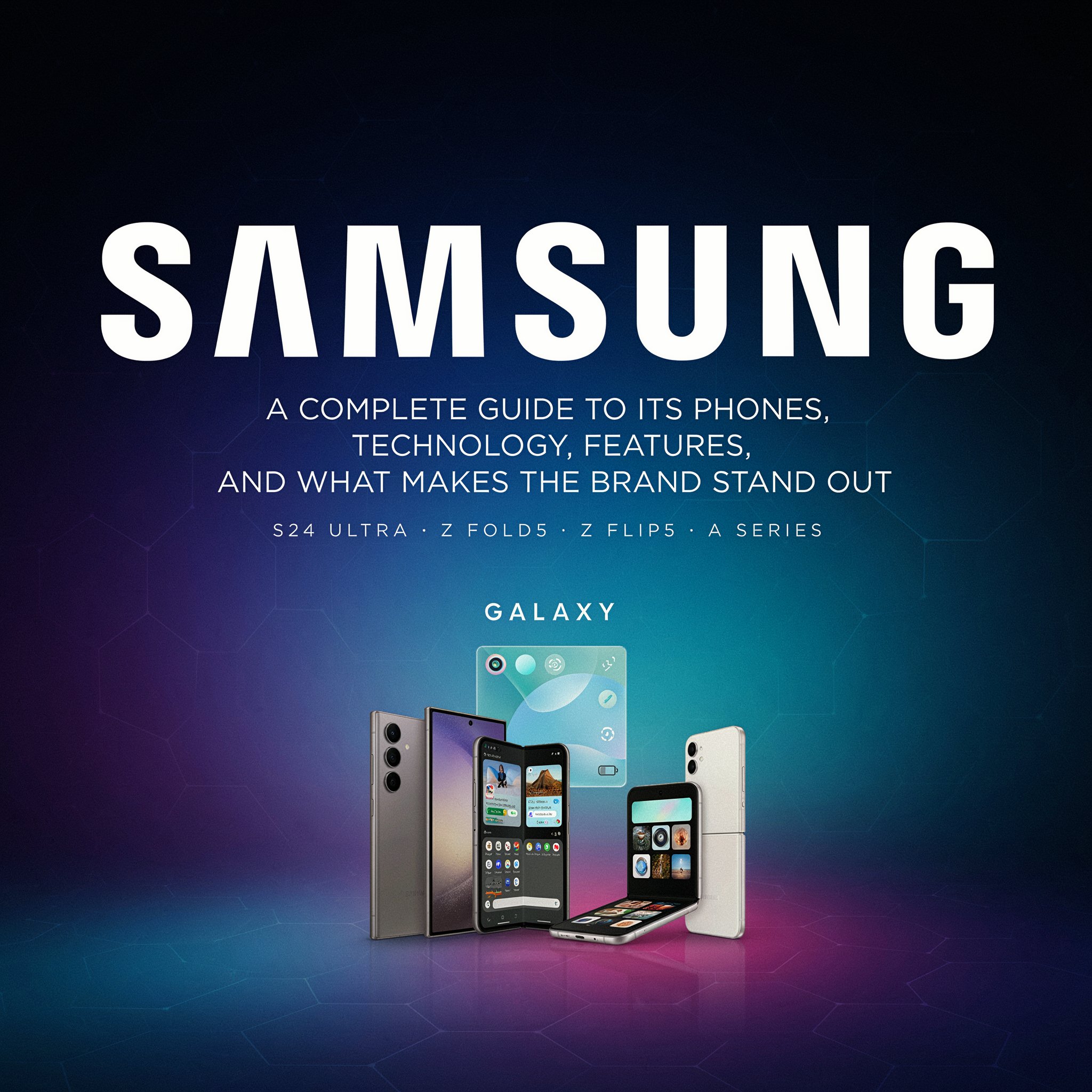
Samsung has become one of the most recognizable names in consumer technology. From affordable smartphones to premium foldable devices, tablets, watches, earbuds, televisions, and other electronics, the company offers products for a remarkably wide range of users.
But what makes the brand so popular? Is it the hardware, software, camera technology, displays, long-term support, or simply the huge variety of devices available?
Whether you are buying your first smartphone, upgrading from an older model, or simply trying to understand what the company offers, this guide explores the major parts of its mobile ecosystem in simple terms.
1. A Brief Look at Samsung’s Smartphone Journey
Samsung’s smartphone story has changed dramatically over the years. Early devices helped establish the company in the mobile market, but its biggest growth came when Android smartphones became mainstream.
The Galaxy family eventually became the company’s most recognizable mobile lineup. Instead of focusing on one type of customer, Samsung developed several ranges aimed at different budgets and lifestyles.
The premium Galaxy S family became associated with powerful hardware, high-quality displays, advanced cameras, and flagship performance. The Galaxy A range brought many of those ideas to more affordable phones. The Galaxy Z series introduced foldable designs to a broader audience.
This variety is one of the company’s biggest strengths.
Think of the product lineup like a large department store. Someone looking for a basic phone does not need to shop in the same section as someone searching for an expensive flagship. Different ranges serve different needs while remaining part of the same ecosystem.
Over time, Samsung has also invested heavily in displays, processors, cameras, artificial intelligence, software, and connected devices. That investment has helped it remain a major competitor in a rapidly changing smartphone industry.
2. Galaxy Phones for Different Budgets
One reason people consider Samsung is the sheer number of choices.
The company’s smartphone catalog generally covers entry-level, mid-range, premium, and foldable categories. That means you can find a device designed around affordability as well as models built around cutting-edge features.
Affordable models
Budget-oriented Galaxy phones are designed for everyday tasks such as messaging, social media, video streaming, browsing, photography, and casual gaming.
They may not include every premium feature, but modern affordable phones can still provide large displays, multiple cameras, capable processors, and long-lasting batteries.
Mid-range models
This category is often where buyers find the best balance between price and features.
A mid-range device can offer a bright screen, respectable cameras, a large battery, smooth performance, and a modern design without reaching flagship pricing.
For many people, this is the sweet spot.
Premium models
High-end Galaxy smartphones are built for users who want the best available hardware and additional features.
These devices typically emphasize camera performance, display quality, processing power, materials, connectivity, and advanced software capabilities.
Foldable models
Foldable phones take a completely different approach. Instead of using a conventional rectangular design, they can open or close to change how the device is used.
This makes them particularly interesting for people who want something beyond the traditional smartphone experience.
3. Display Technology Remains a Major Strength
Ask many smartphone owners what they notice first about a phone, and the display will probably be high on the list.
Samsung has developed a strong reputation for screen technology. Its smartphones commonly feature vivid colors, deep contrast, high resolution, and smooth refresh rates.
A good display affects almost everything you do.
Watching a movie becomes more enjoyable. Photos appear more detailed. Websites are easier to read. Games can feel smoother. Even ordinary scrolling can seem more responsive.
Why refresh rate matters
Refresh rate describes how many times the screen can update its image each second.
However, numbers are not everything.
A screen also needs good brightness, accurate colors, strong viewing angles, and efficient power management. A phone with impressive specifications can still feel disappointing if the display is poorly tuned.
Samsung’s premium devices have traditionally placed considerable attention on this area, while more affordable models increasingly receive features once associated mainly with expensive phones.
4. Camera Features and Everyday Photography
Smartphone cameras have become much more than tools for taking occasional snapshots.
People now use them for family memories, travel, work, social media, documents, video calls, and content creation.
Samsung’s camera approach focuses on giving users flexibility.
A typical multi-camera setup may combine a primary sensor with an ultrawide camera and another lens designed for closer subjects or optical zoom.
Primary camera
The main camera is usually responsible for the majority of everyday photographs. It needs to perform well in daylight, indoor environments, and lower-light conditions.
Ultrawide camera
An ultrawide lens is useful when you want to capture a larger scene. It can be particularly helpful for landscapes, buildings, group photographs, and travel.
Zoom camera
A dedicated zoom lens can help photograph distant subjects without relying entirely on digital enlargement.
The real advantage of multiple cameras is flexibility. Instead of trying to make one sensor do everything, each lens can serve a different purpose.
Software processing is equally important. Modern smartphones use computational photography to adjust exposure, color, sharpness, noise, and other aspects of an image.
As a result, taking a good photograph often requires little technical knowledge from the user.
5. Performance, Gaming, and Battery Life
Performance is another major consideration when choosing a smartphone.
Most users do not need the most powerful processor available. What matters more is how smoothly the phone handles the tasks they actually perform.
For everyday users, that may include social networking, web browsing, video streaming, navigation, photography, and messaging.
Power users may expect more.
They might edit videos, play demanding games, multitask between several applications, or keep a large number of files and apps on the device.
Gaming performance
Gaming can place considerable pressure on a smartphone’s processor, graphics system, memory, and cooling hardware.
A capable phone should maintain stable performance rather than delivering high speeds for a few minutes and then slowing significantly because of heat.
Battery capacity
Battery size is important, but it does not tell the entire story.
A large battery can still drain quickly if the display is inefficient, applications consume excessive power, or the processor is poorly optimized.
Software optimization, screen technology, processor efficiency, and charging speed all contribute to the overall experience.
For many buyers, dependable battery life is more useful than simply having the largest battery number on a specification sheet.
6. One UI and the Android Experience
Hardware is only half of a smartphone.
The software determines how you interact with the device every day.
Samsung’s phones use Android with the company’s own One UI interface. It changes the appearance and behavior of the operating system while adding features designed specifically for Galaxy devices.
One UI places considerable emphasis on customization and accessibility.
Users can adjust wallpapers, themes, widgets, notification behavior, icons, lock-screen elements, and other parts of the interface.
Multitasking
Larger screens and powerful hardware make multitasking increasingly useful.
Depending on the device, users can work with multiple applications, move between programs quickly, and take advantage of features designed for larger displays.
This becomes especially interesting on foldable phones and tablets, where the extra screen area can make multitasking feel more natural.
Software updates
Long-term software support has also become an increasingly important part of smartphone ownership.
A phone is no longer something most people replace every year. Buyers increasingly want devices that remain secure and useful for several years.
Samsung has made software support a major part of its modern smartphone strategy, although the exact update policy depends on the specific model and market.
7. Galaxy AI and Smarter Smartphone Features
Artificial intelligence has become one of the biggest themes in modern mobile technology.
Rather than treating AI as a separate product, smartphone manufacturers are integrating it into features people can use during everyday activities.
On compatible Galaxy devices, AI-powered tools can assist with tasks such as writing, translation, image editing, search, communication, and productivity.
The most useful AI features are usually the ones that save time.
For example, imagine reading a message in another language while traveling. A translation tool can reduce the need to copy text into a separate application.
Similarly, image-editing tools can make certain changes without requiring professional editing software.
However, AI features should be judged by usefulness rather than marketing language.
A feature is valuable when it genuinely solves a problem. If it simply adds another button that people rarely use, its presence matters much less.
8. Foldable Phones Change the Traditional Design
Foldable smartphones are among the most interesting developments in mobile hardware.
Traditional phones have remained broadly rectangular for years. Foldables challenge that design by allowing the screen to physically change shape.
There are two major ideas behind modern foldables.
Compact folding design
Some models are designed to become smaller when closed. This makes them easier to carry while still providing a larger screen when opened.
Book-style folding design
Other models open like a small book. When unfolded, they provide a much larger workspace than a conventional smartphone.
This extra space can be useful for reading, multitasking, watching videos, editing documents, and browsing websites.
Of course, foldables also involve compromises.
They can cost more than conventional phones, have more complex mechanical components, and may require users to adapt to a different form factor.
For some people, those trade-offs are worth it. For others, a standard smartphone remains the simpler choice.
9. The Galaxy Ecosystem: More Than a Phone
One of Samsung’s biggest advantages is its broader ecosystem.
A Galaxy phone can work alongside tablets, watches, earbuds, laptops, televisions, and other compatible devices.
This creates a connected experience.
For example, wireless earbuds can connect with a phone for music and calls. A smartwatch can provide notifications and fitness-related information. A tablet can provide a larger screen for productivity and entertainment.
Smartwatches
Galaxy watches combine traditional watch functions with smart features. Depending on the model, users can receive notifications, track activities, manage calls, and access various applications.
Tablets
Galaxy tablets range from affordable entertainment devices to high-end models designed for productivity.
A larger display can make reading, watching videos, drawing, gaming, and working more comfortable.
Earbuds
Wireless earbuds provide a convenient companion for mobile devices. They can be particularly useful for commuting, exercising, calls, and entertainment.
The ecosystem works much like a team. Each device has its own job, but they can work together to create a more convenient experience.
10. Security, Privacy, and Everyday Reliability
Security is easy to overlook when buying a smartphone, but it becomes increasingly important once the device contains personal photographs, messages, financial applications, passwords, and work documents.
Modern Galaxy devices include multiple security technologies designed to protect user information.
Biometric authentication can make unlocking more convenient while reducing dependence on passwords. Secure hardware features can also help protect sensitive information.
Software updates play another important role.
Security patches address vulnerabilities that may be discovered after a device reaches the market. This is one reason long-term software support matters.
Durability
Physical durability is equally relevant.
Water and dust resistance on supported models can provide additional protection against everyday accidents. Stronger glass and reinforced frames can also improve resistance to scratches and drops.
Still, no smartphone is indestructible.
A protective case and screen protector can be sensible additions, particularly for expensive devices.
11. How to Choose the Right Galaxy Device
With so many models available, choosing the right one can feel confusing.
The easiest approach is to begin with your needs rather than the specification sheet.
Start with your budget
Set a realistic spending limit first. There is little benefit in paying for features you will never use.
Think about your daily activities
Do you mainly use messaging, social media, YouTube, and web browsing?
Or do you play demanding games, edit videos, take lots of photographs, and use your phone for work?
Your answer can dramatically change which model makes sense.
Consider the camera
If photography is important, look beyond the number of megapixels. Camera quality depends on the sensor, lens, image processing, stabilization, and software.
Check battery expectations
Heavy users should pay close attention to battery capacity, charging options, processor efficiency, and display behavior.
Think about longevity
If you plan to keep your phone for several years, software support, storage capacity, build quality, and repairability become more important.
The best smartphone is not necessarily the most expensive one. It is the device that fits your actual habits.
12. Final Thoughts: Is Samsung Still Worth Considering?
Samsung’s biggest strength is its range.
The company does not depend on a single type of smartphone. Instead, it offers products for people with different budgets, priorities, and lifestyles.
Some buyers want a straightforward affordable device. Others want a premium camera phone. Some prefer a large screen, while others are attracted to foldable technology.
Its display expertise, camera systems, Android software, connected ecosystem, and growing AI features make the platform appealing to a broad audience.
At the same time, buyers should not assume that every model is automatically the right choice. Prices, specifications, cameras, battery performance, software support, and features can vary considerably between devices.
The smartest approach is simple: decide what matters most to you, compare the models that fit those needs, and avoid paying extra for features you will not use.
Frequently Asked Questions
1. Why are Samsung phones so popular?
They offer a wide range of devices across different price categories, along with strong displays, capable cameras, Android software, customization, and access to a broader connected ecosystem.
2. Is Samsung good for everyday use?
Yes. Galaxy smartphones can handle common activities such as messaging, social media, browsing, streaming, photography, navigation, and casual gaming. The right model depends on your budget and usage habits.
3. Are Samsung foldable phones worth buying?
They can be worthwhile for users who value flexible designs, larger displays, and multitasking. However, conventional smartphones may provide better value for people who prefer simplicity and lower prices.
4. How long can a Samsung phone last?
The useful lifespan depends on the model, battery condition, software support, physical care, and how heavily the device is used. A well-maintained modern smartphone can remain useful for several years.
5. What should I check before buying a Samsung phone?
Consider your budget, display, processor, camera system, battery, storage, software support, connectivity, size, and the features you actually expect to use. Comparing these factors is more useful than choosing a phone based on specifications alone.
Ultimately, Samsung’s appeal comes from giving consumers choices. Whether you want affordability, premium hardware, productivity, photography, or a new form factor, there is likely a Galaxy device designed around that particular need.