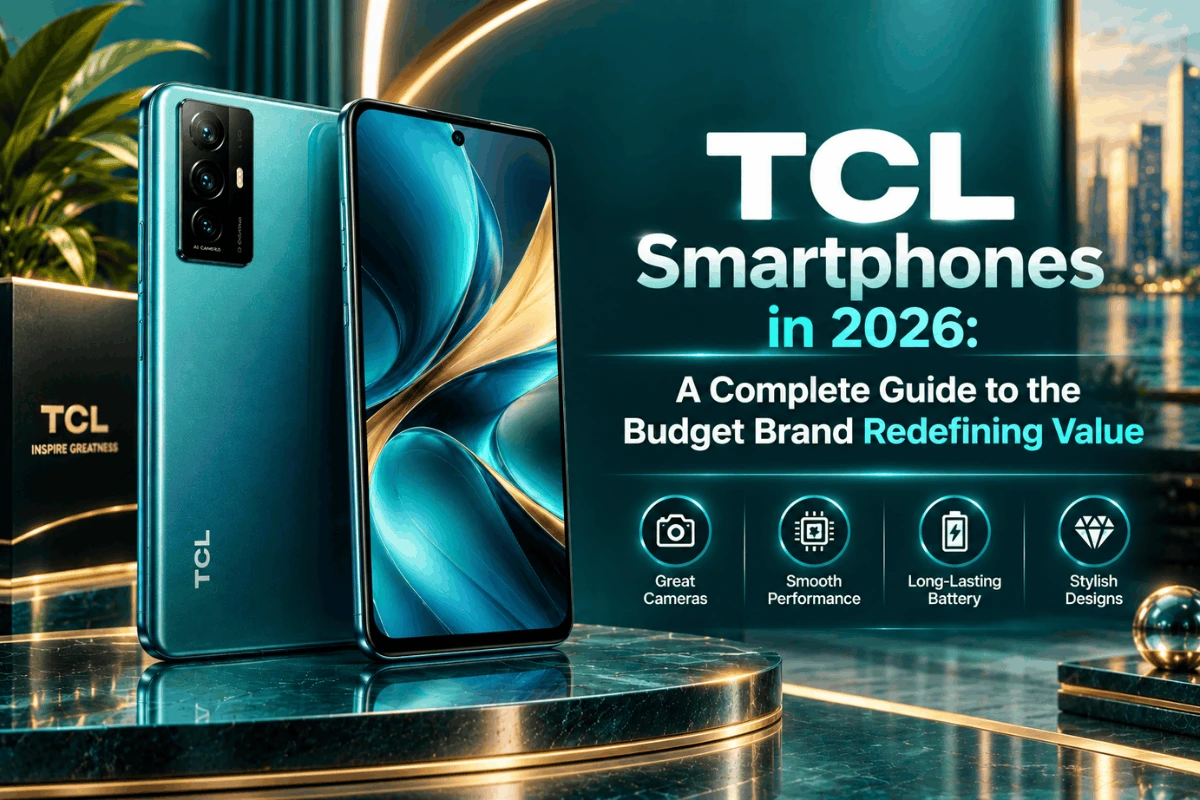
This guide breaks down what a TCL smartphone actually offers in 2026, who it’s built for, and whether it deserves consideration on your next upgrade.
The Company Behind the Brand
TCL is not a recent entrant into consumer electronics. Founded in 1981, the company has grown into a global manufacturer with sales offices spanning more than 80 countries, and operations covering over 160 countries and regions across Asia, the Americas, Europe, and Oceania.
Long before TCL launched phones under its own name, it built devices for other well-known brands. The company acquired the Palm brand from HP in 2014, and in 2016 signed an agreement with BlackBerry Limited to manufacture smartphones under the BlackBerry Mobile label — a partnership that continued until August 2020.
This history matters. By the time TCL introduced its own smartphone line, the company already had years of hands-on manufacturing experience behind it, along with a well-established position in the television industry, where it ranks as one of the world’s largest suppliers.
Market Position: A Faster Rise Than Most Assume
TCL’s own smartphone brand only launched in 2019, yet its early performance defied expectations. Based on fourth-quarter 2020 results, TCL ranked second in Portugal, fourth in the UK, Spain, and Hungary, and fifth in Greece. That is a remarkably quick foothold for a brand many consumers had not encountered a year prior.
This growth is supported by TCL’s broader manufacturing scale. The parent company overtook both Sony and LG by 2019 to become the world’s second-largest television supplier, and it currently holds the leading position for TV shipments in the United States. A company with that level of display expertise inevitably brings similar priorities into its smartphone division — and that connection is visible in TCL’s product design philosophy.
Display Technology: TCL’s Strongest Differentiator
The single most distinctive feature across TCL’s smartphone lineup is its display technology. Rather than competing purely on camera specifications or raw processing power, TCL has focused on a less commonly addressed problem: prolonged screen exposure and eye strain.
The company’s NXTPAPER technology has been independently lab-tested and shown to reduce blue light exposure by 61%, a verifiable specification rather than a marketing claim.
TCL continues to refine this approach. At MWC 2026, the company introduced the NXTPAPER 70 Pro, featuring a dedicated NXTPAPER Key that allows users to switch between display modes for different lighting conditions and use cases, alongside a 50MP OIS camera system and AI-assisted features.
At IFA 2026, TCL extended this technology further with the launch of the P80 Series — comprising the P80, P80 Pro, and P80 Ultra. This lineup marked the first integration of NXTPAPER technology into full AMOLED displays, combining vibrant color reproduction with reduced glare and blue-light output. In effect, TCL has closed the gap between visual quality and visual comfort — two attributes that were previously treated as competing priorities.
Value-Focused Devices Without Compromise
TCL’s core strength remains in the mid-range and budget segments, where the brand has worked to eliminate common trade-offs. Its expanded 60 Series now includes six models, each equipped with consistent 5G connectivity — a feature once reserved almost exclusively for phones priced above $250.
This shift is significant. For years, affordable devices with 5G support often came with underpowered chipsets that struggled under everyday multitasking. TCL’s approach has narrowed that compromise considerably.
The brand’s pricing structure also reflects a segmented, purpose-driven strategy rather than a blanket approach. Distinct product lines — including the NXTPAPER 70 Pro, the broader 60 Series, and the battery-focused K70 Power — are each designed around specific user needs, allowing buyers to select a device suited to their actual usage patterns rather than paying for unnecessary features.
Who TCL Smartphones Are Designed For
TCL doesn’t try to be everything for everyone, and that focus is actually a strength. If your daily routine revolves around reading, writing, video calls, or browsing — the kind of work where a comfortable screen matters more than a chart-topping benchmark score — this is exactly the audience TCL builds for. The same goes for anyone buying their first smartphone, or an older family member who wants something simple, reliable, and easy on the eyes.
But it’s just as important to know where TCL steps back. If your phone needs to keep up with fast-paced mobile games, capture magazine-quality photos, or plug into a tightly connected ecosystem like AirDrop or Samsung DeX, TCL’s near-stock Android approach won’t compete with brands built specifically around those strengths.
At a Glance: Strengths and Limitations
Strengths
- Independently verified blue-light reduction technology
- 5G connectivity extended into budget price segments
- Clear, need-based product segmentation
- Minimal bloatware with a near-stock Android experience
- Accessible design for first-time or older users
Limitations
- Camera and gaming performance trail flagship competitors
- Limited proprietary ecosystem integrations
- Software update window is standard, not industry-leading
Software Support Policy
Long-term software support is often overlooked during a purchase decision, yet it directly affects how a device performs over time.
All TCL models released in 2025 and 2026 are backed by two major Android version updates and three years of security patches, with no model exceeding this commitment.
For users who upgrade their device every 12 to 18 months, this policy is unlikely to be a concern. For those who intend to keep a device for three years or longer, this is a factor worth weighing against alternatives — though the transparency of TCL’s stated policy is itself a point in its favor.
TCL’s Move Into the Premium Segment
The TCL P80 Ultra represents the brand’s most deliberate step toward premium positioning to date. TCL has described it as the most advanced smartphone in the company’s history, combining NXTPAPER AMOLED display technology, refined photography capabilities, strong performance, and dependable battery life into a single device.
According to Stefan Streit, Chief Marketing Officer at TCL Europe, the intent behind the P80 series extends beyond specifications: the goal is to help users move fluidly between capturing moments, reading, working, and unwinding — while making it easier to disconnect when needed. This framing reflects a broader industry shift toward digital wellbeing as a genuine purchasing consideration, rather than a marketing trend.
Video via Tech Sprut (sponsored hands-on review)
Frequently Asked Questions
1.Is TCL a trustworthy smartphone brand?
Yes. TCL has operated in consumer electronics since 1981 and holds established positions in both the television and smartphone industries, giving it substantially more manufacturing history than many newer budget-phone competitors.
2.Does TCL manufacture its own display technology?
Yes. TCL’s display expertise stems directly from its position as one of the world’s largest television manufacturers, which directly informs the NXTPAPER technology used across its smartphone lineup.
3.Are TCL phones suitable for photography or gaming?
Generally, no. TCL positions these devices around display comfort, reliability, and everyday use rather than competitive gaming or advanced photography performance.
4.What is TCL’s software update policy?
Current 2025–2026 models receive two major Android updates and three years of security patches.
Final Assessment
TCL is not positioning itself to compete directly with Samsung or Apple at the flagship level, and the company appears to recognize this. Instead, it has carved out a distinct market position built on display comfort, transparent budget pricing, and expanded 5G accessibility — areas that premium brands have largely left unaddressed at lower price points.
For buyers who prioritize screen comfort, dependable performance, and value-conscious pricing over camera specifications or gaming benchmarks, a TCL smartphone is a reasonable and well-supported choice. For those focused on photography, competitive gaming, or ecosystem lock-in, other brands remain a better fit.