
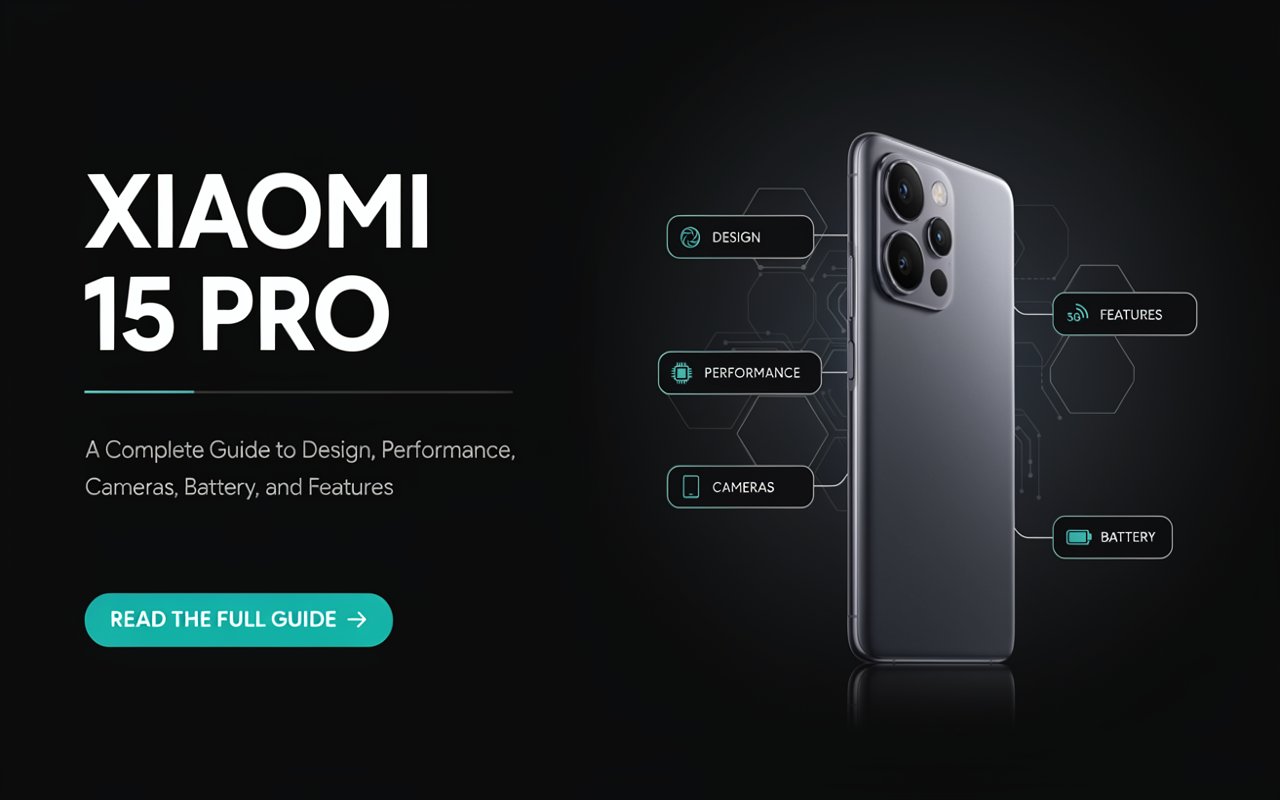
The smartphone market moves quickly. Every year, manufacturers try to make their flagship phones faster, smarter, and more capable, but only a few devices manage to create a strong balance between performance, photography, design, and everyday usability. The Xiaomi 15 Pro is one of those phones that aims to bring nearly every premium feature together in a single package.
Xiaomi positioned the 15 Pro as a high-end member of its 2024 flagship generation, alongside the standard Xiaomi 15. The series introduced Qualcomm’s Snapdragon 8 Elite mobile platform and Xiaomi’s HyperOS 2, while continuing the company’s partnership with Leica for its camera experience. Xiaomi also highlighted an ultrasonic fingerprint sensor, a high-brightness display, and a large Surge battery as important parts of the series.
But specifications alone do not tell the whole story. What is it actually like to use a phone with this much hardware? Is the camera good enough for serious photography? Can the battery survive a busy day? And does the phone make sense for someone who simply wants a reliable premium smartphone?
Let’s take a closer look.
Xiaomi 15 Pro at a Glance
Before going into individual features, it helps to understand what kind of device this is.
The Xiaomi 15 Pro belongs to the premium flagship category. That means it is designed for people who want more than basic communication, social media, and casual photography. It is aimed at users who may play demanding games, record high-resolution video, edit photos, stream movies, multitask between applications, and keep their phone for several years.
Its major attractions include a large high-resolution display, flagship-level processing hardware, a Leica-developed photography experience, substantial battery capacity, fast charging, and Xiaomi’s modern software platform.
One useful way to think about the phone is as a Swiss Army knife for digital life. A Swiss Army knife combines several tools in one compact object. In much the same way, this smartphone combines a camera, gaming machine, entertainment screen, communication device, productivity tool, and portable computer.
That versatility is what makes the device interesting.
Key Areas That Stand Out
- Premium flagship construction
- High-end Snapdragon 8 Elite processor
- Large AMOLED display
- Leica-branded camera system
- High-resolution photography
- Optical image stabilization
- Large battery
- Fast wired charging
- Wireless charging support
- HyperOS software
- Advanced connectivity
- Ultrasonic fingerprint unlocking
Exact configurations and features can vary by market, so buyers should always check the specifications available in their country.
Premium Design and Build Quality
A flagship phone should feel expensive before you even turn its screen on. Xiaomi understands that expectation, and the 15 Pro follows the modern premium-phone design philosophy.
The handset uses a refined body with carefully finished edges and a large display that dominates the front. Rather than making the design unnecessarily complicated, Xiaomi focuses on a clean appearance with the camera module serving as the main visual feature on the rear.
The large camera area immediately tells you that photography is an important part of the device’s identity.
Comfortable Handling
Large flagship smartphones can sometimes become uncomfortable during extended use. The challenge is to provide a big screen and large battery without making the device feel like a small tablet.
Xiaomi attempts to balance these requirements through its curved design approach and carefully shaped frame.
The result is a phone that feels substantial without looking excessively bulky.
Of course, personal preference matters. Someone who prefers compact phones may find a Pro-sized device large, while people who enjoy watching videos or playing games will probably appreciate the additional screen space.
A Professional Appearance
The design also has a certain understated quality. It does not rely entirely on bright colors or aggressive styling to attract attention.
That makes it suitable for different environments.
Whether you’re using it at work, traveling, taking photographs outdoors, or relaxing at home, the phone has the appearance expected from a premium device.
Display: Built for Movies, Gaming, and Everyday Use
The display is one of the features you interact with every time you pick up a smartphone.
For that reason, screen quality can have a bigger effect on daily satisfaction than some specifications that look impressive on paper.
The Xiaomi 15 Pro uses a large high-end AMOLED panel designed to provide strong contrast, rich colors, smooth motion, and excellent visibility.
Why AMOLED Matters
AMOLED technology allows individual pixels to control their own illumination. This makes it possible to display very deep blacks because pixels can effectively turn off when displaying black content.
The advantage becomes obvious when watching movies in a dark room.
Scenes can look more cinematic, while photographs benefit from stronger contrast. Dark interfaces can also look particularly attractive.
High Refresh Rate
The high refresh rate makes supported animations, scrolling, and compatible games feel smoother.
Think of refresh rate like the number of pages a flipbook can show every second. More pages generally allow movement to appear more fluid.
You may notice this while scrolling through websites, switching between applications, or playing games.
The display can also dynamically adjust its refresh behavior depending on what you’re doing, helping balance smoothness with power efficiency.
Outdoor Visibility
Brightness is another important factor.
A screen that looks beautiful indoors is not necessarily pleasant to use under direct sunlight. Xiaomi has therefore placed considerable attention on display brightness and outdoor readability across its flagship generation.
This matters particularly for people who frequently use navigation, photography, messaging, or social media outdoors.
Performance: Snapdragon Power for Demanding Users
Performance is where the Xiaomi 15 Pro becomes particularly interesting.
The phone is powered by Qualcomm’s Snapdragon 8 Elite mobile platform, a flagship chipset based on a 3nm manufacturing process. Xiaomi’s 15 series introduced this platform as part of its performance strategy.
For ordinary tasks, this level of processing power may seem excessive.
Opening messages, checking email, browsing websites, or watching videos does not require a flagship processor.
But the advantage becomes clearer when you start demanding more from the phone.
Multitasking
You can move between several applications quickly, keep multiple browser tabs open, edit photographs, download files, and switch between productivity tools without the phone feeling like it is struggling.
This is particularly useful for people who use their smartphone as a primary computing device.
Gaming Performance
Mobile gaming has become much more sophisticated.
Modern titles can include detailed environments, advanced lighting, large multiplayer worlds, and demanding graphics effects. A powerful chipset gives the phone more room to handle these workloads.
The Snapdragon 8 Elite is designed for high-end performance and graphics processing, making it suitable for demanding games.
However, there is an important point to remember: performance is not simply about the processor.
Cooling, software optimization, game settings, and sustained temperature all influence the real-world experience.
A phone may deliver impressive benchmark numbers but still need sensible thermal management during long gaming sessions.
Long-Term Performance
Another advantage of flagship hardware is longevity.
A powerful processor gives a device more headroom as applications become more demanding over time.
That does not guarantee that the phone will remain perfectly fast forever, but it can make the device feel capable for a longer period.
Leica Camera System and Mobile Photography
Photography is arguably one of the biggest reasons people consider premium smartphones.
Xiaomi’s partnership with Leica has become a major part of the company’s flagship camera strategy. The 15 series continues that approach, combining Leica-oriented optics, image processing, photography modes, and visual styles.
The goal is not simply to produce photographs with lots of pixels. The goal is to create images that look pleasing and give photographers more flexibility.
Main Camera
The primary camera is designed to handle the majority of everyday photographs.
It is particularly important for situations such as:
- Family photographs
- Street photography
- Landscapes
- Food photography
- Travel images
- Portraits
- Indoor scenes
- Night photography
Optical image stabilization can help reduce the effect of small hand movements, which becomes especially useful in lower light.
Instead of thinking of stabilization as a magical feature that makes every image perfect, consider it a safety net. It gives the camera a better chance of capturing a sharp photograph when your hands are not completely still.
Telephoto Photography
A dedicated telephoto camera adds another level of flexibility.
Instead of simply enlarging an image digitally, optical telephoto hardware can provide a more natural perspective for distant subjects.
This can be especially useful for:
- Portraits
- Architecture
- Wildlife
- Sports
- Travel
- Detail shots
Having different focal perspectives also allows photographers to be more creative.
You can step back and compress the scene, isolate a subject, or capture details that would otherwise be difficult to frame.
Ultra-Wide Camera
The ultra-wide camera is useful when the standard lens cannot capture enough of the scene.
Imagine standing in front of a large building. With a conventional lens, you may need to move far backward to fit everything into the frame.
An ultra-wide perspective allows you to capture more of the environment from a closer position.
This makes it useful for landscapes, buildings, group photographs, and travel scenes.
Leica Photography Styles
One of the interesting aspects of Xiaomi’s Leica collaboration is the emphasis on different photographic looks.
Instead of giving every photograph the same processing, users can select different visual styles.
This is important because photography is not purely technical.
Two photographs can contain the same subjects and still create completely different emotional impressions because of color, contrast, exposure, and processing.
Video Recording and Content Creation
Smartphones have increasingly replaced traditional cameras for casual video production.
For many people, the phone is the camera they always have with them.
The Xiaomi 15 generation supports high-resolution video recording and professional-oriented options. Xiaomi’s published specifications for its Leica-focused devices show the company’s continued emphasis on features such as 8K recording, high-frame-rate 4K, stabilization, slow motion, and professional video modes.
Why Video Features Matter
High-resolution recording is useful when you want to crop footage later or preserve additional detail.
However, resolution should not be the only thing you consider.
Good video also depends on:
- Stabilization
- Exposure
- Autofocus
- Color consistency
- Audio quality
- Low-light performance
- Storage capacity
A camera that records enormous files is not automatically better if the footage is difficult to use.
For Social Media Creators
For people creating short videos for social networks, a capable smartphone camera can eliminate the need to carry multiple pieces of equipment.
You can shoot, edit, and publish from the same device.
That convenience is arguably one of the strongest benefits of modern flagship phones.
Battery Life and Charging
Performance and cameras are exciting, but battery life is what determines whether you can actually enjoy those features throughout the day.
The Xiaomi 15 series uses Xiaomi Surge battery technology, and Xiaomi emphasizes battery capacity and charging efficiency as major parts of its flagship experience.
A large battery provides additional room for demanding activities such as:
- Gaming
- Video streaming
- Photography
- GPS navigation
- Mobile hotspot use
- Video recording
- Social media
- Web browsing
Real-World Battery Expectations
Battery life is always influenced by usage.
Someone who mostly sends messages and makes occasional calls may get substantially longer endurance than someone who spends several hours gaming or recording video.
Screen brightness, mobile network strength, background applications, refresh rate, and camera use can all affect battery consumption.
So rather than asking whether the phone lasts exactly a certain number of hours, it is more useful to ask whether it has enough capacity for your personal routine.
For most heavy users, a large battery provides welcome breathing room.
Fast Charging
Fast charging is another major convenience.
You do not always have an hour available to recharge your phone.
Sometimes you have only a few minutes before leaving the house.
Fast charging allows you to recover a meaningful amount of battery in a shorter period, depending on the charger, cable, temperature, and charging conditions.
Wireless charging can also be useful when convenience matters more than absolute charging speed.
HyperOS and the Software Experience
Hardware is only half of a smartphone.
The software determines how all that hardware feels in everyday use.
Xiaomi’s flagship generation introduced HyperOS 2, representing the company’s ongoing shift away from its older software branding toward a broader ecosystem-oriented operating system. Xiaomi states that the Xiaomi 15 series runs on HyperOS 2.
Everyday Interface
HyperOS focuses on a modern visual interface, system customization, device management, and integration with Xiaomi’s wider ecosystem.
For everyday users, the most important question is simple:
Does it make the phone easy to use?
Applications should open quickly, notifications should remain manageable, settings should be understandable, and common tasks should not require unnecessary steps.
AI Features
AI has become an increasingly important part of smartphone software.
Modern phones can use AI for tasks such as writing assistance, image editing, search, transcription, productivity, and contextual functions.
The availability of particular AI features can vary by country, software version, language, and service provider, so users should check local support rather than assuming every advertised function will work everywhere.
This is especially important with flagship devices that receive different software packages across markets.
Connectivity, Security, and Everyday Features
A modern flagship smartphone is expected to provide more than a powerful processor and good cameras.
Connectivity is equally important.
The Xiaomi 15 family supports modern wireless technologies designed for fast communication with cellular networks, Wi-Fi accessories, headphones, cars, smart devices, and other equipment.
Biometric Security
One notable feature highlighted by Xiaomi for the 15 series is its ultrasonic under-display fingerprint sensor. The company described this as a first for its Xiaomi 15 series.
An under-display fingerprint system is convenient because the sensor does not require a separate physical button.
You simply place your finger in the appropriate area of the display.
Security features are particularly important because our phones increasingly contain personal photographs, messages, financial applications, work documents, passwords, and other sensitive information.
USB-C and Accessories
USB-C has become the standard connection for modern smartphones.
It makes charging and data transfer more convenient and works with a broad ecosystem of accessories.
Depending on the market and package, buyers should also check exactly which charger and accessories are included rather than assuming every region receives the same bundle.
Xiaomi 15 Pro for Gaming
Gaming deserves its own discussion because flagship hardware can make a noticeable difference here.
The combination of a high-end chipset, fast display, capable graphics hardware, and large battery creates a strong foundation for mobile gaming.
Smooth Gameplay
Fast refresh rates can make supported games feel more responsive.
The powerful processor and GPU can also handle demanding graphics settings more comfortably than mid-range hardware.
However, gamers should keep one thing in mind: maximum graphics settings are not always the best choice.
Sometimes lowering a few visual settings can improve sustained frame rates and reduce heat.
Heat Management
Performance generates heat.
This is true for every powerful smartphone.
During short gaming sessions, this may not be a major concern. During long sessions, however, thermal management becomes increasingly important.
Xiaomi’s flagship strategy combines powerful processors with cooling and software optimization to maintain performance under demanding workloads.
For serious mobile gamers, a phone cooler may still be useful during extended sessions, but ordinary users should generally be fine with normal gaming workloads.
Who Should Buy the Xiaomi 15 Pro?
The Xiaomi 15 Pro makes the most sense for users who want a premium Android smartphone with strong performance and photography capabilities.
It is particularly appealing to several types of users.
Photography Enthusiasts
If you enjoy taking photographs but do not want to carry a dedicated camera everywhere, the Leica-oriented system provides plenty of flexibility.
The combination of multiple lenses, image stabilization, photography styles, and advanced processing gives you many ways to approach different scenes.
Power Users
If your smartphone is central to your work and entertainment, flagship processing hardware can be valuable.
People who regularly multitask, edit media, play games, or use demanding applications are more likely to notice the benefits.
Travelers
Travelers can benefit from having a versatile camera, large display, substantial battery, navigation tools, and communication apps in one device.
Instead of carrying several gadgets, the smartphone can become a compact travel companion.
Content Creators
For casual creators, the ability to capture high-quality photographs and video without carrying dedicated equipment can be extremely useful.
You can record a clip, edit it, and publish it from the same device.
Who Might Want Something Else?
No smartphone is perfect for everyone.
If you prefer very small phones, the Pro model’s larger size may not be ideal.
Likewise, if you already own a recent premium smartphone, upgrading may not provide enough practical improvement to justify the expense.
Someone who mainly uses a phone for calls, messaging, basic browsing, and occasional photographs may also find a less expensive model more sensible.
There is nothing wrong with buying more affordable hardware when your needs are simple.
A flagship phone is like buying a high-performance sports car. If you regularly need that performance, it can be worthwhile. If you only drive a few blocks to the grocery store, a simpler vehicle may accomplish the same job for less money.
Xiaomi 15 Pro: Pros and Cons
Before making a purchasing decision, it helps to separate the strongest qualities from the potential limitations.
Pros
- Powerful flagship-level processing
- Premium design
- High-quality AMOLED display
- Leica-focused photography experience
- Multiple camera perspectives
- Strong video capabilities
- Large battery capacity
- Fast charging
- Wireless charging convenience
- Modern HyperOS software
- Ultrasonic fingerprint technology
- Excellent choice for demanding users
Cons
- Large size may not suit everyone
- Premium pricing can make it expensive
- Some features may vary between markets
- Flagship hardware can generate heat under heavy workloads
- Advanced camera capabilities may be unnecessary for casual users
- Software preferences are subjective
Final Verdict
The Xiaomi 15 Pro is designed for people who do not want to compromise easily.
It combines flagship processing power with a premium display, advanced photography hardware, Leica-oriented imaging features, substantial battery capacity, fast charging, and Xiaomi’s modern software platform.
The camera system is one of its biggest attractions, especially for users who enjoy experimenting with different focal lengths and photographic styles. The powerful processor also makes the phone well suited to gaming, multitasking, and demanding applications.
At the same time, the phone’s impressive specifications should not automatically make it the right choice for everyone. If your smartphone needs are limited to messaging, calls, browsing, and occasional photography, a cheaper model could provide better value.
But if you want a premium Android experience where performance, photography, entertainment, and battery endurance all matter, the Xiaomi 15 Pro deserves serious consideration.
Ultimately, the best smartphone is not the one with the longest specification sheet. It is the one that fits the way you actually live and use technology.
Frequently Asked Questions
1. Is the Xiaomi 15 Pro a flagship smartphone?
Yes. It is positioned as a premium flagship device in Xiaomi’s 15 series, featuring high-end processing hardware, an advanced display, premium cameras, large battery capacity, and flagship software features. Xiaomi’s 2024 annual report confirms the 15 series included the Xiaomi 15 Pro and used the Snapdragon 8 Elite mobile platform.
2. Does the Xiaomi 15 Pro have Leica cameras?
The Xiaomi 15 Pro is part of Xiaomi’s Leica-focused flagship camera strategy. Leica branding and tuning are central to the camera experience, with multiple focal perspectives designed for different photography situations.
3. Is the Xiaomi 15 Pro good for gaming?
Yes. Its flagship Snapdragon platform provides the processing and graphics capability needed for demanding mobile games. The large display and high refresh rate also contribute to a smoother gaming experience.
4. Does the Xiaomi 15 Pro support fast charging?
Yes. Fast charging is one of the major features associated with Xiaomi’s flagship battery strategy. Charging performance can vary depending on the market, compatible charger, cable, temperature, and charging conditions.
5. Should you buy the Xiaomi 15 Pro?
If you want a premium smartphone with powerful performance, advanced photography, a high-quality display, and strong battery capabilities, it can be an excellent option. However, buyers should compare its local price, warranty, software support, and available configuration against newer models before purchasing.