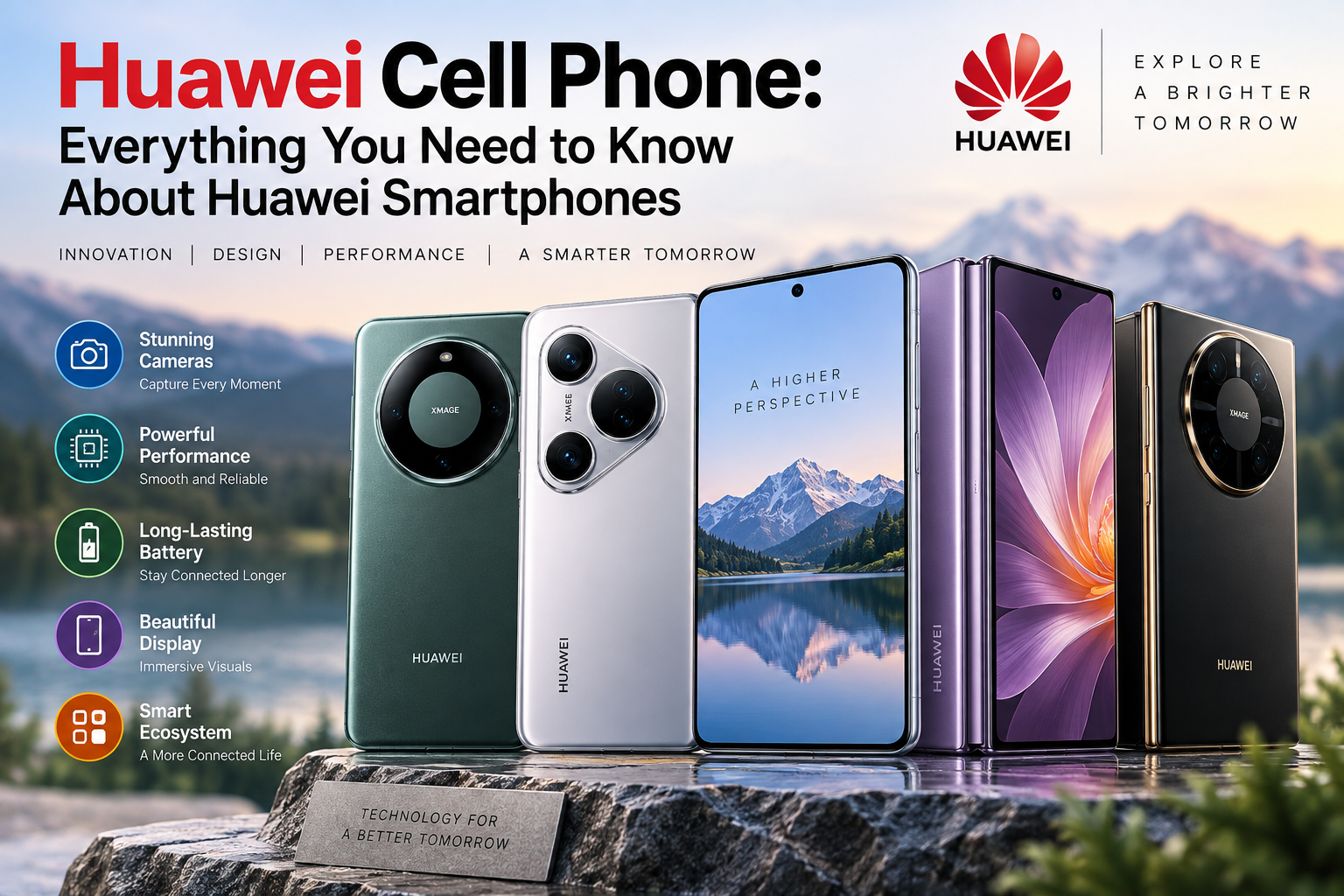
When people talk about the smartphone industry, a few names immediately come to mind. Huawei is one of them. The company has built a reputation for attractive designs, innovative cameras, powerful hardware, and a strong focus on connecting phones with other smart devices.
But Huawei’s journey has been anything but ordinary.
The company has experienced major changes in the global smartphone market, particularly around software and access to Google’s mobile services. At the same time, Huawei has continued developing its own ecosystem and releasing new devices. In 2026, its global smartphone lineup includes products such as the Pura 90 series, Mate 80 Pro, Mate X7, nova 15 series, and other models.
So, what makes a Huawei cell phone different from other smartphones? Is it still worth considering? So, what should you consider before buying one?
Let’s explore the brand, its technology, software, cameras, performance, battery life, connectivity, and the things buyers should consider before making a decision.
1. What Makes Huawei Smartphones Different?
A brand built around innovation
Huawei has always tried to stand apart from the crowd. Rather than simply following every smartphone trend, the company has frequently experimented with new designs and technologies.
Its phones have appeared in several categories, including premium flagship models, foldable devices, photography-focused smartphones, and more affordable products.
Huawei currently organizes its smartphone range around several major families. The Mate line focuses heavily on flagship performance and productivity, the Pura series emphasizes photography and design, while the nova family targets users interested in stylish phones and portrait photography. Huawei’s official global product listings also include foldable models such as the Mate X7 and Mate XT ULTIMATE DESIGN.
This variety means there is no single Huawei experience.
A person buying a high-end Mate device may have very different priorities from someone choosing a nova phone.
Think of the brand like a large toolbox. You do not choose the biggest tool simply because it is the most expensive. You choose the one that fits the job.
The same idea applies here.
2. Huawei’s Smartphone Evolution
From Android devices to a broader ecosystem
Huawei’s smartphone story has changed considerably over the years.
Earlier generations became popular because they offered competitive hardware, attractive designs, strong cameras, and access to the Android ecosystem. Models from the Mate, P, nova, and Y families helped Huawei establish itself as one of the major names in mobile technology.
The company later faced significant changes surrounding Google’s mobile services. Huawei’s own support documentation states that Mate 30 series and later devices were not preinstalled with Google Mobile Services because of authorization restrictions.
That situation forced Huawei to develop alternatives.
Instead of depending entirely on Google’s ecosystem, Huawei expanded its own services, including Huawei Mobile Services, AppGallery, Huawei Cloud, Huawei ID, and other components.
This was a major shift.
For consumers, it meant that choosing a Huawei phone became about more than hardware. Software compatibility and app availability became equally important.
Huawei essentially had to build another road while the road it had previously traveled became more difficult.
That challenge also pushed the company to invest heavily in its own ecosystem.
3. Huawei Phone Design and Build Quality
Premium materials and attention to detail
Design has traditionally been one of Huawei’s strongest areas.
Many of its premium phones use carefully finished bodies, curved or flat displays, distinctive camera modules, and premium materials.
The company also experiments with different form factors. Its current range includes conventional smartphones as well as foldable models. Huawei’s global product catalog lists the Mate X7 and Mate XT ULTIMATE DESIGN alongside traditional flagship devices.
Why does design matter?
Because your phone is something you may hold for several hours every day.
A good smartphone should feel comfortable in your hand, fit naturally into your pocket, and withstand ordinary daily use.
Huawei’s premium models are generally designed with that idea in mind.
However, design preferences are personal.
Some people prefer thin and lightweight phones. Others like larger devices because they provide more screen space. Foldable phones introduce another option for users who want a larger display without carrying a traditional tablet.
This is why there is no universally perfect design.
The best choice depends on how you use your phone.
4. Display Technology
A screen designed for modern entertainment
The display is one of the first things you notice when using a smartphone.
Huawei’s higher-end phones typically focus on providing vibrant visuals, high resolution, smooth scrolling, and comfortable viewing.
A good display can make everyday activities feel better. Reading websites becomes easier, photographs look more detailed, and videos become more enjoyable.
Refresh rate is also important.
A higher refresh rate can make scrolling and animations appear smoother, although the actual experience depends on software optimization and the content being viewed.
Modern Huawei phones also come in different screen formats. Traditional models offer large rectangular displays, while foldable devices can provide a much larger viewing area when opened.
The important thing is not simply choosing the biggest screen.
Ask yourself what you actually do.
Do you watch videos every day?
Do you read for long periods?
Do you play games?
Do you edit photographs?
Or do you mainly use your phone for messaging, calls, browsing, and social media?
Your answer should influence the type of display you choose.
5. Camera Technology
Photography has become one of Huawei’s biggest strengths
If there is one area where Huawei has attracted enormous attention, it is smartphone photography.
The company has invested heavily in camera hardware and computational photography. Its Pura family is specifically positioned around photography, with Huawei describing the Pura line as focused on pioneering photography.
A modern Huawei camera system may include multiple lenses designed for different situations.
For example, depending on the model, you may find:
- A main camera for everyday photographs
- An ultra-wide camera for landscapes
- A telephoto camera for distant subjects
- Portrait features
- Night photography modes
- AI-assisted image processing
- High-resolution video recording
But megapixels alone do not determine image quality.
A camera is more like a complete recipe.
The sensor is one ingredient. Lens quality is another. Image processing is another. Software optimization brings everything together.
This is why two phones with similar camera resolutions can produce very different photographs.
Huawei has historically paid close attention to this combination.
That can be particularly valuable for people who want to take travel photographs, portraits, food pictures, family moments, and nighttime images without carrying a dedicated camera.
6. Performance and Everyday Speed
Hardware should match your daily needs
A Huawei cell phone’s performance depends heavily on the specific model.
A premium Mate or Pura phone is designed for a completely different performance level than an entry-level or mid-range device.
Flagship models typically provide stronger processors, more memory, faster storage, and better thermal management.
That makes them suitable for demanding activities such as:
- Multitasking
- High-resolution photography
- Video editing
- Gaming
- Streaming
- Large applications
- Productivity tasks
But not everyone needs flagship performance.
If your daily routine consists mainly of messaging, calls, browsing, music, and social media, spending considerably more for maximum processing power may not make sense.
A good smartphone should feel like a reliable assistant rather than a machine you constantly have to manage.
This is why choosing based on your real usage is often smarter than choosing based solely on specifications.
7. HarmonyOS and the Huawei Software Experience
Huawei’s own software ecosystem
Software is one of the most important parts of the modern Huawei experience.
Huawei has developed HarmonyOS as a broader operating-system and device ecosystem. The company’s official description emphasizes communication and collaboration between different smart products, allowing phones and other devices to work together more closely.
This approach is different from simply treating the phone as an isolated device.
Instead, Huawei wants the smartphone to act as a central part of a larger ecosystem.
For example, depending on the products and region, Huawei devices can work together across phones, tablets, laptops, watches, earbuds, and other smart hardware.
Features such as cross-device collaboration and file transfers are designed to make moving between devices easier. Huawei’s HarmonyOS documentation highlights features such as Super Device and cross-device collaboration.
This can be particularly useful if you already own several Huawei products.
The more pieces of the ecosystem you use, the more valuable those connections can become.
8. App Availability and Google Services
One of the most important things buyers should understand
This is probably the biggest consideration when purchasing a Huawei smartphone.
Huawei’s own support documentation confirms that newer devices affected by Google’s authorization restrictions do not come with Google Mobile Services preinstalled.
That means buyers should not assume that every Huawei phone works exactly like a typical Android smartphone from Samsung, Xiaomi, Motorola, or other brands.
Google services such as the Play Store, Google Maps, Gmail, and other applications may not work in the same way on every Huawei model or region.
Huawei has its own ecosystem, including AppGallery and Huawei Mobile Services.
The company has continued expanding its application ecosystem and working with developers.
However, app availability can vary by country and by application.
This is why checking the apps you personally use is essential before buying.
For example, if your daily life depends heavily on several Google applications, you should investigate compatibility before making a purchase.
On the other hand, if you mainly use browser-based services, messaging apps, social networks, streaming platforms, and applications available through Huawei’s ecosystem, the experience may be much easier.
The key lesson is simple:
Do not buy a Huawei phone based only on its camera, design, or processor. Check the software experience first.
9. Huawei Mobile Services and AppGallery
An alternative mobile ecosystem
Huawei Mobile Services, commonly known as HMS, is an important part of the company’s strategy.
HMS provides Huawei’s own collection of services and developer tools. AppGallery acts as Huawei’s application marketplace.
Huawei has continued developing this ecosystem as an alternative to relying completely on Google’s services.
This has created an interesting situation.
Instead of asking whether Huawei phones have an ecosystem, the better question is whether that ecosystem contains the services you need.
For some people, it may be sufficient.
For others, missing applications or differences in how certain services operate may be frustrating.
The experience can also vary between regions.
Therefore, a buyer in one country may have a different app experience from a buyer in another.
This is one reason why checking the exact regional model is important.
10. Battery Life and Charging
A practical feature that affects every user
Even the best smartphone becomes frustrating when its battery constantly runs low.
Huawei has paid significant attention to battery capacity and charging technology across its smartphone lineup.
Battery performance depends on several factors, including:
- Display brightness
- Processor efficiency
- Network strength
- Mobile data usage
- Camera use
- Gaming
- Background applications
- Battery capacity
A larger battery does not automatically guarantee longer battery life.
Think of the battery as the fuel tank of a car.
A bigger tank helps, but if the engine consumes fuel extremely quickly, you may still need frequent refueling.
Likewise, software optimization and hardware efficiency matter just as much as capacity.
Huawei’s flagship devices are designed to balance performance with battery efficiency, while charging technology can reduce the amount of time users need to keep the phone connected to power.
For busy users, that can make a significant difference.
11. Connectivity and Network Support
Staying connected wherever you go
Modern smartphones need to do much more than make phone calls.
Huawei devices can offer a range of connectivity technologies depending on the model and region.
These may include:
- 4G LTE
- 5G
- Wi-Fi
- Bluetooth
- GPS
- NFC
- USB connectivity
- Satellite-related features on selected models and markets
However, connectivity specifications vary between devices.
A phone sold in one market may support different network bands from a model sold elsewhere.
This is especially important if you purchase an imported Huawei phone.
Before buying, check:
- Supported cellular bands
- SIM configuration
- 5G availability
- eSIM support if needed
- Wi-Fi standards
- NFC availability
- Regional software
A phone can have impressive specifications and still be inconvenient if it does not fully support your local network.
12. Security and Software Updates
Long-term support matters
A smartphone is an investment, even when it is relatively affordable.
That means software updates should be part of the buying decision.
Huawei maintains a security bulletin for supported phones and states that certain current Mate, Pura, and nova models receive monthly or quarterly security patches, depending on the device and region.
This is important because security threats evolve over time.
Updates can address vulnerabilities, improve system stability, and sometimes introduce new features.
However, support periods can differ between models and markets.
If you plan to keep your phone for several years, check the official support information for the exact model you are considering.
Do not assume that every Huawei phone receives identical update treatment.
13. Foldable Huawei Phones
A different approach to smartphone design
Huawei has become particularly interesting in the foldable phone category.
Devices such as the Mate X7 and Mate XT ULTIMATE DESIGN demonstrate how the company is experimenting with flexible displays and unusual form factors. Huawei currently lists these models among its global smartphone products.
Why would someone want a foldable phone?
The answer is simple: more screen without carrying a conventional tablet.
When folded, the device can behave like a regular smartphone.
When opened, it can provide a much larger display for reading, multitasking, video, and productivity.
Of course, foldable phones are usually more expensive and mechanically more complicated than standard smartphones.
They may also require greater care.
So, while they are exciting, they are not automatically the best choice for everyone.
They are more like a convertible vehicle: flexible and interesting, but not necessarily necessary for every driver.
14. Huawei Mate, Pura, and nova Series Explained
Different families for different users
Understanding Huawei’s product families can make choosing a phone much easier.
Mate Series
The Mate family is positioned around flagship performance and advanced technology.
Models such as the Mate 80 Pro represent Huawei’s premium smartphone direction.
These phones are generally aimed at users who want strong performance, advanced features, premium design, and productivity capabilities.
Pura Series
The Pura line places a strong emphasis on photography and design.
Huawei’s current global lineup includes models such as the Pura 90s Pro Max, Pura 90s Pro, Pura 80 Pro, and Pura 80 Ultra.
Photography enthusiasts may find this family particularly attractive.
nova Series
The nova family is positioned toward stylish smartphones and portrait-focused experiences.
Huawei currently lists the nova 15, nova 15 Pro, and nova 15 Max among its products.
These models can appeal to users who care about design, social photography, and everyday smartphone features without necessarily buying the company’s most expensive flagship.
15. Huawei Phones for Photography Lovers
A strong choice for people who use their phone as a camera
If photography is one of your main priorities, Huawei deserves consideration.
A good smartphone camera can replace a compact camera for many everyday situations.
You can take photographs while traveling, capture family events, record short videos, photograph food, and create social-media content.
Huawei’s focus on computational photography means that the software plays a major role alongside the physical camera hardware.
This can help with difficult scenes such as:
- Low-light environments
- Bright skies
- Portraits
- Distant subjects
- Moving objects
- Indoor photography
Still, buyers should compare actual camera samples rather than relying entirely on marketing claims.
Specifications can tell you what hardware exists.
Real-world photographs tell you how that hardware performs.
16. Huawei Phones for Business and Productivity
More than a communication device
A smartphone can also function as a small productivity tool.
People use their phones to answer emails, review documents, join meetings, communicate with colleagues, manage calendars, and transfer files.
Huawei’s ecosystem approach can become useful here, particularly for people who also use Huawei laptops or tablets.
HarmonyOS includes cross-device collaboration features intended to make moving between compatible devices easier.
For example, depending on device compatibility, users can share files or work across multiple screens.
This is one of the areas where ecosystem ownership can make a noticeable difference.
If you already use several Huawei products, choosing a Huawei phone can create a more unified setup.
17. Is a Huawei Cell Phone Good for Everyday Use?
The answer depends on your priorities
For everyday activities such as calling, messaging, browsing, photography, video, music, and social media, a Huawei smartphone can provide a strong experience.
The more important question is whether the specific model supports the applications and services you use.
For some people, this will not be a problem.
For others, Google-related services may be an important part of daily life.
That is why the software ecosystem deserves just as much attention as the camera or processor.
A smartphone should fit into your life rather than force you to completely change your habits.
If Huawei’s ecosystem fits your needs, the experience can be smooth.
If it does not, even excellent hardware may not compensate for the inconvenience.
18. Advantages of Huawei Smartphones
Why buyers continue to consider the brand
Huawei phones have several strengths.
Innovative design
The company continues experimenting with premium materials, foldable phones, and distinctive form factors.
Strong photography
Camera technology remains one of Huawei’s most recognizable strengths.
Premium displays
Higher-end models are designed to provide immersive visual experiences.
Large product range
The Mate, Pura, nova, and foldable families offer different choices.
Strong ecosystem
Huawei continues building connections between phones, tablets, laptops, watches, earbuds, and other devices.
Software development
HarmonyOS and Huawei Mobile Services demonstrate the company’s long-term investment in its own platform.
Security support
Selected current devices receive regular security updates, although the exact schedule depends on the model and region.
These advantages help explain why Huawei remains an important smartphone brand.
19. Things to Consider Before Buying
Hardware is only half of the decision
Before buying a Huawei phone, take a few minutes to check the following.
App compatibility
Make a list of the applications you use every day.
Check whether they are officially available and fully supported.
Google services
If Google Maps, Gmail, Google Drive, YouTube, or other Google products are essential to your routine, investigate how they work on the exact model.
Huawei itself explains that newer affected devices do not come with GMS preinstalled.
Regional version
Imported models can have different software, network bands, and services.
Warranty
A locally sold model may provide easier warranty support than an imported device.
Updates
Check how long the exact phone is expected to receive security and system updates.
Price
Compare the Huawei model with competing phones in the same price range.
The cheapest option is not always the best value.
20. Huawei vs. Other Smartphone Brands
There is no single winner for everyone
Huawei competes in a crowded market.
Brands such as Samsung, Apple, Xiaomi, Google, Motorola, and others offer different combinations of hardware and software.
Huawei’s biggest differentiators are its camera technology, design, foldable products, and independent ecosystem.
Apple has its tightly integrated ecosystem.
Samsung offers a broad Android portfolio and strong global app compatibility.
Google focuses heavily on Android integration and computational photography.
Xiaomi often competes aggressively on specifications and price.
Huawei takes a somewhat different route.
Its strategy is increasingly based on building an ecosystem that it controls more directly.
This can be a strength if you like Huawei products.
It can also be a limitation if your preferred services are strongly tied to another ecosystem.
21. Who Should Buy a Huawei Cell Phone?
The right buyer can get a lot from the experience
A Huawei phone may be a good choice if you:
- Care strongly about smartphone photography
- Appreciate premium design
- Want a foldable device
- Already own Huawei products
- Are comfortable using Huawei’s app ecosystem
- Want strong hardware innovation
- Do not depend heavily on Google services
- Prefer exploring alternatives to the largest smartphone ecosystems
It may be less suitable if you:
- Depend heavily on Google applications
- Want the widest possible app compatibility
- Prefer simple Android without ecosystem differences
- Need guaranteed compatibility with a particular service
- Want the broadest international carrier support
Again, there is no universal answer.
The right smartphone is the one that fits your digital life.
22. The Future of Huawei Smartphones
A company continuing to build its own path
Huawei’s future smartphone strategy is closely connected to its broader technology ecosystem.
The company continues releasing new smartphones and expanding HarmonyOS across supported devices.
Its 2026 product activity includes new Pura, Mate, and nova products, showing that Huawei remains active in the smartphone market.
The company’s continued investment in its own operating system and connected-device ecosystem is particularly important.
Huawei is no longer simply trying to make another Android phone.
It is developing a wider technology environment.
That includes phones, tablets, laptops, watches, audio products, and other connected devices.
If this strategy succeeds, Huawei smartphones could become even more valuable to consumers who own multiple products from the company.
The smartphone itself may become only one part of the experience.
23. Final Verdict
Should you consider a Huawei smartphone?
Huawei remains one of the most interesting names in mobile technology.
Its phones offer several qualities that appeal to modern users: premium design, strong photography, advanced hardware, foldable form factors, and a growing ecosystem.
The company has also shown that restrictions and market challenges do not necessarily stop technological development. Instead, Huawei has invested heavily in building its own software and services.
At the same time, buyers should be realistic.
The biggest question is not simply whether Huawei makes good phones.
It does.
The more important question is whether a Huawei phone fits your needs.
If your priority is camera quality, innovative design, premium hardware, and Huawei’s connected ecosystem, the brand can be very appealing.
If you depend heavily on Google’s services or require maximum app compatibility, you should investigate those issues before purchasing.
Ultimately, choosing a smartphone is a little like choosing a home. The best one is not necessarily the largest or most expensive. It is the one where everything you need works comfortably together.
Huawei’s smartphones can offer that experience for the right user.
And as the company continues developing its phones, HarmonyOS, and wider device ecosystem, it remains a brand worth watching.
Frequently Asked Questions
1. Is Huawei still making smartphones in 2026?
Yes. Huawei continues to release smartphones in 2026, including models from the Pura, Mate, and nova families. Its official global website currently lists products such as the Pura 90s Pro Max, Mate 80 Pro, Mate X7, and nova 15 series.
2. Do Huawei phones have Google Play Store?
Huawei’s newer affected smartphones do not come with Google Mobile Services preinstalled. Huawei’s official support documentation explains that Mate 30 series and later affected devices were not preinstalled with GMS because of Google’s authorization restrictions.
3. What operating system do Huawei phones use?
Huawei has developed HarmonyOS as its own operating-system ecosystem. The exact software version depends on the device and market, so buyers should check the specifications of the particular model they plan to purchase.
4. Are Huawei phones good for photography?
Yes, photography is one of Huawei’s major smartphone strengths. The company positions its Pura series around photography and offers advanced camera systems on selected flagship models.
5. Are Huawei phones worth buying?
They can be, particularly for users who value camera quality, premium design, innovative hardware, and Huawei’s ecosystem. However, buyers should check Google-service compatibility, app availability, network support, warranty coverage, and regional software before purchasing.
6. What is the best Huawei phone?
There is no single best model for everyone. Premium options such as the Mate 80 Pro are aimed at flagship users, while Pura models emphasize photography and nova devices target a broader everyday audience. Huawei’s current lineup includes several different product families, so the best choice depends on your budget and priorities.
7. Does Huawei make foldable phones?
Yes. Huawei’s current smartphone lineup includes foldable devices such as the Mate X7 and Mate XT ULTIMATE DESIGN.
8. Does Huawei provide security updates?
Huawei maintains a security bulletin for supported phones and currently lists monthly or quarterly security updates for selected Mate, Pura, and nova models. Update availability varies according to the model and region.