
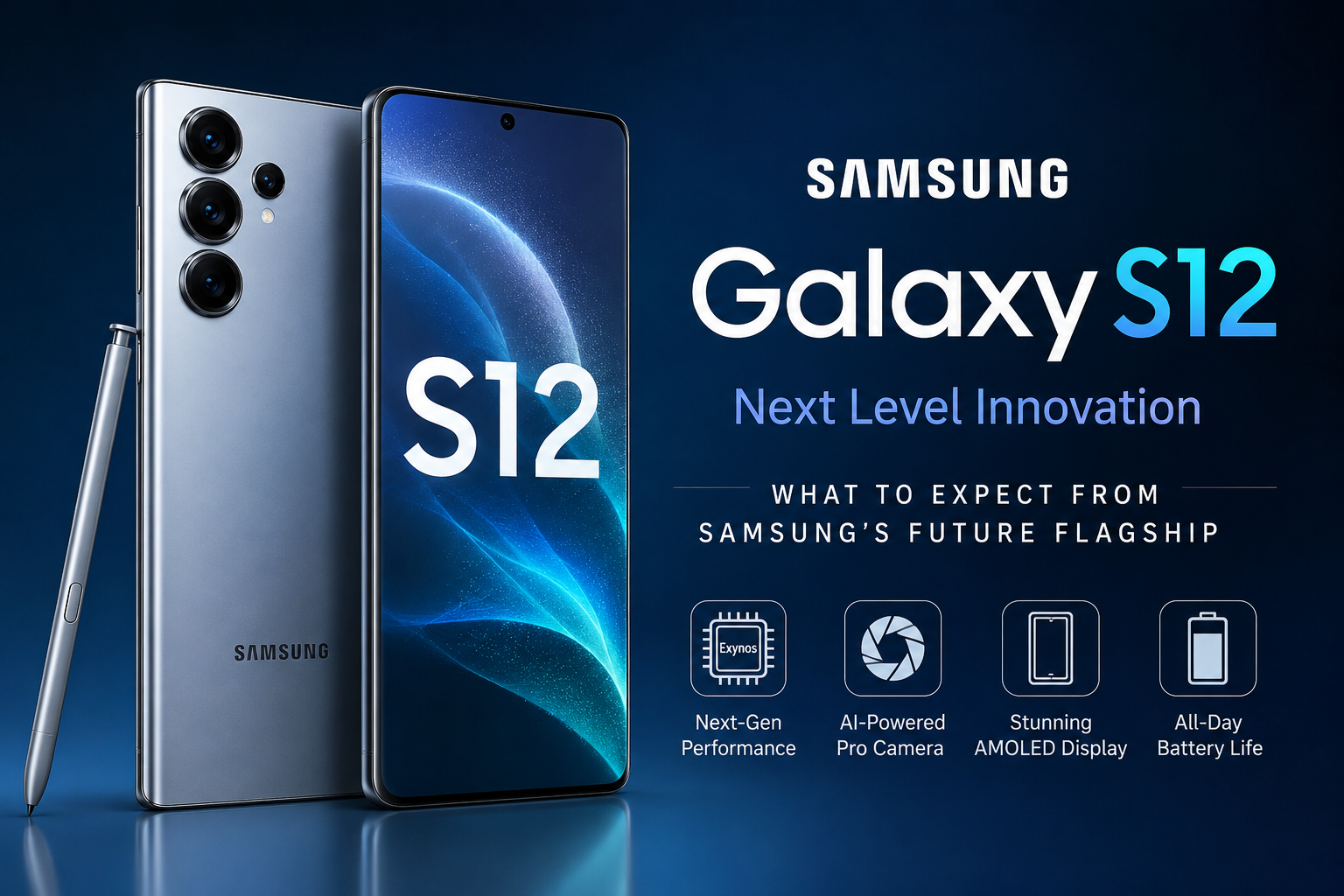
Still, looking at Samsung’s flagship direction, current smartphone technology, and the features users increasingly expect can provide a useful picture of what a future Galaxy S-series device may offer.
1. Is the Samsung Galaxy S12 a Real Phone?
Before discussing possible features, it is important to understand the current situation.
As of August 2026, Samsung has officially released the Galaxy S26 series, including the Galaxy S26, S26+, and S26 Ultra. There is currently no official Samsung announcement, product page, or confirmed specification for a device called the Samsung Galaxy S12.
This makes the Galaxy S12 an interesting topic from an expectations and future-smartphone perspective rather than a traditional product review.
The name may also cause confusion because Samsung’s current flagship naming has moved well beyond the S12 generation. Therefore, readers should be careful when encountering websites or social media posts that present Galaxy S12 specifications as confirmed information.
A good rule is simple: until Samsung officially announces a device, specifications, pricing, images, and release dates should be treated as rumors or predictions.
So, rather than inventing specifications, let’s explore what a future Samsung flagship carrying the Galaxy S12 name could reasonably offer based on the company’s current technology direction.
2. A More Refined and Durable Design
Premium materials could remain a priority
Modern flagship smartphones have gradually moved toward slimmer designs, stronger frames, improved glass protection, and better water resistance.
Samsung’s current Galaxy S26 lineup already emphasizes a refined design, durable materials, and water resistance. The standard model uses Armor Aluminum and Corning Gorilla Glass Victus 2, while the series continues Samsung’s focus on premium construction.
A future flagship could continue this direction.
Possible improvements may include:
- A slimmer body
- Reduced weight
- Stronger glass
- Improved scratch resistance
- Better protection against drops
- Enhanced water and dust resistance
- Smaller camera components
The challenge is finding the right balance.
People want larger batteries, bigger camera sensors, and improved cooling systems, but they also want thinner and lighter phones. It is a little like packing for a long journey: everyone wants to bring more, but nobody wants to carry a heavier bag.
Future smartphone design will depend on how manufacturers solve that problem.
Comfort may become more important than appearance alone
A beautiful phone is useful, but it also needs to feel comfortable.
Sharp edges, excessive weight, and oversized camera modules can affect daily use. A future Galaxy flagship could therefore focus on better ergonomics rather than simply making the device thinner.
Small improvements in weight distribution and grip can make a bigger difference than an extra millimeter of thinness.
3. Display Technology Could Become Even More Advanced
Brighter, smoother, and more efficient screens
Samsung is already using Dynamic AMOLED 2X technology and adaptive refresh rates of up to 120Hz in its current Galaxy S26 lineup.
A future device could build on this foundation with improvements in:
- Peak brightness
- Outdoor visibility
- Power efficiency
- Color accuracy
- Adaptive refresh technology
- Eye comfort
- Privacy features
Samsung has already introduced a built-in Privacy Display feature on the Galaxy S26 Ultra, demonstrating how display technology can go beyond simple resolution and brightness.
Imagine sitting on a train, reading a private message, and knowing that people beside you cannot easily see your screen. Features like this show that the future of displays may focus on privacy and usability as much as visual quality.
Could bezels become even smaller?
Probably.
Future smartphones may continue reducing the visible borders around the display. There is also ongoing interest across the industry in finding better ways to hide front-facing sensors without affecting camera quality.
However, a completely bezel-free design is not automatically better. Phones still need space for antennas, sensors, speakers, and structural protection.
The best solution will be one that improves immersion without sacrificing reliability.
4. Future Performance and Processing Power
Faster chips are only part of the story
Every new flagship smartphone receives a more advanced processor, but raw speed is becoming less important to ordinary users.
Today’s premium phones are already fast enough for messaging, browsing, streaming, photography, and most applications.
The real improvements are increasingly happening in areas such as:
- Artificial intelligence
- Graphics performance
- Energy efficiency
- Image processing
- Multitasking
- Gaming
- Thermal management
The Galaxy S26 series uses advanced processors that vary by model and market, including the Snapdragon 8 Elite Gen 5 for Galaxy and Exynos 2600.
A future Galaxy device would likely continue this strategy of combining powerful processing with stronger AI capabilities.
Better efficiency could matter more than benchmark numbers
Imagine two cars.
One has a bigger engine but uses more fuel. The other delivers similar performance while traveling farther on every tank.
For most people, the second option is more useful.
The same principle applies to smartphones.
A future processor does not need to be dramatically faster if it can provide better battery life, produce less heat, and handle demanding tasks more efficiently.
That may be one of the most important areas of smartphone development in the coming years.
5. AI Could Become a Central Part of the Experience
From individual features to a smarter system
Artificial intelligence is already becoming deeply integrated into Samsung’s flagship phones.
Samsung describes the Galaxy S26 series as its third-generation AI phone lineup, with Galaxy AI designed to handle more complex tasks and reduce the number of steps required for everyday activities.
A hypothetical future Galaxy S12 could take this idea even further.
Instead of opening several apps manually, users may increasingly ask the phone to complete broader tasks.
For example:
“Find the photos from my last trip, choose the best ones, and create a travel album.”
An advanced AI system could potentially understand the request and perform several actions in sequence.
More on-device processing
Privacy is likely to remain an important part of AI development.
Future devices may process more information directly on the phone rather than sending every request to a remote server.
Potential benefits include:
- Faster responses
- Better privacy
- Offline functionality
- Reduced dependence on internet connections
Of course, large and complex tasks may still require cloud processing.
The future may involve a combination of on-device intelligence and cloud-based computing, with the phone deciding which approach is most suitable.
6. Camera Technology Could Focus on Quality Over Numbers
More megapixels do not always mean better photos
One of the most common mistakes when comparing smartphone cameras is focusing only on megapixel numbers.
A camera is a complete system.
Sensor size, lens quality, image processing, autofocus, stabilization, and lighting all affect the final photograph.
Samsung’s Galaxy S26 Ultra currently features a 200MP main camera, while the broader S26 lineup demonstrates different camera configurations for different users.
A future flagship could improve photography through:
- Larger sensors
- Better low-light performance
- Faster autofocus
- Improved optical zoom
- More accurate colors
- Reduced motion blur
- Advanced portrait photography
- Smarter image processing
Computational photography will continue to grow
The future of smartphone photography may depend as much on software as hardware.
When you press the shutter button, the phone can analyze light, adjust exposure, reduce noise, improve detail, and combine information from multiple frames.
The goal should not be to create an image that looks artificially processed.
Instead, future software may focus on producing photographs that look natural while preserving important details.
For everyday users, the ideal camera is simple: you take out your phone, press the button, and get a photo you are happy to share.
7. Zoom Photography Could Become More Useful
Capturing distant subjects without sacrificing quality
Telephoto cameras have become an important part of flagship smartphones.
People use zoom photography for:
- Travel
- Sports
- Wildlife
- Concerts
- Architecture
- Family events
A future Samsung flagship could improve both optical hardware and digital processing.
The most important improvement may not be achieving an extremely large zoom number. Instead, it may be improving image quality at the zoom levels people actually use most frequently.
For example, clean and detailed images at moderate distances may be more valuable than a massive zoom level that produces soft photographs.
AI could also help stabilize images and improve details when shooting from a distance.
8. Battery Life Could Become a Major Upgrade
The feature everyone uses
A camera might be used occasionally. A stylus might be useful for specific tasks. AI features may depend on personal preference.
But everyone uses the battery.
That is why battery life remains one of the most important areas for future improvement.
Samsung’s current Galaxy S26 lineup includes typical battery capacities ranging from 4,300mAh on the standard model to 5,000mAh on the Ultra model.
A future device could improve daily endurance through several approaches:
- More efficient processors
- Better battery chemistry
- Smarter software
- Adaptive power management
- More efficient displays
- Improved cooling
Charging may also continue to evolve
Fast charging is convenient, especially when you have limited time.
Samsung’s current Galaxy S26 Ultra advertises charging up to 75% in around 30 minutes under supported conditions.
Future devices could potentially improve charging speed further, but there is a balance to consider.
Faster charging can create additional heat and may affect long-term battery management. The best charging technology will combine speed with safety and durability.
9. Software Support Could Add Long-Term Value
A great phone should remain useful for years
When people spend a significant amount of money on a smartphone, they want it to last.
Hardware is important, but software support is equally valuable.
Future flagship devices are likely to continue receiving:
- Security updates
- New Android versions
- Feature improvements
- AI enhancements
- Camera upgrades
- Performance optimizations
Samsung’s current Galaxy S26 series launched with Android 16 and One UI 8.5, showing the company’s continued focus on combining Android with its own software experience.
For users, long-term software support can make a smartphone feel new even years after purchase.
That is particularly important because modern flagship phones are expensive.
If a device remains secure, compatible, and capable for a longer period, it may provide better value over time.
10. Connectivity Could Become Faster and More Reliable
A smartphone is only as useful as its connections
Modern phones connect to much more than mobile networks.
They communicate with:
- Wi-Fi networks
- Smartwatches
- Wireless earbuds
- Cars
- Computers
- Smart home devices
- Payment terminals
- Tracking accessories
The Galaxy S26 series supports modern connectivity technologies, including 5G, Wi-Fi 7, and Bluetooth 6.0, depending on market and device compatibility.
A future flagship may focus less on simply increasing theoretical speeds and more on improving connection reliability.
For example, a phone could switch more intelligently between Wi-Fi and mobile data or manage wireless accessories more efficiently.
These improvements may not generate exciting marketing headlines, but they can significantly improve everyday use.
11. Security and Privacy May Become Bigger Selling Points
Protecting information in an AI-driven world
As smartphones store more personal information, security becomes increasingly important.
Your phone may contain:
- Banking information
- Private photographs
- Passwords
- Messages
- Work documents
- Location data
- Personal accounts
Future devices may introduce stronger privacy tools and better ways to protect sensitive information.
Samsung’s current Galaxy S26 Ultra Privacy Display is one example of how privacy can become a hardware feature rather than simply a software setting.
Future improvements could include:
- More advanced biometric security
- Better protection against phishing
- AI-powered scam detection
- Improved app permissions
- Stronger private processing
- Better control over personal data
As AI becomes more integrated into smartphones, users will increasingly ask an important question: Where is my information going?
Companies that provide clear answers and useful privacy controls may have an advantage.
12. What Would Make the Samsung Galaxy S12 Worth Buying?
Real improvements matter more than longer feature lists
If Samsung eventually releases another major flagship generation under a name such as Galaxy S12, its success will not depend only on specifications.
Consumers will want meaningful improvements.
A future premium smartphone would become more attractive if it delivered:
- Noticeably longer battery life
- Better low-light photography
- More useful AI tools
- Improved durability
- Faster and cooler performance
- Better privacy
- Strong long-term software support
- More reliable connectivity
The most successful smartphone will not necessarily be the one with the longest specification sheet.
It will be the one that makes everyday life easier.
That could mean helping you capture better photographs, keeping your battery alive longer, protecting your information, or completing tasks with fewer steps.
Samsung Galaxy S12: Rumors vs Reality
Because no official Galaxy S12 has been announced, readers should be especially careful with online information.
Here is the difference:
Confirmed information
- Samsung has officially released the Galaxy S26 series.
- The current lineup includes the Galaxy S26, S26+, and S26 Ultra.
- The series includes advanced AI features, modern processors, AMOLED displays, and updated camera systems.
Unconfirmed information
- Galaxy S12 specifications
- Galaxy S12 camera details
- Galaxy S12 battery capacity
- Galaxy S12 price
- Galaxy S12 release date
- Galaxy S12 design
Until an official announcement appears, these details should not be presented as confirmed facts.
For the latest official Galaxy information, readers can visit Samsung’s official smartphone pages.
Conclusion
The Samsung Galaxy S12 is not currently an officially announced smartphone, so there are no confirmed specifications, pricing details, or release dates to review. However, Samsung’s current Galaxy S26 series provides an interesting indication of the direction its flagship technology is taking, particularly in AI, display innovation, cameras, privacy, processing power, and battery efficiency.
A future Galaxy flagship could become smarter, more efficient, more private, and more capable without necessarily changing the basic purpose of a smartphone. The biggest improvements may happen behind the scenes—in the processor, AI system, battery technology, and camera software.
Ultimately, the future of premium smartphones is likely to be less about adding features simply because they sound impressive. The real winners will be devices that make technology feel simpler, faster, and more useful.
FAQs
1. Has Samsung officially announced the Samsung Galaxy S12?
No. As of August 2026, Samsung has not officially announced a smartphone called the Galaxy S12. Samsung’s current flagship lineup is the Galaxy S26 series.
2. What could the Samsung Galaxy S12 features include?
If Samsung eventually released a future flagship under this name, possible improvements could include advanced AI, improved cameras, more efficient processors, longer battery life, stronger security, and better displays. These are expectations, not confirmed specifications.
3. What could be the Samsung Galaxy S12 release date?
There is currently no official release date because Samsung has not announced the Galaxy S12.
4. Could the Samsung Galaxy S12 have better AI features?
A future Samsung flagship would likely continue developing AI features, especially because Galaxy AI is already a major part of Samsung’s current flagship strategy.
5. Should you trust Samsung Galaxy S12 specifications online?
Be careful. Unless specifications come directly from an official Samsung announcement or another highly reliable source reporting confirmed information, they should be treated as rumors or predictions rather than facts.